Skip to content

Rye Bread I

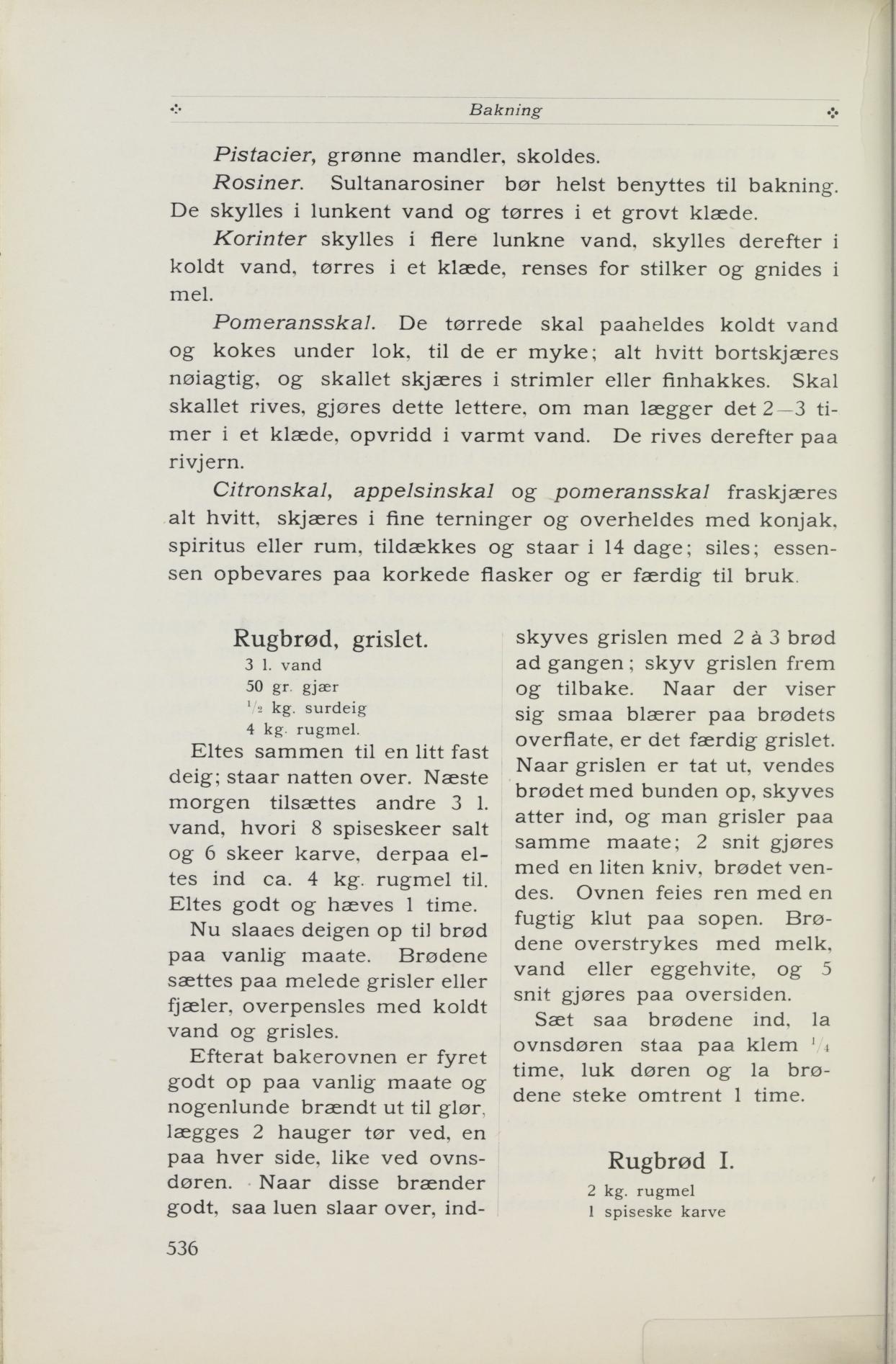
Simple rye bread of 2 kg rye flour, 14 dl lukewarm water, 30 g yeast, caraway and salt. The dough rises 5 hours, is shaped into loaves, proofed 10 minutes, brushed and pricked, and baked 3/4–1 hour. Erken also explains the rules for warm-risen dough and an alternative cold rise overnight at about 10 °C.

Source: Henriette Schønberg Erken, Stor kokebok, 1914-utg. s. 536 (falt i det fri)

Be the first to rate

About the dish

A simple everyday rye bread with caraway, baked with yeast. Erken adds a small lesson in leavening technique: the rules for warm-risen dough and the advantages of a cold rise overnight – one of the clearest examples of her didactic style in the baking chapter.

How to make it

  1. 1

    Set the yeast

    Stir the yeast with 1 teaspoon sugar until it turns liquid. Stir in 1/2 dl lukewarm water and 1 tablespoon wheat flour. Let the yeast mixture rise in a warm place for a quarter hour.

  2. 2

    Make the dough

    Sift the rye flour and mix in the caraway and salt. Stir in the lukewarm water little by little into a smooth dough, and finally stir in the risen yeast.

  3. 3

    Rising

    Let the dough rise for 5 hours, covered and free from draft or cold.

  4. 4

    Shape the loaves

    Knead the dough up into loaves, adding a little more flour if needed, and place the loaves on a greased baking sheet. Let them proof for 10 minutes.

  5. 5

    Baking

    Brush the loaves with water or milk and prick 3–5 holes with a floured fork just before they go in. Bake for 3/4–1 hour; in a modern oven about 200 °C (390 °F).

  6. 6

    Cold rise (alternative)

    To save time and effort, stir the yeast with 1 teaspoon sugar and 1/2 dl cold milk or water, stir it straight into the dough, and let the dough stand from evening to morning at about 10 °C (50 °F).

Changes from the original

Measures are converted to modern units (dl, grams, tablespoons/teaspoons). A baking temperature has been added, since the original only gives baking time for a wood-fired oven. The cold-rise variant is described as its own optional step.

Tidsmaskin – hva endret seg?

Velg to utgaver og se hva Henriette Schønberg Erken la til, fjernet eller endret mellom dem.

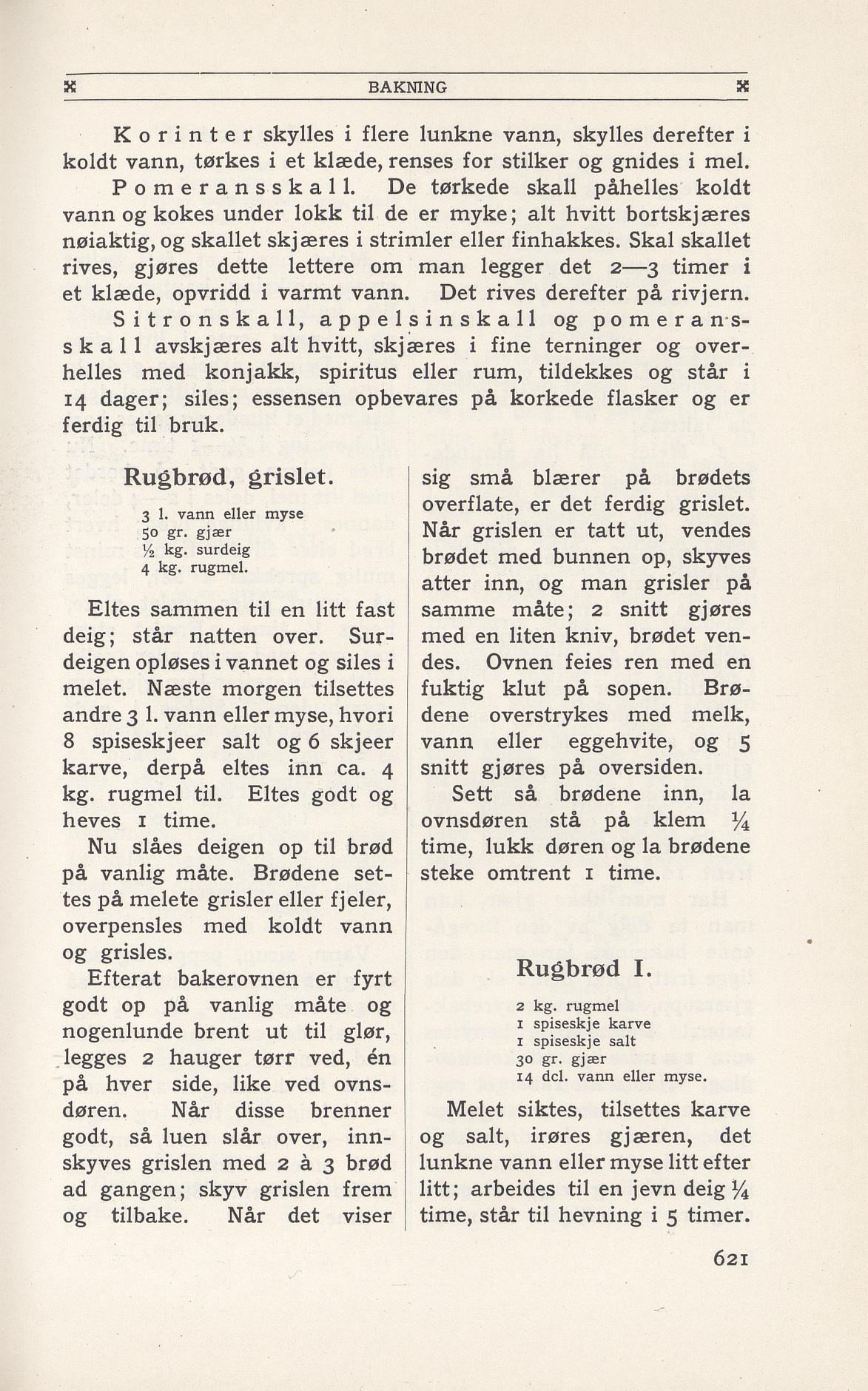
1914 (korrekturlest, s. 536)1949 (korrekturlest, s. 621)~87% av teksten endretfjernetlagt til
2 kg. rugmel 1 spiseske spiseskje karve 1 spiseske spiseskje salt 30 gr. gjær 14 del. vand. Gjæren utrøres med en teske sukker, til den er flytende. Irøres ½ 1⁴⁄₁₆ del. lunkent vand og 1 spiseske hvetemel; gjæren staar til hævning paa et lunt sted ¼ time. vann eller myse. Melet sigtes, tilsættes siktes, tilsettes karve og salt, irøres gjæren, det lunkne vand vann eller myse litt efter litt; arbeides til en jevn deig, irøres den hævede gjær; staar deig ¾ time, står til hævning hevning i 5 timer. Deigen eltes op til brød — mel tilsættes hvis nødvendig —, lægges paa smurt plate. Hæves igjen i 10 minutter, pensles over med vand eller melk, prikkes 3—5 stik med en melet gaffel, straks de sættes i ovnen. Stekes paa ¾—1 time. Ovenstaaende er varmhævet deig, og følgende ting maa da iagttages: 1) Melet maa ha almindelig stuetemperatur. 2) Vand eller melk maa lunkes (omkring 28° C). 3) Gjæren maa utrøres og hæves, før den haves i deigen. 4) Under tilberedning av deigen maa den ikke utsættes for kulde eller træk. Ved koldhævning spares tid og arbeide. Man rører da gjæren ut med en teske sukker og ½ del. kold melk eller vand, rører den i deigen med det samme, og deigen staar fra aften til morgen ved omtrent 10 gr. C.
Community interpretations

Be the first to share your own version.

See interpretations

Frequently asked questions

How long does the rye bread take?
Reckon on about 7 hours in all: pre-ferment about 15 minutes, main rise 5 hours, final proof 10 minutes and baking 3/4–1 hour.
What ingredients do I need?
2 kg rye flour, 1 tablespoon caraway, 1 tablespoon salt, 30 g yeast and 14 dl water. In addition a little sugar and 1 tablespoon wheat flour to stir up the yeast.
Why are the loaves pricked with a fork?
The loaves are brushed with water or milk and pricked with 3–5 holes with a floured fork just before they go into the oven. It lets steam escape and keeps the bread from cracking.
What is meant by "warm-risen dough"?
The dough is risen with lukewarm water in a warm place, and both flour and utensils should be warm. The recipe is from Henriette Schønberg Erken's "Stor kokebok" (1914).

Related recipes

More dishes in the same category from the archive

Read also

Kommentarer

Ingen kommentarer ennå. Bli den første til å dele!