Skip to content

Rye Bread II

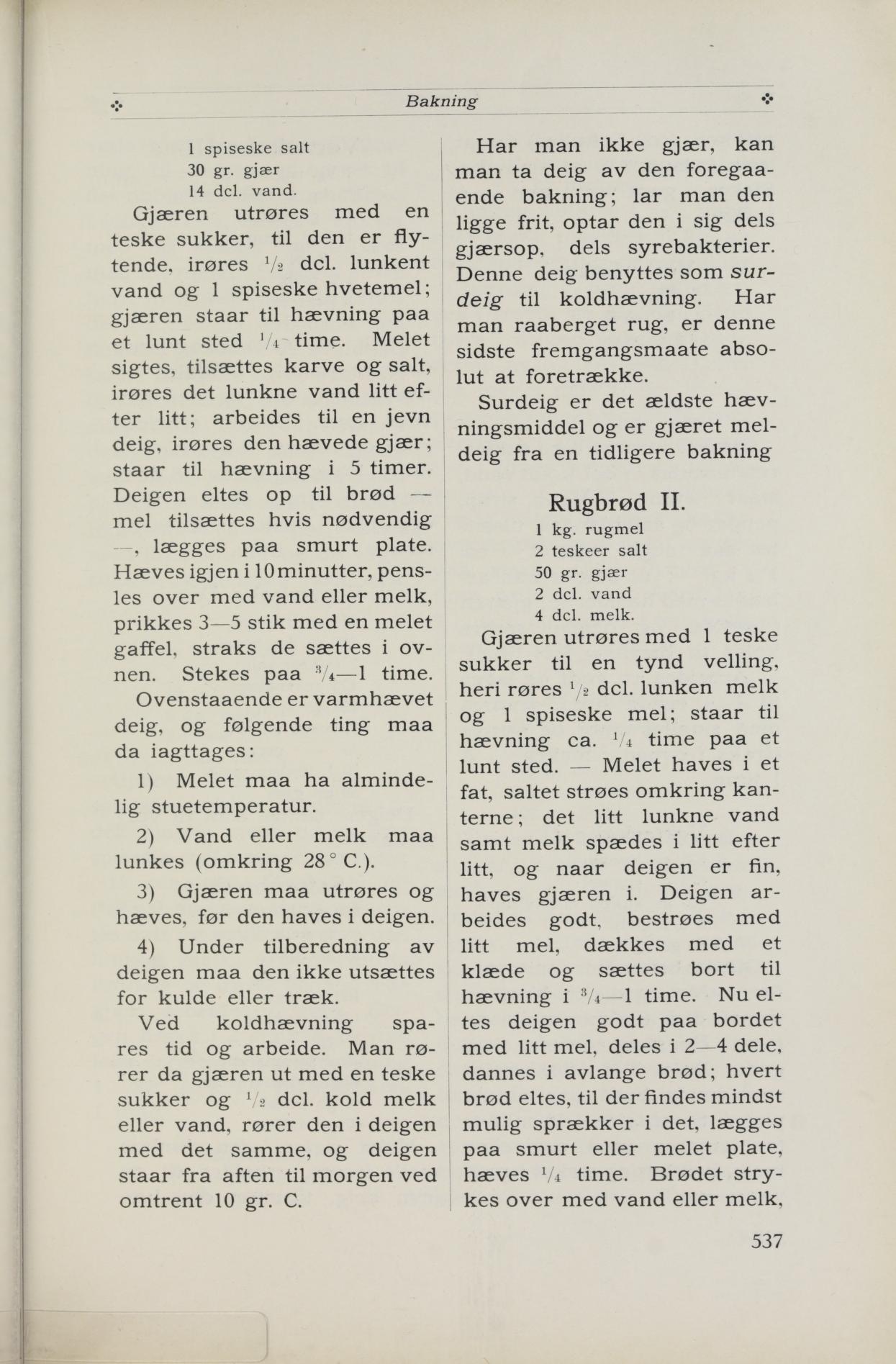
Rye Bread II from Erken's Stor kokebok (1914): 1 kg rye flour, 2 tsp salt, 50 g yeast, 2 dl water and 4 dl milk. The yeast is pre-fermented with sugar, a little milk and flour, the dough kneaded, risen 45–60 min, divided into 2–4 oblong loaves, proofed 30 min, brushed and pricked, and baked 30–45 min in a good hot oven.

Source: Henriette Schønberg Erken, Stor kokebok, 1914-utg. s. 537 (falt i det fri)

Be the first to rate

About the dish

The recipe stands in the bread chapter of "Stor kokebok" (1914), right after Rye Bread I and Erken's explanation of warm-risen and cold-risen dough. Rye bread was the household's everyday bread, and Erken gives several variants with different proportions of milk and water.

How to make it

  1. 1

    Set the pre-ferment

    Stir the yeast with 1 tsp sugar into a thin gruel. Stir in 1/2 dl lukewarm milk and 1 tbsp flour. Let the pre-ferment stand warm for about 30 minutes.

  2. 2

    Mix the dough

    Sift the rye flour into a mixing bowl and sprinkle the salt along the edges. Blend in the lukewarm water and the rest of the milk little by little, and when the dough is smooth, stir in the yeast mixture.

  3. 3

    First rise

    Work the dough well, sprinkle a little flour over it, cover with a cloth and let it rise 45–60 minutes.

  4. 4

    Shape the loaves

    Knead the dough well on the table with a little flour, divide it into 2–4 pieces and shape oblong loaves. Knead each loaf until there are as few cracks in the surface as possible, and place them on a greased or floured baking sheet.

  5. 5

    Final proof

    Let the loaves rise about 30 minutes.

  6. 6

    Brush and prick

    Brush the loaves with water or milk and prick about 5 holes in each, so the carbon dioxide can escape.

  7. 7

    Baking

    Bake in a good hot oven for 30–45 minutes.

Changes from the original

Quantities are converted to modern units (deciliters, grams, teaspoon/tablespoon) and the text of the steps is modernized. "Fat" (tub/bowl) is interpreted as a mixing bowl, and rising times are given in minutes. The amounts of flour and milk for the pre-ferment are taken from the method itself (1/2 dl milk, 1 tbsp flour, 1 tsp sugar).

Tidsmaskin – hva endret seg?

Velg to utgaver og se hva Henriette Schønberg Erken la til, fjernet eller endret mellom dem.

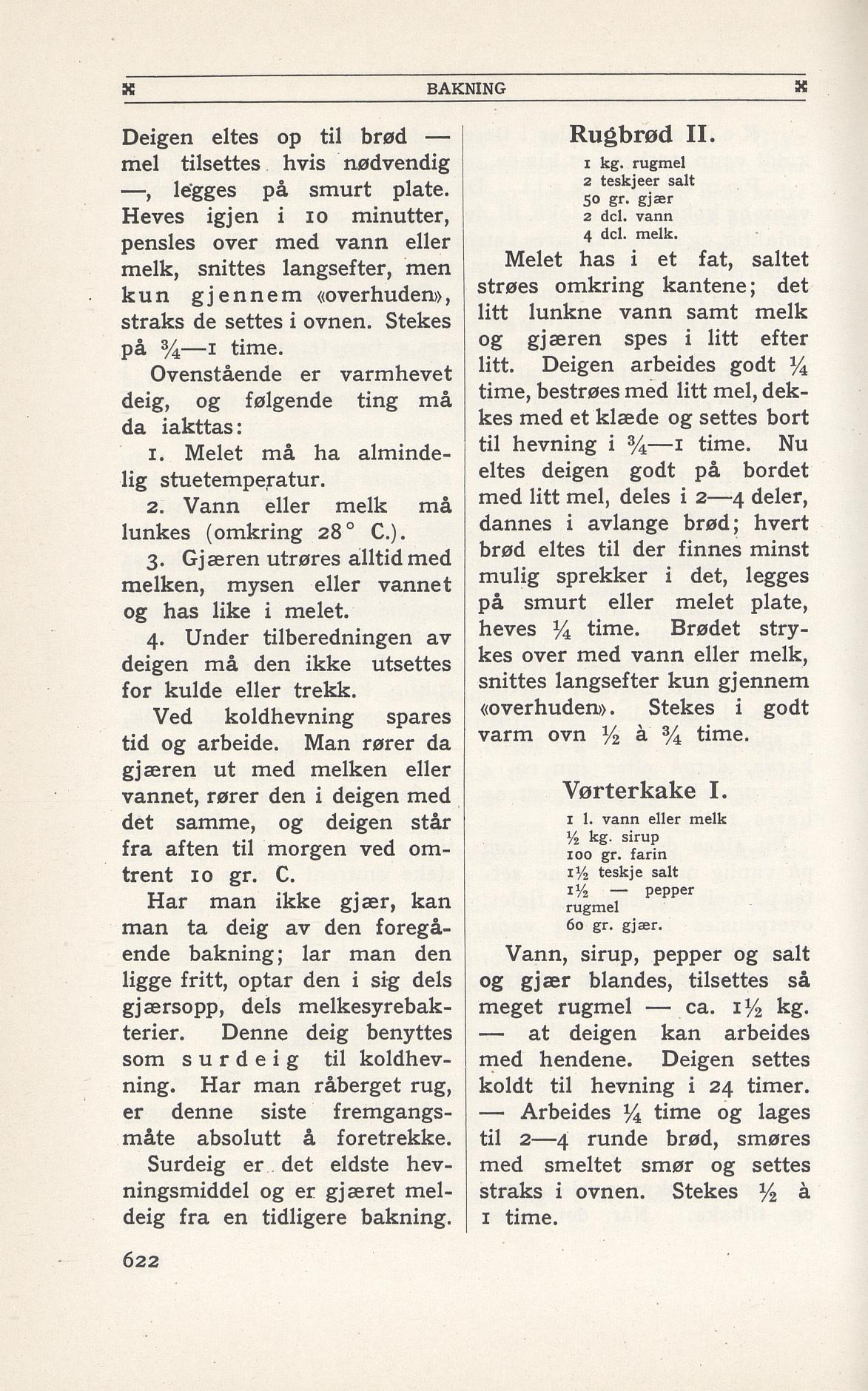
1914 (korrekturlest, s. 537)1949 (korrekturlest, s. 622)~57% av teksten endretfjernetlagt til
1 kg. rugmel 2 teskeer teskjeer salt 50 gr. gjær 2 del. vand vann 4 del. melk. Gjæren utrøres med 1 teske sukker til en tynd velling, heri røres ½ del. lunken melk og 1 spiseske mel; staar til hævning ca. ½ time paa et lunt sted. — Melet haves has i et fat, saltet strøes omkring kanterne; kantene; det litt lunkne vand vann samt melk spædes i litt efter litt, og naar deigen er fin, haves gjæren i. spes i litt efterlitt. Deigen arbeides godt, godt ¾ time, bestrøes med litt mel, dækkes dekkes med et klæde og sættes settes bort til hævning hevning i ¾—1 time. Nu eltes deigen godt paa bordet med litt mel, deles i 2—4 dele, deler, dannes i avlange brød; hvert brød eltes, eltes til der findes mindst finnes minst mulig sprækker sprekker i det, lægges paa legges på smurt eller melet plate, hæves ½ heves ¾ time. Brødet strykes over med vand vann eller melk, prikkes (ca. 5 huller) for at lette kulsyren i at undvike. snittes langsefter kun gjennem «overhuden». Stekes i godt varm ovn ½ à ¾ å ¾ time.

Community interpretations

Be the first to share your own version.

See interpretations

Frequently asked questions

How long does the rising take in all?
Three rises: the pre-ferment with yeast and milk about 1/2 hour, the dough 3/4–1 hour, and the shaped loaves 1/2 hour on the sheet. Altogether about 2 hours of rising, and the recipe is figured for about 3 hours total.
Which ingredients do I need?
1 kg rye flour, 2 teaspoons salt, 50 g yeast, 2 dl water and 4 dl milk. In addition 1 teaspoon sugar to stir up the yeast.
Why is the salt sprinkled around the edge of the flour?
As the recipe from Schønberg Erken's "Stor kokebok" (1914) describes it, the salt is kept away from the yeast until the dough is mixed smooth, so the yeast is not inhibited. The yeast is added only once the water and milk are blended in.
How many loaves does it make?
The dough is divided into 2–4 pieces and shaped into oblong loaves. Knead each loaf until there are as few cracks as possible, place on a greased or floured sheet and brush with water.

Related recipes

More dishes in the same category from the archive

Read also

Kommentarer

Ingen kommentarer ennå. Bli den første til å dele!