Chicken forcemeat II from Erken's Stor kokebok (1914): finely scraped raw chicken meat is combined with egg white, a cooked and cooled panade of flour, egg yolk, boiling milk, and melted butter, chilled on ice, and thinned with raw and whipped cream. Shaped into quenelles or sausages, optionally filled with salpicon, poached and served with sauce suprême or tomato sauce.
Source: Henriette Schønberg Erken, Stor kokebok, 1914-utg. s. 295 (falt i det fri)
Be the first to rate
About the dish
The recipe belongs to Erken's series of fine poultry forcemeats, where finely scraped chicken meat is combined with a cooked panade and cream into an airy mass, shaped into quenelles or sausages and cooked gently in water. Such forcemeats were the basis for French-inspired starters in Norwegian upper-class kitchens.
How to make it
1
The meat forcemeat
Scrape the chicken meat fine and pound it well in a mortar. Add salt, pepper, and just a little nutmeg.
2
Work in the egg white
Add the egg white little by little while stirring constantly, until the mass is smooth.
3
The panade
Sift the flour into a saucepan, stir in the egg yolk and spices. Thin little by little with the boiling milk and the melted butter.
4
Cook the panade
Press the mixture through a fine-mesh sieve, pour it back into the pot, and stir over the heat until it boils. Let it boil, stirring, for 5 minutes.
5
Cool
Spread the panade at once over a greased platter and lightly grease the surface so it does not dry out. Let it become completely cold.
6
Combine the mixtures
Combine the meat forcemeat and the cold panade well with the pestle. Set the mass on ice for 2 hours.
7
Thin with cream
Stir the mass for 1 minute with a wooden spoon, add the raw cream by the teaspoon, and finally the whipped cream. If the forcemeat is too soft, add a little more egg white; if too firm, a little more cream.
8
Shape and cook
Shape the forcemeat into quenelles or sausages. If you like, make an incision in them and fill with a bound salpicon, asparagus, or truffles. Cook them gently (poach) in lightly salted, barely simmering water until cooked through.
9
Serving
Arrange with sauce suprême, tomato sauce, or a ragout, ideally with shrimp added.
Changes from the original
Measurements have been converted to modern units (dl, g), the "hair sieve" is replaced by a fine-mesh sieve, and the method has been divided into numbered steps. The cooking method for the quenelles (originally cross-referenced to page 126) is described as poaching in salted water.
📖1914
Original 1914 recipe
Verbatim from the first edition of the Big Cookbook.
Foto: Faksimile: Nasjonalbiblioteket
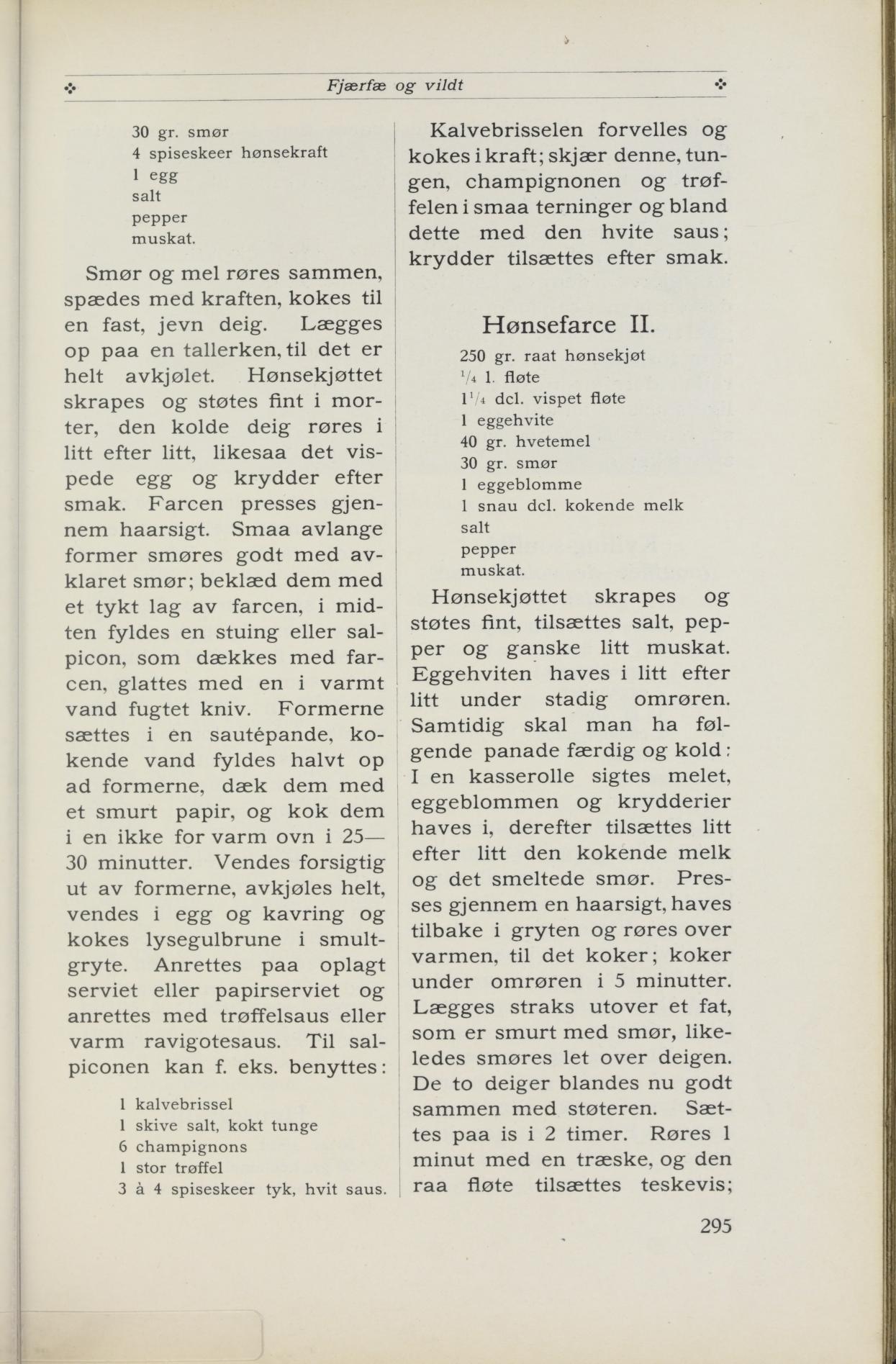
ProofreadPage 295
250 gr. raat hønsekjøt
1/4 l. fløte
1 1/4 del. vispet fløte
1 eggehvite
40 gr. hvetemel
30 gr. smør
1 eggeblomme
1 snau del. kokende melk
salt
pepper
muskat.
Hønsekjøttet skrapes og støtes fint, tilsættes salt, pepper og ganske litt muskat. Eggehviten haves i litt efter litt under stadig omrøren. Samtidig skal man ha følgende panade færdig og kold: I en kasserolle sigtes melet, eggeblommen og krydderier haves i, derefter tilsættes litt efter litt den kokende melk og det smeltede smør. Presses gjennem en haarsigt, haves tilbake i gryten og røres over varmen, til det koker; koker under omrøren i 5 minutter. Lægges straks utover et fat, som er smurt med smør, likeledes smøres let over deigen. De to deiger blandes nu godt sammen med støteren. Sættes paa is i 2 timer. Røres 1 minut med en træske, og den raa fløte tilsættes teskevis; tilsidst haves den stivvispede fløte i. Er farcen for bløt, tilsættes litt mere eggehvite, er den for fast, tilsættes litt fløte. Deigen kan lages til boller eller pølser; et indsnit kan gjøres i dem, og heri fyldes en jevnet salpicon, asparges, trøfler o. s. v. De kokes som forklaret side 126. Anrettes derefter med forskjellige sauser eller stuinger, som suprémesaus, tomatsaus, tilsat ræker o. s. v.
📖1949
Revised 1949 recipe
From the revised edition of the Big Cookbook.
Foto: Faksimile: Nasjonalbiblioteket
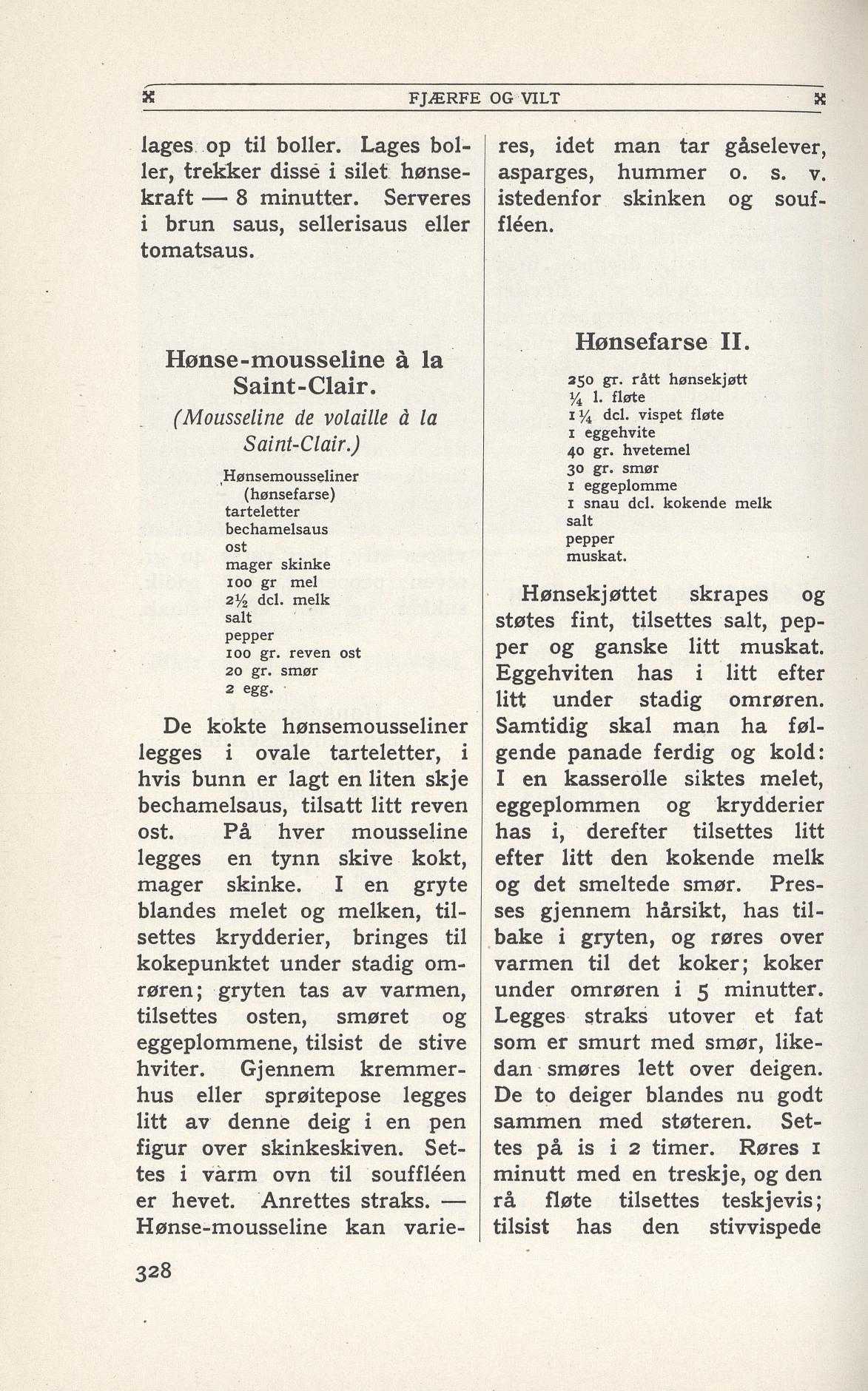
ProofreadPage 328
250 gr. rått hønsekjøtt
¾ L fløte
1 ½ del. vispet fløte
1 eggekvite
40 gr. hvetemel
30 gr. smør
1 eggeplomme
1 snau del. kokende melk
salt
pepper
muskat.
Hønsekjøttet skrapes og støtes fint, tilsettes salt, pepper og ganske litt muskat. Eggehviten hes i litt efter litt under stadig omrøren. Samtidig skal man ha følgende panade ferdig og kold: I en kasserolle siktes melet, eggeplommen og krydderier hes i, derefter tilsettes litt efter litt den kokende melk og det smeltede smør. Presses gjennem hårsikt, hes tilbake i gryten, og røres over varmen til det koker; koker under omrøren i 5 minutter. Legges straks utover et fat som er smurt med smør, likedan smøres lett over deigen. De to deiger blandes nu godt sammen med støteren. Settes på is i 2 timer. Røres 1 minutt med en treskje, og den rå fløte tilsettes teskjevis; tilsist hes den stivvispede fløte i. Er farsen for bløt, tilsettes litt mere eggehvite, er den for fast, tilsettes litt fløte. Deigen kan lages til boller eller pølser; et innsnitt kan gjøres i dem, og heri fylles en jevnet salpicon, asparges, trøfler o. s. v. De kokes meget forsiktig og anrettes derefter med forskjellige sauser eller stuinger, som supremesaus, tomatsaus, tilsatt reker o. s. v.
In stores now
Clean, minimally processed groceries matched to the ingredients — approximate prices.
1914 (korrekturlest, s. 295) → 1949 (korrekturlest, s. 328)~35% av teksten endretfjernetlagt til
250 gr. raat hønsekjøt 1/4 l. rått hønsekjøtt ¾ L fløte 1 1/4 ½ del. vispet fløte 1 eggehvite eggekvite 40 gr. hvetemel 30 gr. smør 1 eggeblomme eggeplomme 1 snau del. kokende melk salt pepper muskat. Hønsekjøttet skrapes og støtes fint, tilsættes tilsettes salt, pepper og ganske litt muskat. Eggehviten haves hes i litt efter litt under stadig omrøren. Samtidig skal man ha følgende panade færdig ferdig og kold: I en kasserolle sigtes siktes melet, eggeblommen eggeplommen og krydderier haves hes i, derefter tilsættes tilsettes litt efter litt den kokende melk og det smeltede smør. Presses gjennem en haarsigt, haves hårsikt, hes tilbake i gryten gryten, og røres over varmen, varmen til det koker; koker under omrøren i 5 minutter. Lægges Legges straks utover et fat, fat som er smurt med smør, likeledes likedan smøres let lett over deigen. De to deiger blandes nu godt sammen med støteren. Sættes paa Settes på is i 2 timer. Røres 1 minut minutt med en træske, treskje, og den raa rå fløte tilsættes teskevis; tilsidst haves tilsettes teskjevis; tilsist hes den stivvispede fløte i. Er farcen farsen for bløt, tilsættes tilsettes litt mere eggehvite, er den for fast, tilsættes tilsettes litt fløte. Deigen kan lages til boller eller pølser; et indsnit innsnitt kan gjøres i dem, og heri fyldes fylles en jevnet salpicon, asparges, trøfler o. s. v. De kokes som forklaret side 126. Anrettes meget forsiktig og anrettes derefter med forskjellige sauser eller stuinger, som suprémesaus, supremesaus, tomatsaus, tilsat ræker tilsatt reker o. s. v.
The panade is a thick binding dough of all-purpose flour, egg yolk, boiling milk, and melted butter, cooked while stirring for 5 minutes. It is sieved through a hair sieve, brought to a boil, and spread out on a greased platter with a little butter on top so it does not dry out. It must be completely cold before it is combined with the forcemeat, otherwise the forcemeat will split.
How do I get the forcemeat as fine as possible?
Use 250 g raw chicken meat, scraped and pounded fine (in 1914 in a mortar, today often a food processor), season with salt, pepper, and a little nutmeg, and add the egg white little by little while stirring constantly. Keep everything cold throughout.
How much cream goes in, and when?
The recipe uses 1/4 liter cream plus 1 1/4 deciliters whipped cream. The whipped cream is folded in gently at the end, so the forcemeat becomes light and airy.
How long does the recipe take?
Allow around 3.5 hours in total for 6 servings – most of it is cooling the panade and resting time, not active work.