Skip to content

Chicken gratin

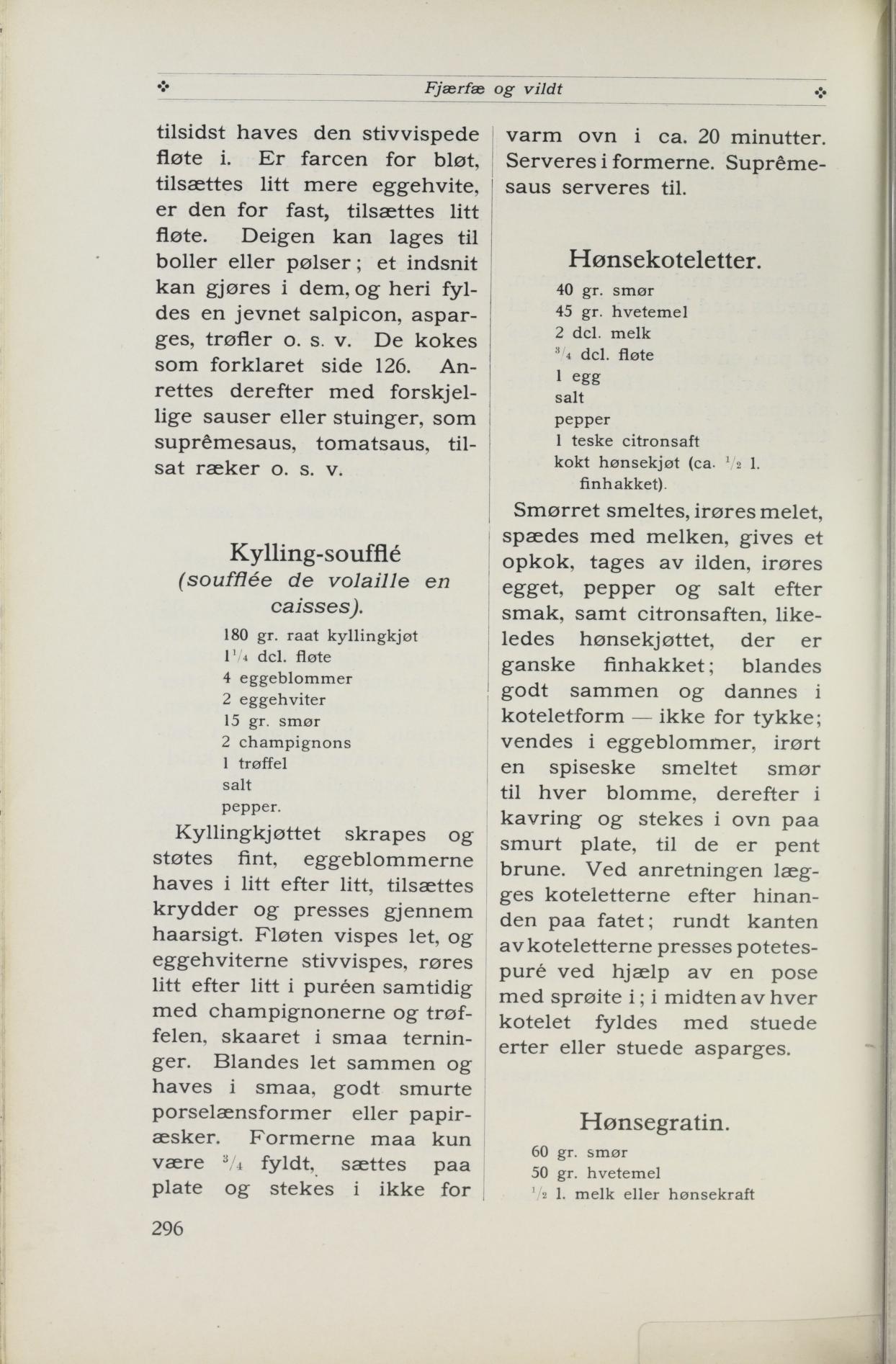
Erken's chicken gratin from 1914: a white sauce of 60 g butter, 50 g flour, and ½ l chicken stock or milk is stirred with 1 dl breadcrumbs, about 300 g finely chopped boiled chicken, 3 egg yolks, parsley, celery, a little onion, salt, and paprika; stiffly beaten egg whites are folded in and the mass is baked in a greased mold in a water bath in a hot oven about 25 minutes.

Source: Henriette Schønberg Erken, Stor kokebok, 1914-utg. s. 296 (falt i det fri)

Be the first to rate

About the dish

A classic gratin of boiled chicken, the forerunner of the Norwegian fish and meat gratin. Erken uses the chicken stock from making soup as the thinning liquid, and lightens the mass with stiffly beaten egg whites. The liquid amount is somewhat uncertain in the OCR and is interpreted here as ½ liter, which suits the amount of flour and butter.

How to make it

  1. 1

    Make the base sauce

    Melt the butter, stir in the flour, and thin with the chicken stock (or milk). Bring to a boil while stirring.

  2. 2

    Mix the mass

    Take the pot off the heat and stir in the breadcrumbs, chicken, the whisked egg yolks, parsley, celery, onion, salt, and paprika.

  3. 3

    Fold in the egg whites

    Beat the egg whites stiff and fold them in gently at the end.

  4. 4

    Bake in a water bath

    Pour the mass into a greased mold and bake in a water bath in a hot oven (about 180 °C (355 °F)) for about 25 minutes, until the gratin is set.

Changes from the original

Measurements have been converted to deciliters/grams: ½ l finely chopped chicken corresponds to about 300 g. "Grated bread or rusk" is given as breadcrumbs/rusk, and oven temperature (about 180 °C (355 °F), water bath) has been added.

In stores now

Clean, minimally processed groceries matched to the ingredients — approximate prices.

Product data and prices via Kassalapp. Prices are updated daily and may vary.

Tidsmaskin – hva endret seg?

Velg to utgaver og se hva Henriette Schønberg Erken la til, fjernet eller endret mellom dem.

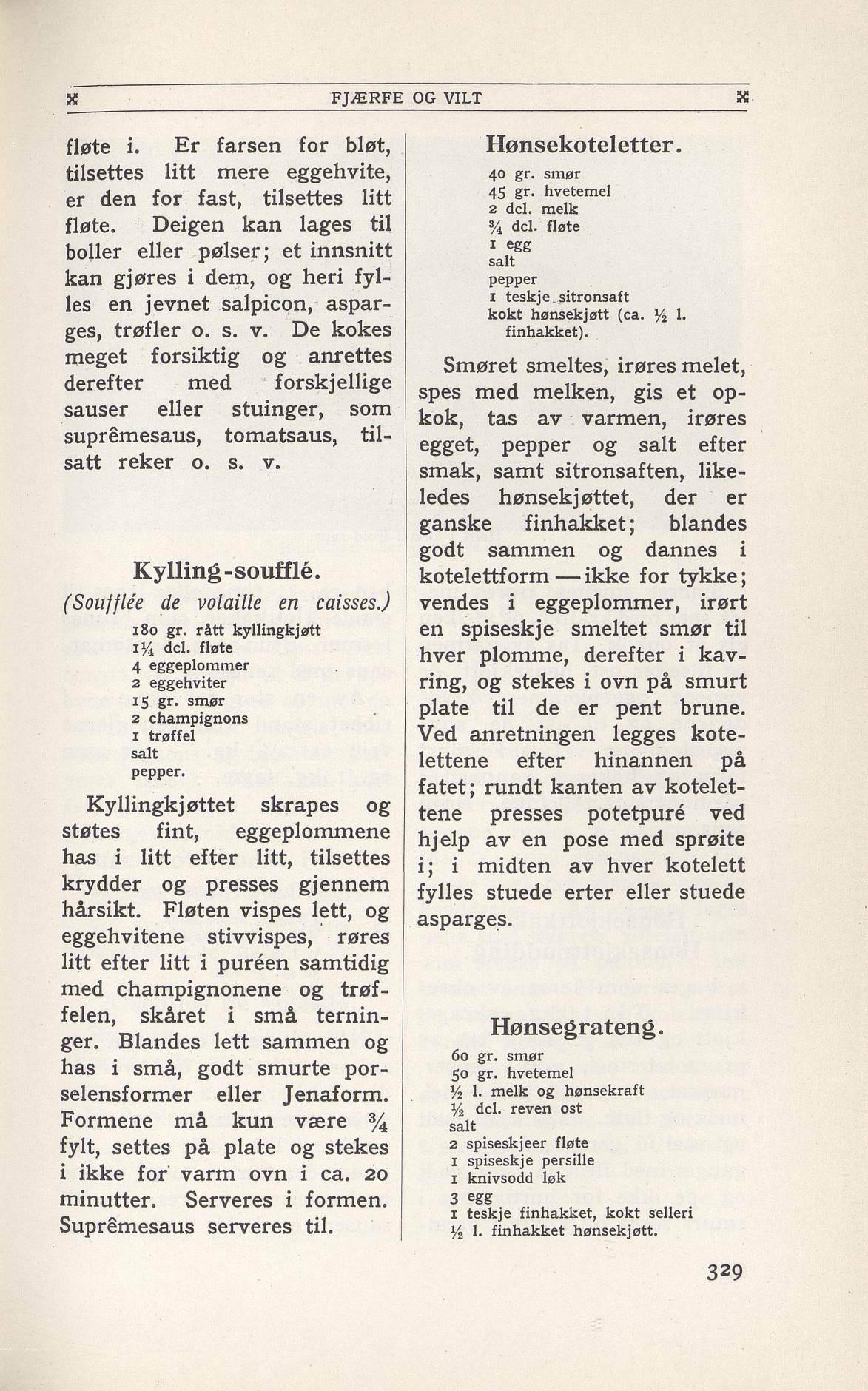
1914 (korrekturlest, s. 296)1949 (korrekturlest, s. 329)~59% av teksten endretfjernetlagt til
Hønsegrateng. 60 gr. smør 50 gr. hvetemel 1/2 ¾ l. melk eller og hønsekraft 1 ½ del. revet brød eller kavring reven ost salt paprika 2 spiseskjeer fløte 1 spiseske spiseskje persille 1 knivsod knivsodd løk 3 egg 1 teske teskje finhakket, kokt selleri 1/2 ½ l. finhakket hønsekjøt. Smørret hønsekjøtt. Smøret smeltes, irøres melet, spædes spes med kraften, gives kraften og melken, gis et opkok. Tages Tas av ilden varmen og tilsættes brød, hønsekjøt, tilsettes ost, hønsekjøtt, de vispede eggeblommer, krydderierne eggeplommer, krydderiene og tilsidst til sist de stivvispede hviter. Haves Has i smurt form og koker kokes i vandbad vannbad i varm ovn ca. 25 minutter. ¾ time. Brunsaus.

Community interpretations

Be the first to share your own version.

See interpretations

Frequently asked questions

What kind of chicken do I use?
Boiled chicken, finely chopped – about 1/2 liter. Gratin is a good way to use up leftover boiled hen, and the stock from the cooking can replace the milk in the sauce.
How is the gratin baked?
The mass is placed in a greased mold and cooked in a water bath in a hot oven for about 25 minutes. The water bath gives even, gentle heat so the gratin does not split.
Why are the eggs separated?
The egg yolks are whisked and stirred into the cooled milk-thickened base, while the whites are beaten stiff and folded in at the end. This makes the gratin light and airy.
Where does the recipe come from?
From Henriette Schønberg Erken's "Stor kokebok" (1914), page 296. It serves 6.

Related recipes

More dishes in the same category from the archive

Read also

Kommentarer

Ingen kommentarer ennå. Bli den første til å dele!