Skip to content

Rhine Wine, German-Style

German-style homemade "rhinskvin" (redcurrant wine imitating German Rhine wine) from 14 liters redcurrants, 18 liters water, and 8.5 kg sugar; fermented in two sugar additions, fortified with 1.5–2 liters cognac, and aged 3–4 years at 14–15 °C before bottling.

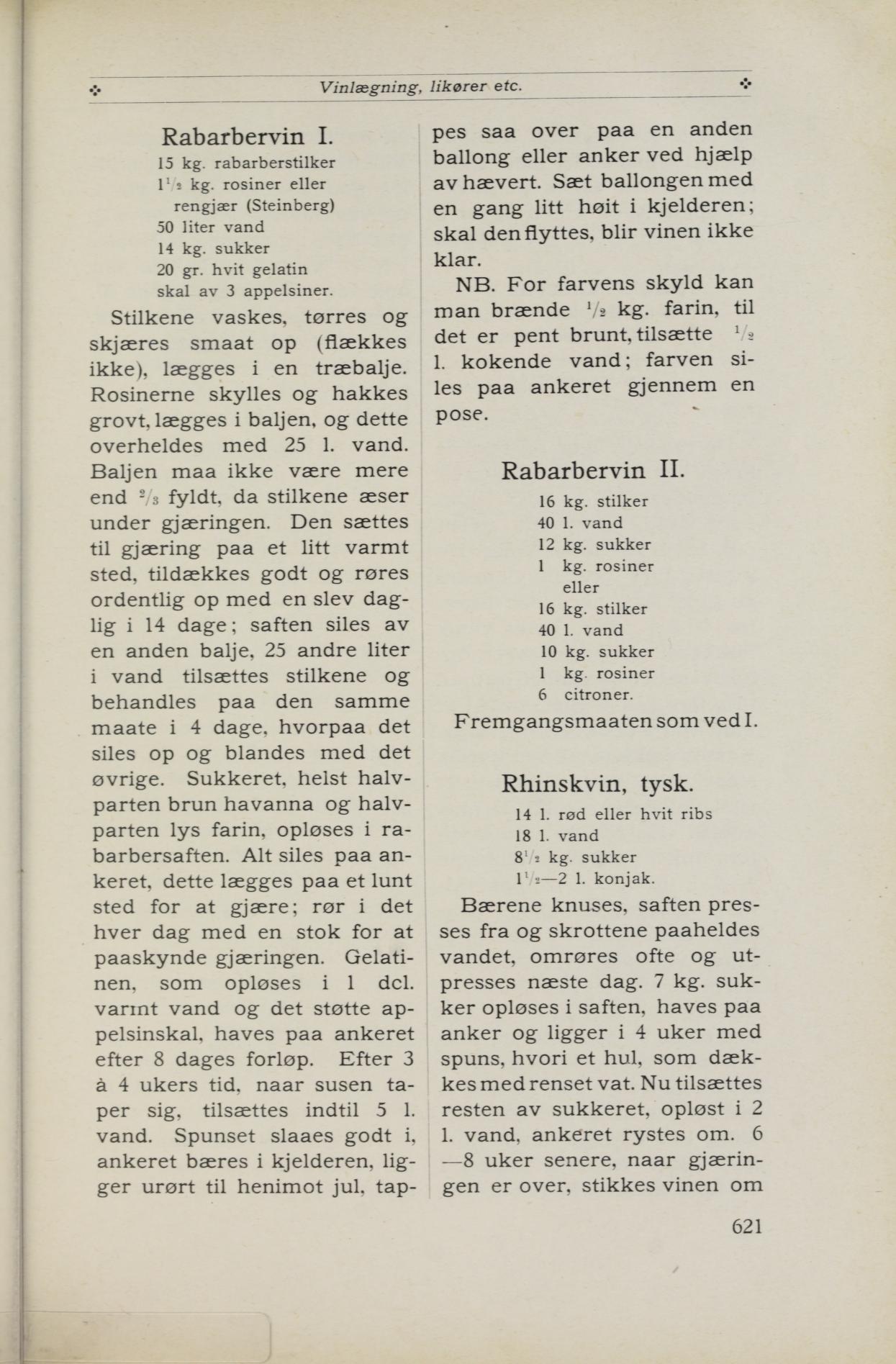
Source: Henriette Schønberg Erken, Stor kokebok, 1914-utg. s. 621 (falt i det fri)

Be the first to rate

About the dish

Redcurrant wine in the German style, called "rhinskvin" because the light, tart wine resembled Rhine wines. Erken reckons on several years of aging, which was common in well-kept cellars with a steady temperature.

How to make it

  1. 1

    Press the berries

    Crush the redcurrants and press out the juice. Pour the water over the pressing residue, stir often, and press it out the next day.

  2. 2

    First sugar

    Dissolve 7 kg sugar in the juice, pour everything into a barrel or carboy, and let it sit for 4 weeks with a bung that has a hole covered by clean cotton wool.

  3. 3

    The rest of the sugar

    Add the rest of the sugar dissolved in 2 liters of water and shake the container well.

  4. 4

    Racking and cognac

    After 6–8 weeks, when fermentation is over, rack the wine and add 1.5–2 liters cognac. Let it stand 2 months with an airlock.

  5. 5

    Aging

    Remove the airlock, bung the barrel tightly, and let the wine sit 3–4 years at 14–15 °C (60 °F). Then bottle it.

Changes from the original

Measures are kept in liters and kilos. The temperature is given in Celsius (the original states 14–15 °C (60 °F)). The steps have been divided up and the language modernized; "gjærspuns" is explained as a fermentation airlock.

Tidsmaskin – hva endret seg?

Velg to utgaver og se hva Henriette Schønberg Erken la til, fjernet eller endret mellom dem.

1914 (korrekturlest, s. 621)Modernisert~83% av teksten endretfjernetlagt til
14 l. rød eller hvit l ribs (røde eller hvite). 18 l. vand 8 1/2 kg. l vann (pluss 2 l til sukkeroppløsning). 8,5 kg sukker 1 1/2—2 l. konjak. Bærene knuses, saften presses fra, (7 kg først, resten senere). 1,75 l konjakk (1,5–2 liter). Knus ribsen og skrottene paaheldes vandet, omrøres press saften fra. Hell vannet over pressrestene, rør ofte om og utpresses næste dag. press ut neste dag.. Løs 7 kg. kg sukker opløses i saften, haves paa anker hell alt på tønne eller ballong og ligger la ligge i 4 uker med spuns, hvori et hul, spuns som dækkes med har et hull dekket av renset vat. Nu tilsættes vatt.. Tilsett resten av sukkeret, opløst sukkeret løst i 2 l. vand, ankeret rystes om. 6—8 uker senere, naar liter vann og rist beholderen godt om.. Etter 6–8 uker, når gjæringen er over, stikkes vinen om og tilsættes 1 1/2—2 l. konjak; staar i 1,5–2 liter konjakk tilsettes. La stå 2 maaneder måneder med gjærspuns. Dette tages ut, ankeret spunses, gjæringslås.. Ta ut gjæringslåsen, spuns tønnen godt til og la vinen ligger 3 a 4 aar ligge 3–4 år ved 14—15° C. Tappes. 14–15 °C. Tapp den så på flasker.

Note til Modernisert

Mål er beholdt i liter og kilo. Temperaturen er angitt i celsius (originalen oppgir 14–15 °C). Trinnene er delt opp og språket modernisert; «gjærspuns» er forklart som gjæringslås.

Community interpretations

Be the first to share your own version.

See interpretations

Frequently asked questions

How long does this wine take?
Reckon on 3–4 years. After pressing and adding sugar it ferments about 4 weeks, then 6–8 weeks after the second sugar dose, 2 months with the fermentation bung, and finally 3–4 years of aging at 14–15 °C before bottling.
What ingredients are needed?
14 liters red or white redcurrants, 18 liters water, 8.5 kg sugar, and 1.5–2 liters cognac. The sugar is divided: 7 kg is dissolved in the juice, the rest (1.5 kg) is dissolved in 2 liters of water and added after 4 weeks.
What is done with the berry residue (pulp)?
After the juice is pressed out, the water is poured over the pulp. The mixture is stirred often and pressed out the next day, and this liquid is used together with the juice.
Why a hole in the bung with cotton wool?
The hole lets the fermentation gas escape, while the clean cotton wool keeps impurities and insects out of the cask. Later a fermentation bung is used, and finally the cask is bunged completely tight for aging.

Related recipes

More dishes in the same category from the archive

Read also

Kommentarer

Ingen kommentarer ennå. Bli den første til å dele!