Skip to content

Krustader (Norwegian Timbale Cases, makes 60)

Base recipe for 60 krustader (crisp Norwegian timbale cases): a thin batter of 125 g wheat flour, 4 dl cold water, 2 dl beer, and 2 eggs rested for half an hour, formed on a heated timbale iron and deep-fried in lard until pale golden and crisp. With troubleshooting, storage, and reusing the fat.

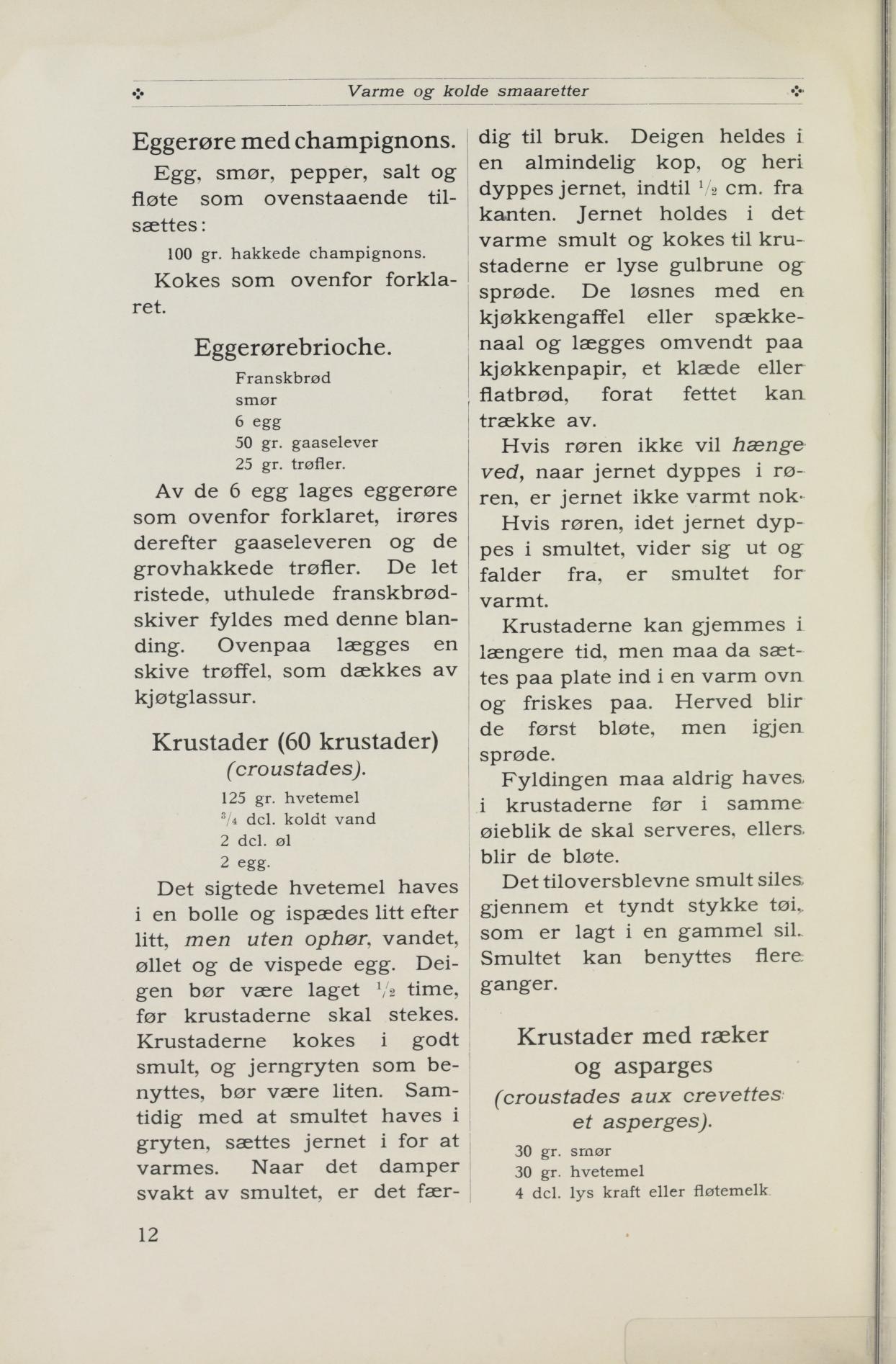
Source: Henriette Schønberg Erken, Stor kokebok, 1914-utg. s. 12 (falt i det fri)

Be the first to rate

About the dish

Krustader are crisp, cup-shaped shells of thin batter, formed on a special timbale iron that is dipped into batter and then into hot fat. They were indispensable as cases for hot savory fillings in party food before the First World War, and Erken gives very precise instructions on the temperature of the iron and the fat.

How to make it

  1. 1

    Make the batter

    Sift the flour into a bowl and thin it out little by little, but without pausing, with the water, beer, and beaten eggs until the batter is smooth.

  2. 2

    Let the batter rest

    The batter should rest for at least half an hour before the krustader are fried.

  3. 3

    Heat fat and iron

    Put the lard in a small, deep iron pot and set the timbale iron in the fat at the same time so it heats along with it. When the lard gives off a faint wisp of steam (about 180 °C (355 °F)), it is ready.

  4. 4

    Form the krustader

    Pour the batter into an ordinary cup. Dip the hot iron into the batter to ½ cm from the rim, then hold it in the hot fat until the krustade is pale golden and crisp.

  5. 5

    Loosen and drain

    Loosen the krustade with a kitchen fork or larding needle and set it upside down on paper towel, a cloth, or flatbread so the fat drains off.

  6. 6

    Adjust the heat

    If the batter does not cling to the iron, the iron is not hot enough. If the batter expands and slides off when the iron is set in the fat, the fat is too hot.

  7. 7

    Storage and serving

    The krustader can be kept for a long time, but should then be placed on a tray in a warm oven and refreshed; they first turn soft, then crisp again. Never fill them until the very moment they are to be served. Strain the remaining lard through a thin cloth laid in a sieve — it can be used several times.

Changes from the original

Lard is kept as the original fat, but neutral frying oil is mentioned as a modern alternative. "del." is interpreted as deciliters, "frying/cooking in lard" is described as deep-frying, and a temperature (about 180 °C (355 °F)) is given as a modern aid. Paper towel retained.

In stores now

Clean, minimally processed groceries matched to the ingredients — approximate prices.

Product data and prices via Kassalapp. Prices are updated daily and may vary.

Time machine – what changed?

Pick two editions and see what Henriette Schønberg Erken added, removed or changed between them.

Pick two different editions to see a comparison.

Community interpretations

Be the first to share your own version.

See interpretations →

Frequently asked questions

Why must the batter rest before frying?
The recipe says the batter should be made half an hour before the krustader are fried. This lets the flour swell, and the batter clings more evenly to the iron.
How do I know the lard is at the right temperature?
The iron is set in the pot at the same time as the lard so it heats up. When the lard gives off a faint wisp of steam, it is ready to use.
How far should the krustade iron be dipped into the batter?
The batter is poured into an ordinary cup, and the iron is dipped to about ½ cm from the rim — no higher, or the krustade becomes hard to release.
What is the batter made of, and how many krustader does it yield?
125 g sifted wheat flour, 4 dl cold water, 2 dl beer, and 2 eggs — enough for 60 krustader, according to Schønberg Erken's Stor kokebok (1914), p. 12.

Related recipes

More dishes in the same category from the archive

Read also

Kommentarer

Ingen kommentarer ennå. Bli den første til å dele!