Base recipe for 60 krustader (crisp Norwegian timbale cases): a thin batter of 125 g wheat flour, 4 dl cold water, 2 dl beer, and 2 eggs rested for half an hour, formed on a heated timbale iron and deep-fried in lard until pale golden and crisp. With troubleshooting, storage, and reusing the fat.
Source: Henriette Schønberg Erken, Stor kokebok, 1914-utg. s. 12 (falt i det fri)
Be the first to rate
About the dish
Krustader are crisp, cup-shaped shells of thin batter, formed on a special timbale iron that is dipped into batter and then into hot fat. They were indispensable as cases for hot savory fillings in party food before the First World War, and Erken gives very precise instructions on the temperature of the iron and the fat.
How to make it
1
Make the batter
Sift the flour into a bowl and thin it out little by little, but without pausing, with the water, beer, and beaten eggs until the batter is smooth.
2
Let the batter rest
The batter should rest for at least half an hour before the krustader are fried.
3
Heat fat and iron
Put the lard in a small, deep iron pot and set the timbale iron in the fat at the same time so it heats along with it. When the lard gives off a faint wisp of steam (about 180 °C (355 °F)), it is ready.
4
Form the krustader
Pour the batter into an ordinary cup. Dip the hot iron into the batter to ½ cm from the rim, then hold it in the hot fat until the krustade is pale golden and crisp.
5
Loosen and drain
Loosen the krustade with a kitchen fork or larding needle and set it upside down on paper towel, a cloth, or flatbread so the fat drains off.
6
Adjust the heat
If the batter does not cling to the iron, the iron is not hot enough. If the batter expands and slides off when the iron is set in the fat, the fat is too hot.
7
Storage and serving
The krustader can be kept for a long time, but should then be placed on a tray in a warm oven and refreshed; they first turn soft, then crisp again. Never fill them until the very moment they are to be served. Strain the remaining lard through a thin cloth laid in a sieve — it can be used several times.
Changes from the original
Lard is kept as the original fat, but neutral frying oil is mentioned as a modern alternative. "del." is interpreted as deciliters, "frying/cooking in lard" is described as deep-frying, and a temperature (about 180 °C (355 °F)) is given as a modern aid. Paper towel retained.
📖1914
Original 1914 recipe
Verbatim from the first edition of the Big Cookbook.
Foto: Faksimile: Nasjonalbiblioteket
ProofreadPage 12
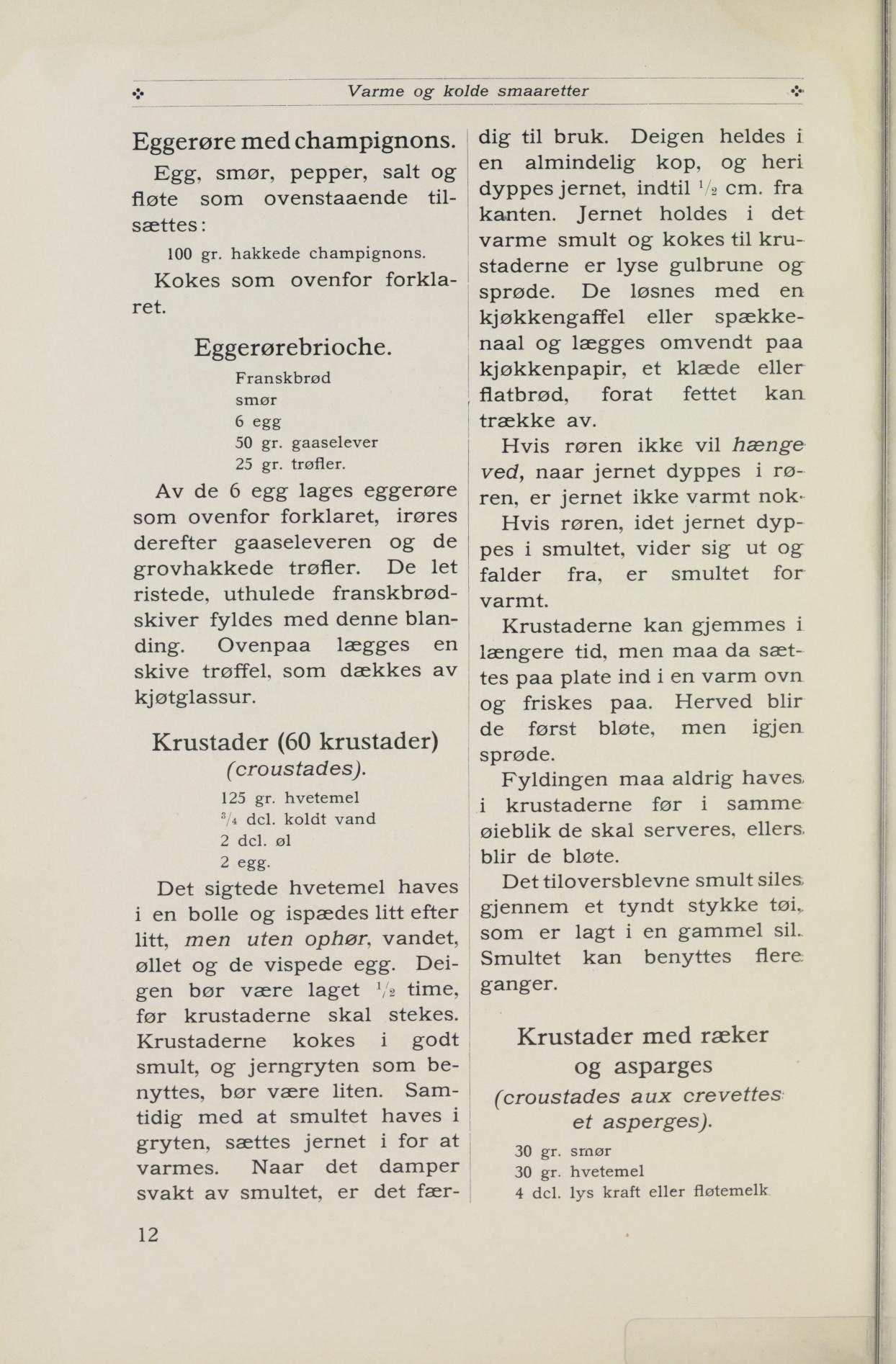
125 gr. hvetemel
4 del. koldt vand
2 del. øl
2 egg.
Det sigtede hvetemel haves i en bolle og ispædes litt efter litt, men uten ophør, vandet, øllet og de vispede egg. Deigen bør være laget ½ time, før krustaderne skal stekes.
Krustaderne kokes i godt smult, og jerngryten som benyttes, bør være liten. Samtidig med at smultet haves i gryten, sættes jernet i for at varmes. Naar det damper svakt av smultet, er det færdig til bruk. Deigen heldes i en almindelig kop, og heri dyppes jernet, indtil ½ cm. fra kanten. Jernet holdes i det varme smult og kokes til krustaderne er lyse gulbrune og sprøde. De løsnes med en kjøkkengaffel eller spækkenaal og lægges omvendt paa kjøkkenpapir, et klæde eller flatbrød, forat fettet kan trække av.
Hvis røren ikke vil hænge ved, naar jernet dyppes i røren, er jernet ikke varmt nok.
Hvis røren, idet jernet dyppes i smultet, vider sig ut og falder fra, er smultet for varmt.
Krustaderne kan gjemmes i længere tid, men maa da sættes paa plate ind i en varm ovn og friskes paa. Herved blir de først bløte, men igjen sprøde.
Fyldingen maa aldrig haves i krustaderne før i samme øieblik de skal serveres, ellers blir de bløte.
Det tiloversblevne smult siles gjennem et tyndt stykke tøi, som er lagt i en gammel sil. Smultet kan benyttes flere ganger.
📖1949
Revised 1949 recipe
From the revised edition of the Big Cookbook.
Foto: Faksimile: Nasjonalbiblioteket
ProofreadPage 17
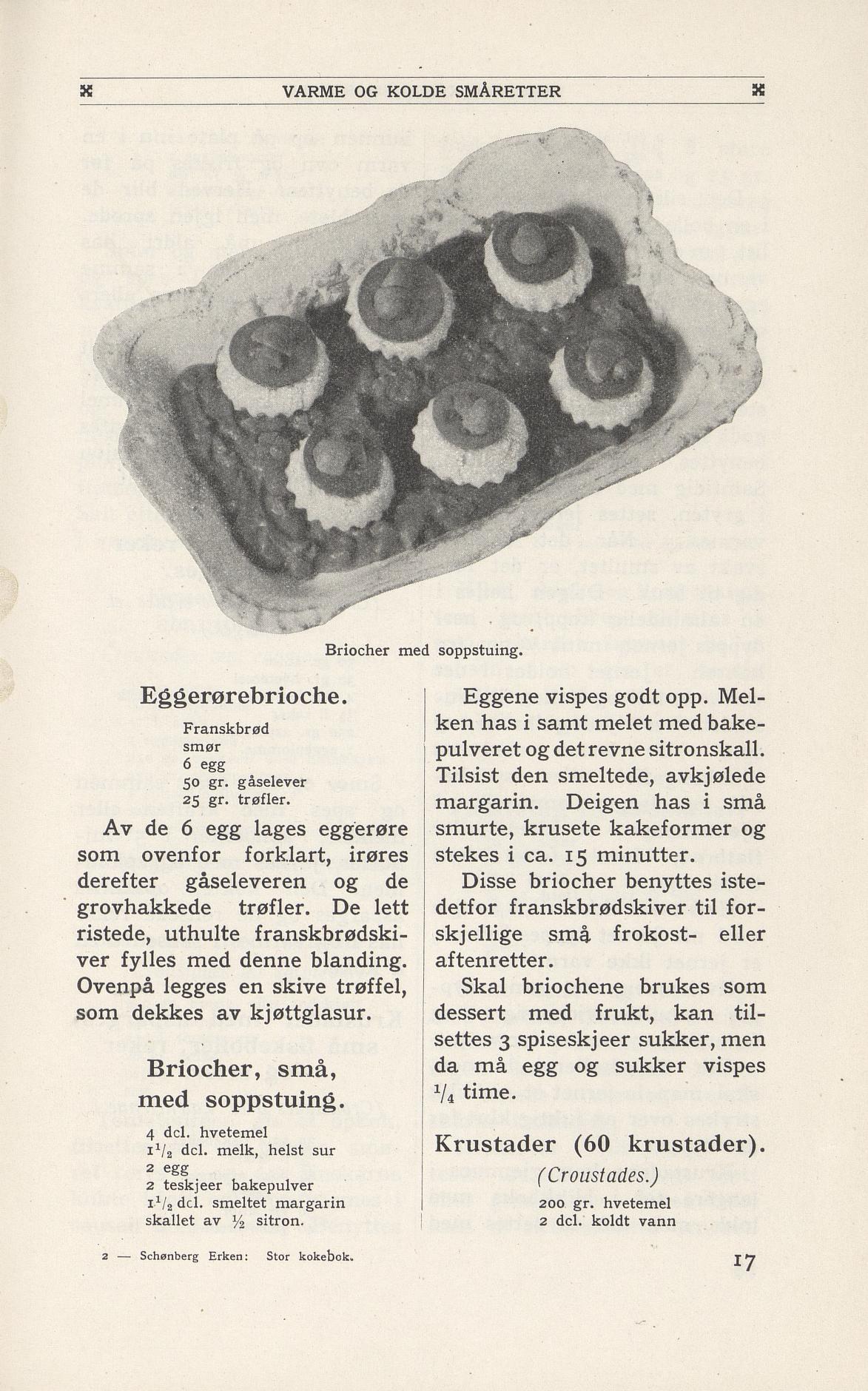
200 gr. hvetemel
2 del. koldt vann
2 del. øl
2 egg
40 gr. smør.
Det siktede hvetemel has i en bolle og ivispes litt efter litt, men uten ophør, vannet, ølet og det ene vispede egg; nu tilsettes 1 eggeplomme og det rørte kolde smør. Deigen bør være laget 1/2 time før krustadene skal stekes. Krustadene kokes i godt smult, og jerngryten som benyttes, bør være liten. Samtidig med at smultet has i gryten, settes jernet i for å varmes. Når det damper svakt av smultet, er det ferdig til bruk. Deigen helles i en almindelig kopp, og heri dyppes jernet, inntil 1/2 cm. fra kanten. Jernet holdes i det varme smult og kokes til krustadene er lyse gulbrune og sprø. De løsnes med en kjøkkengaffel eller spekke nål og legges omvendt på kjøkkenpapir, et klæde eller flatbrød, foråt fettet kan trekke av. Hvis røren ikke vil henge ved når jernet dyppes i røren, er jernet ikke varmt nok. Hvis røren, idet jernet dyp pes i smultet, vider sig ut og faller fra, er smultet for varmt. Blir der huller i bunnen, skal man la jernet et øieblikk strykes over en fuktig klut før det dyppes. Krustadene kan gjemmes i lengere tid i blikkboks med lokk, men må da settes med bunnen op på plate inn i en varm ovn og friskes på før de benyttes. Herved blir de først bløte, men igjen sprøde. Fyllingen må aldri has i krustadene før i samme øieblikk de skal serveres, ellers blir de bløte. Det tiloversblevne smult siles gjennem et tynt stykke tøi, som er lagt i en gammel sil. Smultet kan benyttes flere ganger. Til denne porsjon må beregnes 3/4 kg. smult.
In stores now
Clean, minimally processed groceries matched to the ingredients — approximate prices.
1914 (korrekturlest, s. 12) → 1949 (korrekturlest, s. 17)~46% av teksten endretfjernetlagt til
125 200 gr. hvetemel 4 2 del. koldt vand vann 2 del. øl 2 egg. egg 40 gr. smør. Det sigtede siktede hvetemel haves has i en bolle og ispædes ivispes litt efter litt, men uten ophør, vandet, øllet vannet, ølet og de det ene vispede egg. egg; nu tilsettes 1 eggeplomme og det rørte kolde smør. Deigen bør være laget ½ time, 1/2 time før krustaderne krustadene skal stekes. Krustaderne Krustadene kokes i godt smult, og jerngryten som benyttes, bør være liten. Samtidig med at smultet haves has i gryten, sættes settes jernet i for at å varmes. Naar Når det damper svakt av smultet, er det færdig ferdig til bruk. Deigen heldes helles i en almindelig kop, kopp, og heri dyppes jernet, indtil ½ inntil 1/2 cm. fra kanten. Jernet holdes i det varme smult og kokes til krustaderne krustadene er lyse gulbrune og sprøde. sprø. De løsnes med en kjøkkengaffel eller spækkenaal spekke nål og lægges legges omvendt paa på kjøkkenpapir, et klæde eller flatbrød, forat foråt fettet kan trække trekke av. Hvis røren ikke vil hænge ved, naar henge ved når jernet dyppes i røren, er jernet ikke varmt nok. Hvis røren, idet jernet dyppes dyp pes i smultet, vider sig ut og falder faller fra, er smultet for varmt. Krustaderne Blir der huller i bunnen, skal man la jernet et øieblikk strykes over en fuktig klut før det dyppes. Krustadene kan gjemmes i længere tid, lengere tid i blikkboks med lokk, men maa må da sættes paa settes med bunnen op på plate ind inn i en varm ovn og friskes paa. på før de benyttes. Herved blir de først bløte, men igjen sprøde. Fyldingen maa aldrig haves Fyllingen må aldri has i krustaderne krustadene før i samme øieblik øieblikk de skal serveres, ellers blir de bløte. Det tiloversblevne smult siles gjennem et tyndt tynt stykke tøi, som er lagt i en gammel sil. Smultet kan benyttes flere ganger. Til denne porsjon må beregnes 3/4 kg. smult.
The recipe says the batter should be made half an hour before the krustader are fried. This lets the flour swell, and the batter clings more evenly to the iron.
How do I know the lard is at the right temperature?
The iron is set in the pot at the same time as the lard so it heats up. When the lard gives off a faint wisp of steam, it is ready to use.
How far should the krustade iron be dipped into the batter?
The batter is poured into an ordinary cup, and the iron is dipped to about ½ cm from the rim — no higher, or the krustade becomes hard to release.
What is the batter made of, and how many krustader does it yield?
125 g sifted wheat flour, 4 dl cold water, 2 dl beer, and 2 eggs — enough for 60 krustader, according to Schønberg Erken's Stor kokebok (1914), p. 12.