Skip to content

Veal sweetbread (ris de veau) – preliminary preparation

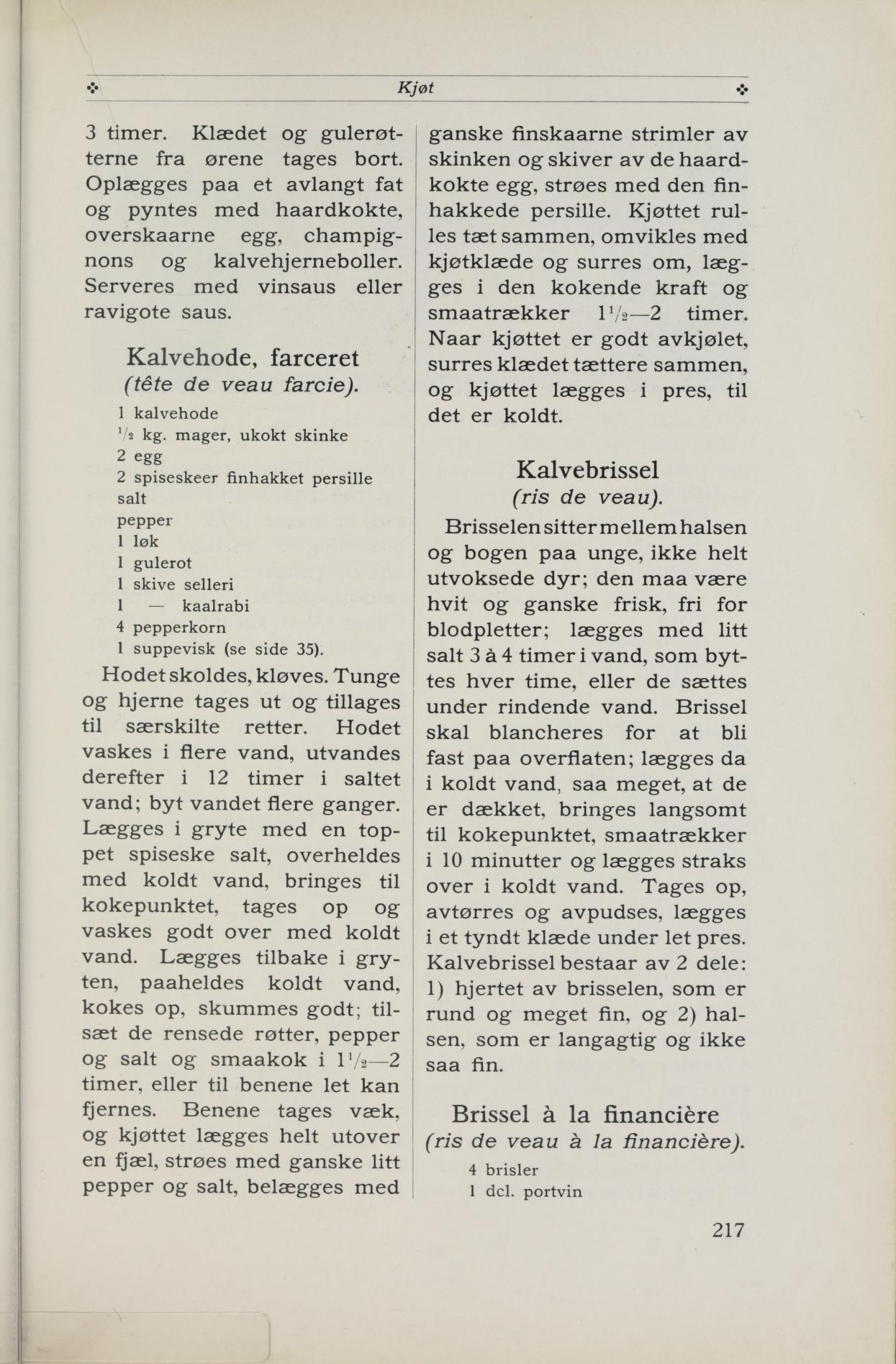
Basic instructions for veal sweetbread from Erken 1914: soaking for 3–4 hours in salted water, slow heating to the boiling point, 10 minutes of gentle poaching, cooling in cold water, trimming, and light pressing.

Source: Henriette Schønberg Erken, Stor kokebok, 1914-utg. s. 217 (falt i det fri)

Be the first to rate

About the dish

Erken's basic instructions for handling veal sweetbread (sweetbreads), which underlie all the sweetbread dishes in the book. Sweetbread was a highly regarded delicacy in bourgeois and finer kitchens around 1900.

How to make it

  1. 1

    Soaking

    Place the sweetbread in water with a little salt for 3–4 hours. Change the water every hour, or leave the sweetbread under running water.

  2. 2

    Blanching

    Place the sweetbread in cold water so it is covered. Heat slowly to the boiling point and let it poach gently for 10 minutes.

  3. 3

    Cooling

    Transfer the sweetbread immediately to cold water.

  4. 4

    Trimming and pressing

    Lift out the sweetbread, pat it dry, and trim it clean. Place it in a thin cloth under light pressure.

  5. 5

    The two parts

    Note that the sweetbread consists of two parts: the heart, which is round and very fine, and the throat, which is elongated and not as fine.

Changes from the original

The text is kept as a preliminary-preparation instruction; the steps are broken up and put into modern language. Amounts are not given in the original and are therefore stated without measures.

Time machine – what changed?

Pick two editions and see what Henriette Schønberg Erken added, removed or changed between them.

Modernised → 1914 (proofread, p. 217)~81% of the text changedremovedadded
kalvebrissel (hvit, Brisselen sitter mellem halsen og bogen paa unge, ikke helt fersk, uten blodflekker). salt (litt, i utvanningsvannet). vann (til utvanning utvoksede dyr; den maa være hvit og blanchering). Legg brisselen i vann ganske frisk, fri for blodpletter; lægges med litt salt 3 à 4 timer i 3–4 timer. Skift vannet vand, som byttes hver time, eller la brisselen ligge de sættes under rennende vann.. Legg brisselen rindende vand. Brissel skal blancheres for at bli fast paa overflaten; lægges da i kaldt vann så den koldt vand, saa meget, at de er dekket. Varm dækket, bringes langsomt opp til kokepunktet og la den trekke svakt kokepunktet, smaatrækker i 10 minutter.. Legg brisselen minutter og lægges straks over i kaldt vann.. Ta brisselen opp, tørk den av koldt vand. Tages op, avtørres og puss den ren. Legg den avpudses, lægges i et tynt klede tyndt klæde under lett press.. Merk at brisselen består let pres. Kalvebrissel bestaar av to deler: hjertet, 2 dele: 1) hjertet av brisselen, som er rundt rund og meget fint, fin, og 2) halsen, som er langaktig langagtig og ikke så saa fin.

Note on Modernised

Teksten er beholdt som forbehandlingsanvisning; trinnene er delt opp og satt i moderne språk. Mengder er ikke oppgitt i originalen og er derfor angitt uten mål.

Community interpretations

Be the first to share your own version.

See interpretations →

Frequently asked questions

How long should the sweetbread soak in water before use?
3–4 hours in water with a little salt. Change the water every hour, or place the sweetbread under running water. This draws out the blood and makes it white.
How do I blanch veal sweetbread correctly?
Place the sweetbread in cold water so it is covered, bring it slowly to the boiling point, and let it poach gently for 10 minutes. Transfer it immediately to cold water, lift it out, pat it dry, and trim it. Blanching makes the surface firm.
What is the difference between the two parts of the sweetbread?
The sweetbread consists of the heart, which is round and very fine, and the throat, which is elongated and not as fine. The sweetbread sits between the throat and the shoulder on young, not fully grown animals.
How should the sweetbread be treated after blanching?
It is patted dry and trimmed, then placed in a thin cloth under light pressure before further preparation.

Related recipes

More dishes in the same category from the archive

Read also

Kommentarer

Ingen kommentarer ennå. Bli den første til å dele!