Skip to content

Veal loaf

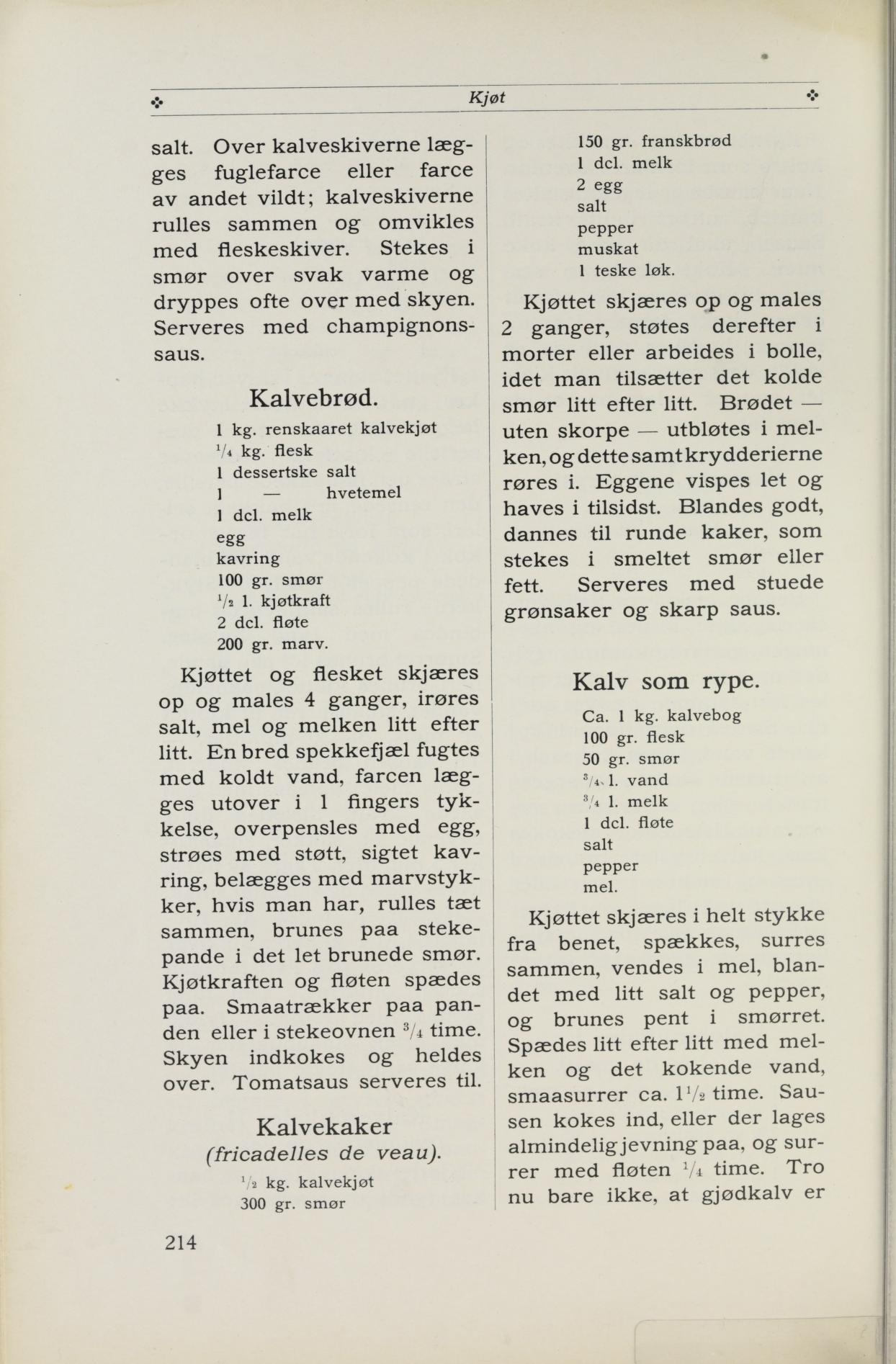
Erken's veal loaf from 1914: veal and pork ground four times, mixed with salt, flour, and milk, rolled with pieces of marrow and rusk, browned in butter, and finished by braising in meat stock and cream. Served with tomato sauce.

Source: Henriette Schønberg Erken, Stor kokebok, 1914-utg. s. 214 (falt i det fri)

Be the first to rate

About the dish

Veal loaf is a rolled meat forcemeat from the veal chapter of Henriette Schønberg Erken's "Stor kokebok" (1914). Marrow from marrow bones was a common filling in the finer forcemeat dishes of the time, and the dish was served with tomato sauce.

How to make it

  1. 1

    Grind the meat

    Cut the veal and pork into pieces and grind the mixture 4 times.

  2. 2

    Mix the forcemeat

    Stir in the salt, then the flour, and thin with the milk little by little into a smooth, firm forcemeat.

  3. 3

    Shape the veal loaf

    Moisten a wide board or baking paper with cold water. Spread the forcemeat out to about a finger's thickness. Brush with beaten egg and sprinkle with sifted rusk. Lay pieces of marrow in a strip along the middle if you are using marrow, and roll the forcemeat up tightly into a loaf.

  4. 4

    Brown

    Lightly brown the butter in a wide pan or pot and brown the veal loaf nicely on all sides.

  5. 5

    Braise until done

    Add meat stock and cream. Let the veal loaf braise gently, covered, on the stovetop or in the oven at 160 °C (320 °F) for about 45 minutes (¾ hour).

  6. 6

    Sauce and serving

    Lift out the veal loaf, reduce the stock to a suitably thick gravy, and pour it over. Serve tomato sauce alongside.

Changes from the original

Amounts are converted to modern measures (1 deciliter = 1 dl, ½ liter stock). "Flesk" is interpreted as fresh, fatty pork belly. Rusk can be replaced with dry breadcrumbs. The marrow is made optional, as the original suggests. Cooking is given with a modern oven temperature.

In stores now

Clean, minimally processed groceries matched to the ingredients — approximate prices.

Product data and prices via Kassalapp. Prices are updated daily and may vary.

Tidsmaskin – hva endret seg?

Velg to utgaver og se hva Henriette Schønberg Erken la til, fjernet eller endret mellom dem.

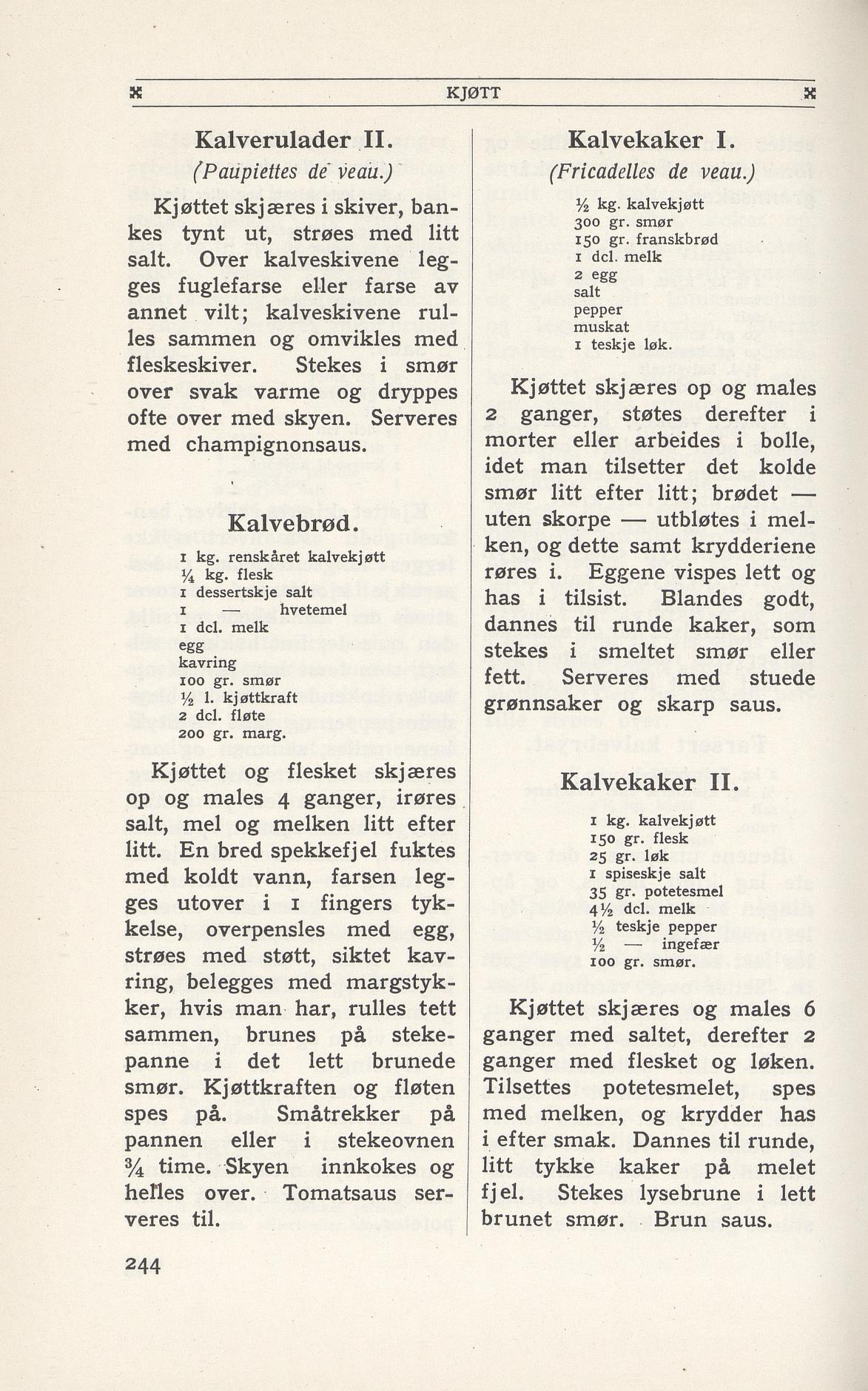
1914 (korrekturlest, s. 214)1949 (korrekturlest, s. 244)~42% av teksten endretfjernetlagt til
1 kg. renskaaret kalvekjøt ¼ renskåret kalvekjøtt ½ kg. flesk 1 dessertske dessertskje salt ½ — hvetemel 1 del. melk 1 egg kavring 100 gr. smør ½ l. kjøtkraft kjøttkraft 2 del. dd. fløte 200 gr. marv. marg. Kjøttet og flesket skjæres op og males 4 ganger, irøres salt, mel og melken litt efter litt. En bred spekkefjæl fugtes spekkefjel fuktes med koldt vand, farcen lægges vann, farsen legges utover i 1 fingers tykkelse, overpensles med egg, strøes med støtt, sigtet siktet kavring, belægges belegges med marvstykker, margstykker, hvis man har, rulles tæt tett sammen, brunes paa stekepande på stekepanne i det let lett brunede smør. Kjøtkraften Kjøttkraften og fløten spædes paa. Smaatrækker paa panden spes på. Småtrekker på pannen eller i stekeovnen ¾ time. Skyen indkokes innkokes og heldes hefles over. Tomatsaus serveres til.

Community interpretations

Be the first to share your own version.

See interpretations

Frequently asked questions

How long should the veal loaf cook?
It is first browned in lightly browned butter in a pan, then braised gently in stock and cream for about ¾ hour (45 minutes) on the pan or in the oven. Total time with preparation is around 100 minutes.
Which meat is used, and how is it prepared?
1 kg trimmed veal and ¼ kg pork are cut up and ground 4 times. Then salt, wheat flour, and 1 deciliter of milk are stirred in little by little.
How is the loaf shaped?
A wide larding board is moistened with cold water, the forcemeat is spread out to one finger's thickness, brushed with egg, sprinkled with ground, sifted rusk, layered with pieces of marrow (200 g marrow) if you have them, and rolled up tightly.
What is served with it?
The gravy is reduced and poured over, and tomato sauce is served alongside. The recipe is from Henriette Schønberg Erken's "Stor kokebok" (1914), p. 214, and makes 8 servings.

Related recipes

More dishes in the same category from the archive

Read also

Kommentarer

Ingen kommentarer ennå. Bli den første til å dele!