Sugar brine from Erken's slaughtering chapter: 10 l water, 3 kg salt, 500 g sugar, and 60 g saltpeter are boiled 15 minutes, skimmed, and cooled completely before the meat goes in. The meat is first rubbed with salt, sugar, and saltpeter. Curing time 3–6 weeks depending on whether the meat is to be cured or boiled. Includes advice on tending, topping up salt and sugar, and rescuing spoiled brine and curing vessels.
Source: Henriette Schønberg Erken, Stor kokebok, 1914-utg. s. 636 (falt i det fri)
Be the first to rate
About the dish
From the chapter on slaughtering, under the heading "Different curing brines." Sugar brine was the household's standard brine for preserving meat and ham through the winter, in an age without refrigerators. Erken gives detailed advice on tending the brine, which easily went bad from the meat juices.
How to make it
1
Boil the brine
Boil the water, salt, sugar, and saltpeter together for a quarter of an hour. Skim off and pour the brine into the curing vessel or crock.
2
Cool completely
Let the brine become completely cold before the meat is put in. Warm brine ruins the meat.
3
Rub in the meat
Mix 2 tbsp salt, 2 tbsp sugar, and 1 tsp saltpeter, and rub the meat well with the mixture before it is placed in the brine.
4
Treat bloody meat first
Bloody meat from beef or horse should not be placed in brine together with other meat or pork until it has lain 36 hours in cold water that has been whisked with salt until an egg floats. Take the meat up, let it drip off, and rub it with salt and saltpeter as usual.
5
Place in brine under a weight
Place the meat in the brine. It must always be completely covered; put a little weight on top. The lid of the curing vessel should not close completely tight.
6
Curing time
Meat can lie 3–4 weeks in the brine without being watered out before boiling. Hams for curing 5–6 weeks, hams for boiling 3–4 weeks.
7
Tend the brine
The brine steadily grows weaker because the meat draws salt and sugar into itself while the meat juices draw out. Stir in a mixture of 3 handfuls of salt and 1 handful of sugar from time to time through the winter, until it is dissolved; then you can usually avoid boiling up the brine.
8
If the brine goes bad
If necessary, boil up the brine, skim it, and pour it ice-cold over the meat again. If the brine spoils, the vessel can be ruined too; then scald it with boiling water, and if that does not help, lime the vessel and let it stand for a few days.
Changes from the original
Amounts are given in modern units (g/l/dl), saltpeter has been kept as in the original but should today be replaced by curing salt (a purchased salt blend) for food-safety reasons. The method has been divided into numbered steps and the language in the steps has been modernized.
📖1914
Original 1914 recipe
Verbatim from the first edition of the Big Cookbook.
Foto: Faksimile: Nasjonalbiblioteket
ProofreadPage 636
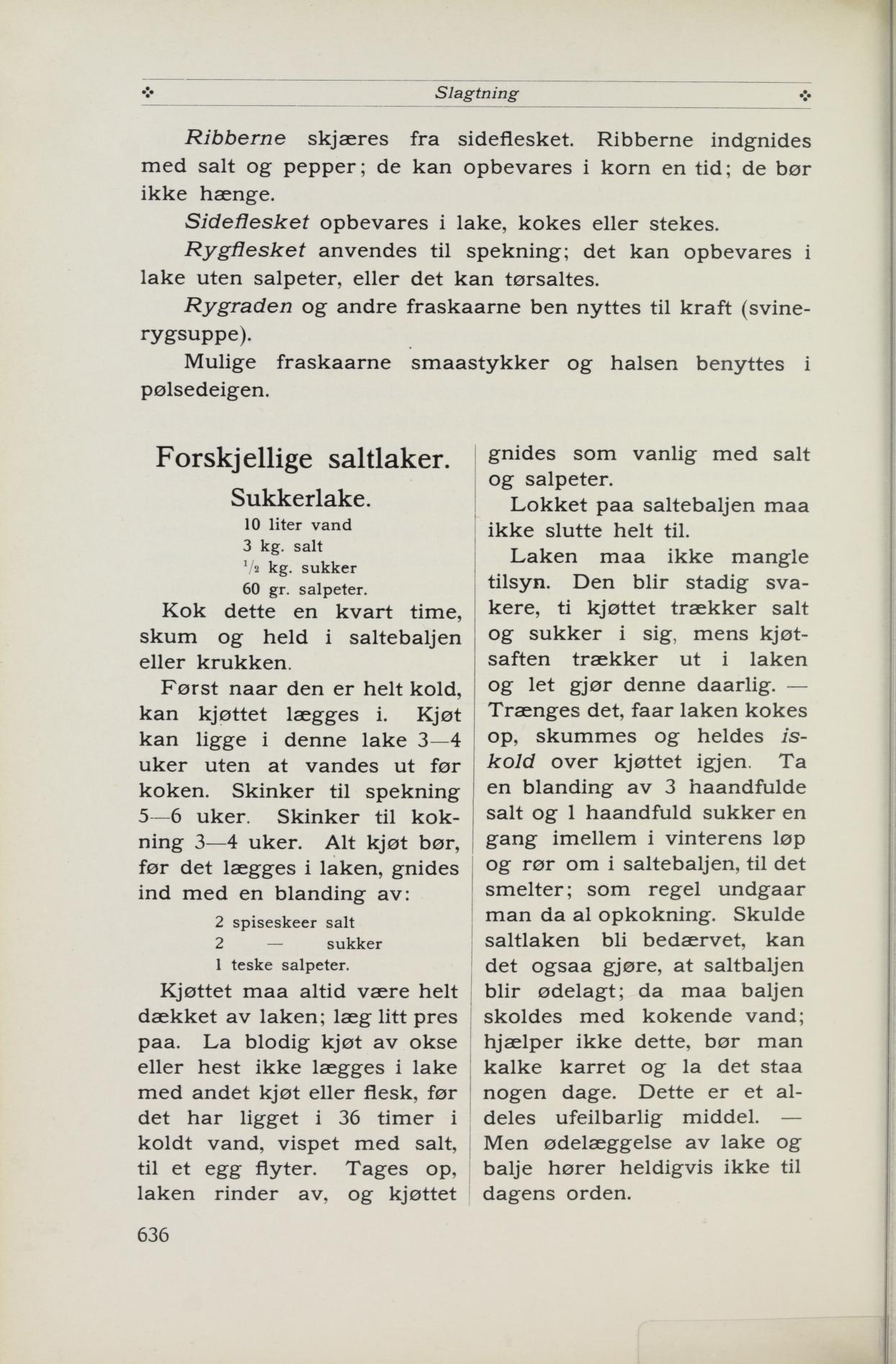
10 liter vand
3 kg. salt
1/2 kg. sukker
60 gr. salpeter.
Kok dette en kvart time, skum og held i saltebaljen eller krukken. Først naar den er helt kold, kan kjøttet lægges i. Kjøt kan ligge i denne lake 3—4 uker uten at vandes ut før koken. Skinker til spekning 5—6 uker. Skinker til kokning 3—4 uker. Alt kjøt bør, før det lægges i laken, gnides ind med en blanding av:
2 spiseskeer salt
2 — sukker
1 teske salpeter.
Kjøttet maa altid være helt dækket av laken; læg litt pres paa. La blodig kjøt av okse eller hest ikke lægges i lake med andet kjøt eller flesk, før det har ligget i 36 timer i koldt vand, vispet med salt, til et egg flyter. Tages op, laken rinder av, og kjøttet gnides som vanlig med salt og salpeter.
Lokket paa saltebaljen maa ikke slutte helt til.
Laken maa ikke mangle tilsyn. Den blir stadig svakere, ti kjøttet trækker salt og sukker i sig, mens kjøtsaften trækker ut i laken og let gjør denne daarlig. — Trænges det, faar laken kokes op, skummes og heldes iskold over kjøttet igjen. Ta en blanding av 3 haandfulde salt og 1 haandfuld sukker en gang imellem i vinterens løp og rør om i saltebaljen, til det smelter; som regel undgaar man da al opkokning. Skulde saltlaken bli bedærvet, kan det ogsaa gjøre, at saltbaljen blir ødelagt; da maa baljen skoldes med kokende vand; hjælper ikke dette, bør man kalke karret og la det staa nogen dage. Dette er et aldeles ufeilbarlig middel. — Men ødelæggelse av lake og balje hører heldigvis ikke til dagens orden.
📖1949
Revised 1949 recipe
From the revised edition of the Big Cookbook.
Foto: Faksimile: Nasjonalbiblioteket
ProofreadPage 770
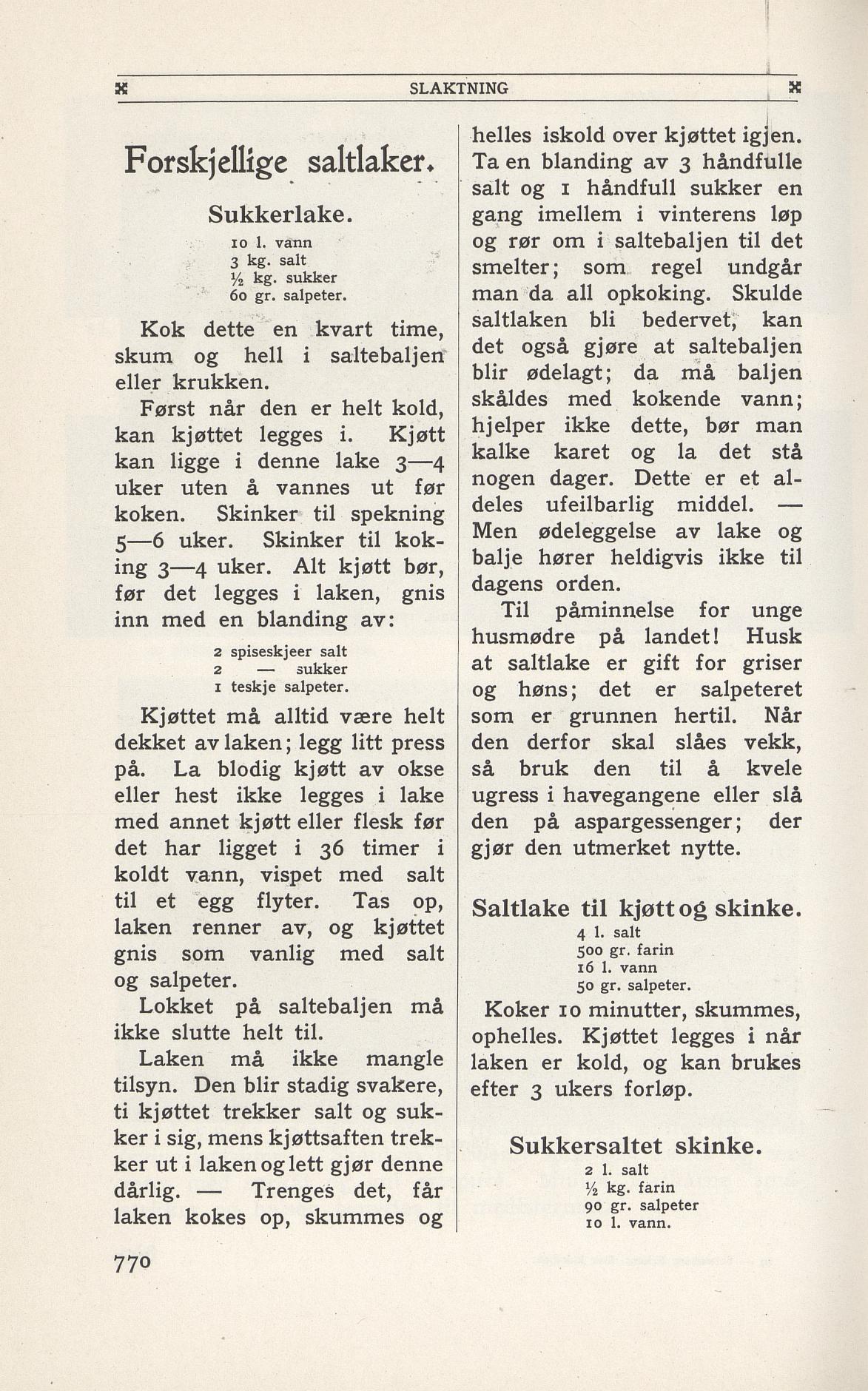
io 1. vann
3 kg. salt
y 2 kg. sukker
6o gr. salpeter.
Kok dette en kvart time, skum og hell i saltebaljen eller krukken. Først når den er helt kold, kan kjøttet legges i. Kjøtt kan ligge i denne lake 3 —4 uker uten å vannes ut før koken. Skinker til spekning 5 —6 uker. Skinker til koking 3 —4 uker. Alt kjøtt bør, før det legges i laken, gnis inn med en blanding av:
2 spiseskjeer salt
2 — sukker
i teskje salpeter.
Kjøttet må alltid være helt dekket av laken; legg litt press på. La blodig kjøtt av okse eller hest ikke legges i lake med annet kjøtt eller flesk før det har ligget i 36 timer i koldt vann, vispet med salt til et egg flyter. Tas op, laken renner av, og kjøttet gnis som vanlig med salt og salpeter. Lokket på saltebaljen må ikke slutte helt til.
Laken må ikke mangle tilsyn. Den blir stadig svakere, ti kjøttet trekker salt og sukker i sig, mens kjøttsaften trekker ut i laken og lett gjør denne dårlig. — Trenges det, får laken kokes op, skummes og helles iskold over kjøttet igjen. Ta en blanding av 3 håndfulle salt og 1 håndfull sukker engang imellem i vinterens løp og rør om i saltebaljen til det smelter; som regel undgår man da all opkoking. Skulde saltlaken bli bedervet, kan det også gjøre at saltebaljen blir ødelagt; da må baljen skåldes med kokende vann; hjelper ikke dette, bør man kalke karet og la det stå nogen dager. Dette er et aldeles ufeilbarlig middel. — Men ødeleggelse av lake og balje hører heldigvis ikke til dagens orden.
Til påminnelse for unge husmødre på landet! Husk at saltlake er gift for griser og høns; det er salpeteret som er grunnen hertil. Når den derfor skal slåes vekk, så bruk den til å kvele ugress i havegangene eller slå den på aspargessenger; der gjør den utmerket nytte.
Time machine – what changed?
Pick two editions and see what Henriette Schønberg Erken added, removed or changed between them.
Modernised → 1914 (proofread, p. 636)~84% of the text changedremovedadded
10 l vann. liter vand 3 kg salt. 500 g sukker. 60 g salpeter (kan erstattes med nitritsalt etter produsentens anvisning). 2 ss kg. salt (til inngnidning av kjøttet). 2 ss 1/2 kg. sukker (til inngnidning av kjøttet). 1 ts salpeter (til inngnidning av kjøttet). 60 gr. salpeter. Kok vann, salt, sukker og salpeter sammen i et kvarter. Skum av dette en kvart time, skum og hell laken held i saltekaret saltebaljen eller krukken.. La laken bli krukken. Først naar den er helt kald før kold, kan kjøttet legges lægges i. Varm Kjøt kan ligge i denne lake ødelegger kjøttet.. Bland 3—4 uker uten at vandes ut før koken. Skinker til spekning 5—6 uker. Skinker til kokning 3—4 uker. Alt kjøt bør, før det lægges i laken, gnides ind med en blanding av: 2 ss salt, spiseskeer salt 2 ss — sukker og 1 ts salpeter, og gni kjøttet godt inn med blandingen før det legges i laken.. Blodig kjøtt teske salpeter. Kjøttet maa altid være helt dækket av laken; læg litt pres paa. La blodig kjøt av okse eller hest skal ikke legges lægges i lake sammen med annet kjøtt andet kjøt eller flesk flesk, før det har ligget i 36 timer i kaldt vann som er koldt vand, vispet med salt salt, til et egg flyter. Ta kjøttet opp, la det dryppe av Tages op, laken rinder av, og gni det inn kjøttet gnides som vanlig med salt og salpeter som vanlig.. Legg kjøttet i laken. Det må alltid være helt dekket; legg litt press oppå. salpeter. Lokket på saltekaret skal paa saltebaljen maa ikke slutte helt tett.. Kjøtt kan ligge 3–4 uker i laken uten å vannes ut før koking. Skinker til speking 5–6 uker, skinker til koking 3–4 uker.. til. Laken maa ikke mangle tilsyn. Den blir stadig svakere fordi svakere, ti kjøttet trekker til seg trækker salt og sukker i sig, mens kjøttsaften trekker ut. Rør inn kjøtsaften trækker ut i laken og let gjør denne daarlig. — Trænges det, faar laken kokes op, skummes og heldes iskold over kjøttet igjen. Ta en blanding av 3 håndfuller haandfulde salt og 1 håndfull haandfuld sukker en gang iblant gjennom vinteren, imellem i vinterens løp og rør om i saltebaljen, til det er oppløst; da slipper man smelter; som regel å koke opp laken.. Er det nødvendig, kok opp laken, skum den og hell den iskald over kjøttet igjen. Blir laken bedervet, kan karet også undgaar man da al opkokning. Skulde saltlaken bli ødelagt; skold bedærvet, kan det ogsaa gjøre, at saltbaljen blir ødelagt; da maa baljen skoldes med kokende vann, og hjelper vand; hjælper ikke det, kalk karet dette, bør man kalke karret og la det stå noen dager. staa nogen dage. Dette er et aldeles ufeilbarlig middel. — Men ødelæggelse av lake og balje hører heldigvis ikke til dagens orden.
Note on Modernised
Mengder er oppgitt i moderne enheter (g/l/dl), salpeter er beholdt som i originalen men bør i dag erstattes av nitritsalt (kjøpt saltblanding) av mattrygghetshensyn. Fremgangsmåten er delt i nummererte trinn og språket i trinnene er modernisert.
10 liters of water, 3 kg of salt, 1/2 kg of sugar, and 60 g of saltpeter. Boil the mixture for a quarter of an hour, skim off, and pour it into the curing tub or crock.
When can the meat be placed in the brine?
Only once the brine is completely cold. Before packing, the meat should be rubbed with 2 tablespoons of salt, 2 tablespoons of sugar, and 1 teaspoon of saltpeter. The meat must always be completely covered by the brine — put a little weight on top.
How long should the meat lie?
Meat can lie 3–4 weeks without being watered out before boiling. Hams for curing 5–6 weeks, hams for boiling 3–4 weeks.
What do you do with bloody meat from beef or horse?
It must not be placed in brine together with other meat or pork until it has lain 36 hours in cold water whisked with salt until an egg floats. Then it is taken up, the brine drains off, and the meat is rubbed as usual. The recipe is from Henriette Schønberg Erken's "Stor kokebok" (1914), p. 636.