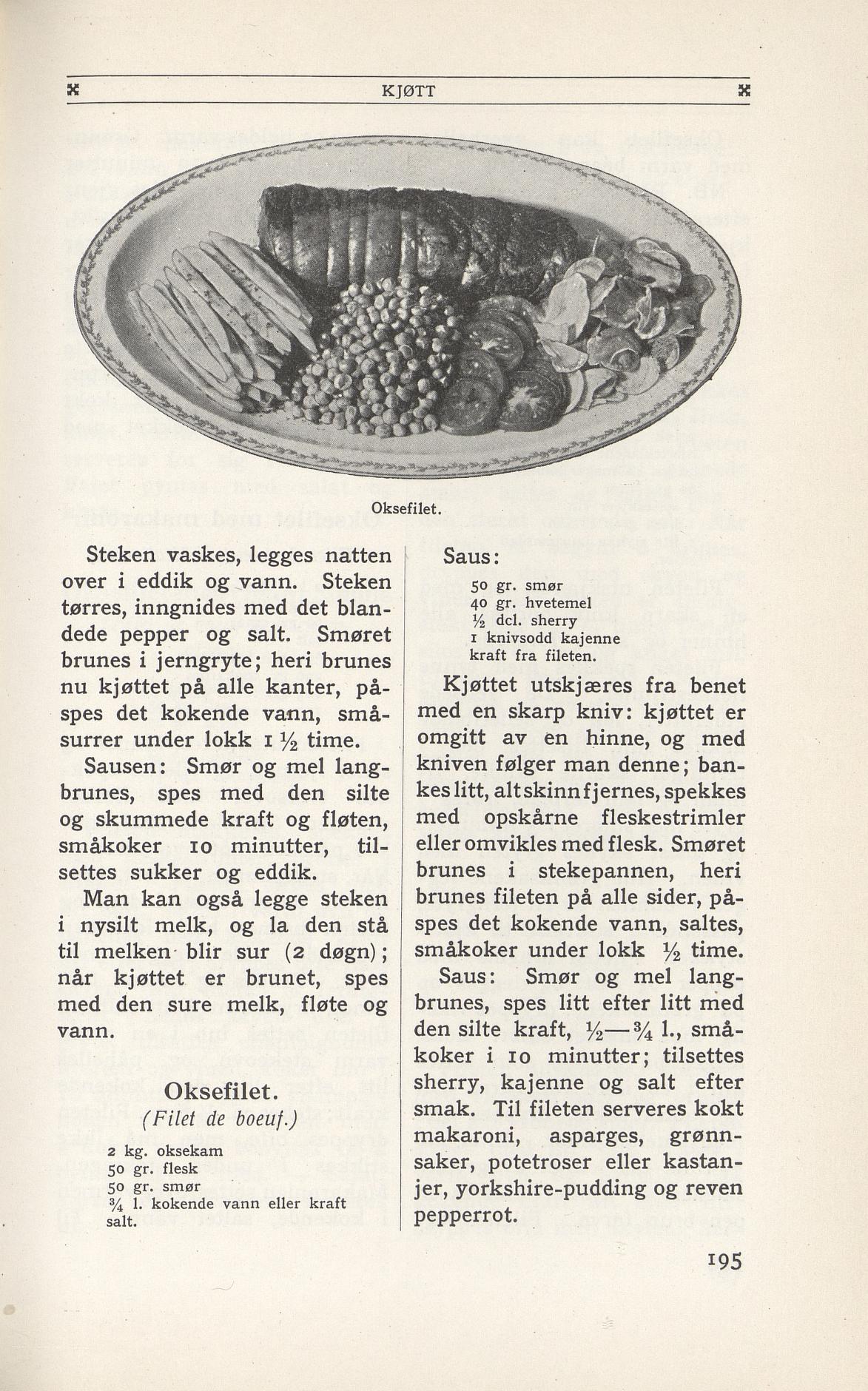
Erken's beef tenderloin (filet de bœuf) from 1914: the tenderloin is cut out of 2 kg beef loin along the membrane, cleaned, larded with pork fat, browned in butter and simmered covered for half an hour with stock. The sauce is a brown roux thinned with the tenderloin stock and seasoned with sherry and cayenne. Served with macaroni, asparagus, potato roses, chestnuts, Yorkshire pudding and horseradish, optionally with béarnaise sauce.
Source: Henriette Schønberg Erken, Stor kokebok, 1914-utg. s. 166 (falt i det fri)
Be the first to rate
About the dish
From the festive-food section of the beef chapter in Stor kokebok (1914). Erken describes how the tenderloin is cut out of the loin along the membrane, and lists the elegant accompaniments that belonged to a tenderloin dinner.
How to make it
1
Cut out the tenderloin
Cut the meat away from the bone with a sharp knife. The tenderloin is surrounded by a membrane – follow it with the knife. Pound the meat lightly and remove all skin and sinews.
2
Lard
Lard the tenderloin with cut strips of pork fat, or wrap pork fat around it.
3
Brown and simmer
Brown the butter in the frying pan and brown the tenderloin on all sides. Thin with boiling water or stock, add salt, and let it simmer covered for about 30 minutes.
4
Sauce
Brown the butter, stir in the flour, and thin little by little with the strained stock, 5–7.5 dl. Let the sauce simmer for 10 minutes and season with sherry, cayenne, and salt.
5
Serving
Serve the tenderloin with boiled macaroni, asparagus, vegetables, potato roses, chestnuts, Yorkshire pudding, and grated horseradish. The tenderloin can also be doused with warm béarnaise sauce.
6
Use the rest
Boil stock from the bone after all the meat has been scraped off; the scraped meat can be used for meatballs, for example.
Changes from the original
Measurements have been converted to dl/g, and "1 knife-point" is kept as a small pinch of cayenne. "Pork fat" is specified as fresh pork belly for larding or barding. The cooking time is kept as in the original (gentle simmering covered).
📖1914
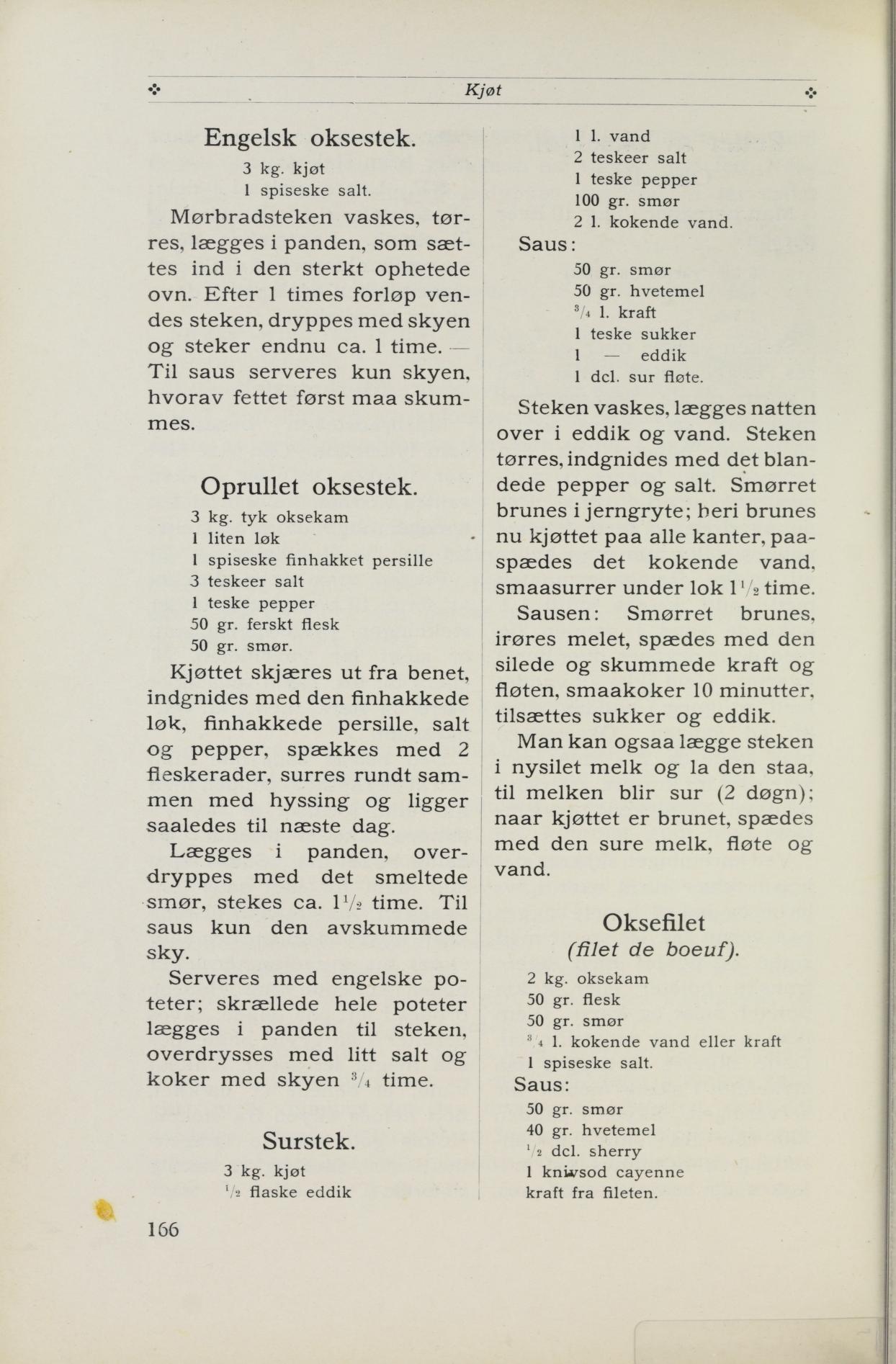
Original 1914 recipe
Verbatim from the first edition of the Big Cookbook.
Foto: Faksimile: Nasjonalbiblioteket
ProofreadPage 166
2 kg. oksekam
50 gr. flesk
50 gr. smør
1/4 l. kokende vand eller kraft
1 spiseske salt.
Saus:
50 gr. smør
40 gr. hvetemel
1/2 del. sherry
1 knivsodd cayenne
kraft fra fileten.
Kjøttet utskjæres fra benet med en skarp kniv: kjøttet er omgit av en hinde, og med kniven følger man denne; bankes litt, alt skind fjernes, spækkes med opskaarne fleskestrimler eller omvikles med flesk. Smørret brunes i stekepanden, heri brunes fileten paa alle sider, paaspædes det kokende vand, saltes, smaakoker under lok 1/2 time.
Saus: Smørret brunes, irøres melet, spædes litt efter litt med den silede kraft, 1/2—3/4 l., smaakoker i 10 minutter; tilsættes sherry, cayenne og salt efter smak. Til fileten serveres kokt makaroni, asparges, grønsaker, potetesroser, kastanjer, yorkshire-pudding og reven pepperrot.
Oksefilet kan overheldes med varm bernaisesaus.
NB. Paa benet kokes kraft, efterat alt kjøt er skrapet fra; kjøttet brukes til kjøtkaker f. eks.
📖1949
Revised 1949 recipe
From the revised edition of the Big Cookbook.
Foto: Faksimile: Nasjonalbiblioteket
ProofreadPage 195
Steken vaskes, legges natten over i eddik og vann. Steken tørres, inngnides med det blandede pepper og salt. Smøret brunes i jerngryte; heri brunes nu kjøttet på alle kanter, på spes det kokende vann, småkoker under lokk 1½–2 time.
Kjøttet utskjæres fra benet med en skarp kniv: kjøttet er omgitt av en hinne, og med kniven følger man denne; bankes litt, altskinnfjernes, spekkes med opskårne fleskestrimler eller omvikles med flesk. Smøret brunes i stekepannen, heri brunes fileten på alle sider, på spes det kokende vann, saltes, småkoker under lokk ½ time.
Sausen: Smør og mel langbrunes, spes med den silte og skummede kraft og fløten, småkoker 10 minutter, tilsettes sukker og eddik.
Man kan også legge steken i nysilt melk, og la den stå til melken blir sur (2 døgn); når kjøttet er brunet, spes med den sure melk, fløte og vann.
Saus: Smør og mel langbrunes, spes litt efter litt med den silte kraft, ½–¾ l., småkoker i 10 minutter; tilsettes sherry, kajenne og salt efter smak. Til fileten serveres kokt makaroni, asparges, grønnsaker, potetroser eller kastanjer, yorkshire-pudding og reven pepperrot.
Innredenser:
2 kg. oksekam
50 gr. flesk
50 gr. smør
¾ l. kokende vann eller kraft
pepper og salt
Saus:
50 gr. smør
40 gr. hvetemel
½ del. sherry
1 knivsodd kajenne
kraft fra fileten.
Oksefilen kan overhelles med varm béarnaisesaus.
NB. På benet kokes kraft, efterat alt kjøtt er skrapet fra; kjøttet brukes til kjøttkaker f. eks.
In stores now
Clean, minimally processed groceries matched to the ingredients — approximate prices.
1914 (proofread, p. 166) → Modernised~80% of the text changedremovedadded
2 kg. kg oksekam (filet skjæres ut). 50 gr. flesk g fersk sideflesk (til spekking eller bardering). 50 gr. g smør 1/4 l. (til bruning). 2,5 dl kokende vand vann eller kraft kraft. 1 spiseske ss salt. Saus: 50 gr. g smør (til sausen). 40 gr. g hvetemel 1/2 del. sherry (til sausen). 0,5 dl sherry. 1 knivsodd cayenne klype cayennepepper (knivsodd). 7 dl kraft fra fileten. Kjøttet utskjæres fileten (5–7,5 dl). Skjær kjøttet ut fra benet beinet med en skarp kniv: kjøttet kniv. Fileten er omgit omgitt av en hinde, og hinne – følg denne med kniven følger man denne; bankes litt, kniven. Bank kjøttet litt og fjern alt skind fjernes, spækkes skinn og sener.. Spekk fileten med opskaarne fleskestrimler oppskårne fleskestrimler, eller omvikles med flesk. Smørret brunes vikle flesk rundt den.. Brun smøret i stekepanden, heri brunes stekepannen og brun fileten paa på alle sider, paaspædes det sider. Spe med kokende vand, saltes, smaakoker vann eller kraft, salt, og la den småkoke under lok 1/2 time. Saus: Smørret brunes, irøres melet, spædes lokk i ca. 30 minutter.. Brun smøret, rør inn melet og spe litt efter etter litt med den silede kraft, 1/2—3/4 l., smaakoker silte kraften, 5–7,5 dl. La sausen småkoke i 10 minutter; tilsættes minutter og smak til med sherry, cayenne og salt efter smak. Til salt.. Server fileten serveres med kokt makaroni, asparges, grønsaker, potetesroser, grønnsaker, potetroser, kastanjer, yorkshire-pudding yorkshirepudding og reven revet pepperrot. Oksefilet Fileten kan overheldes også overhelles med varm bernaisesaus. NB. Paa benet kokes kraft, efterat bearnaisesaus.. Kok kraft på beinet etter at alt kjøt kjøttet er skrapet fra; skrapt av; det avskrapte kjøttet kan brukes til kjøtkaker f. eks. for eksempel kjøttkaker.
Note on Modernised
Mål er omregnet til dl/g, «1 knivsodd» er beholdt som liten klype cayenne. «Flesk» er angitt som fersk sideflesk til spekking eller bardering. Steketiden er beholdt som i originalen (småkoking under lokk).
After the meat is browned on all sides in butter, it is thinned with ¼ liter of boiling water or stock, salted, and simmered covered for ½ hour. Allow around 90 minutes in total including preparation and sauce.
Which cut is used, and how is it prepared?
The recipe uses 2 kg of beef loin. The meat is cut from the bone with a sharp knife – following the membrane that surrounds the meat – pounded lightly, all skin removed, and larded with cut strips of pork fat or wrapped with pork fat (50 g pork fat).
How is the sauce made?
50 g butter is browned, 40 g wheat flour is stirred in, and it is thinned little by little with the strained stock from the tenderloin, ½–¾ liter. The sauce simmers for 10 minutes and is seasoned with ½ dl sherry, a pinch of cayenne, and salt.
Where does the recipe come from?
From Henriette Schønberg Erken's Stor kokebok from 1914, page 166. It serves 8.