Skip to content

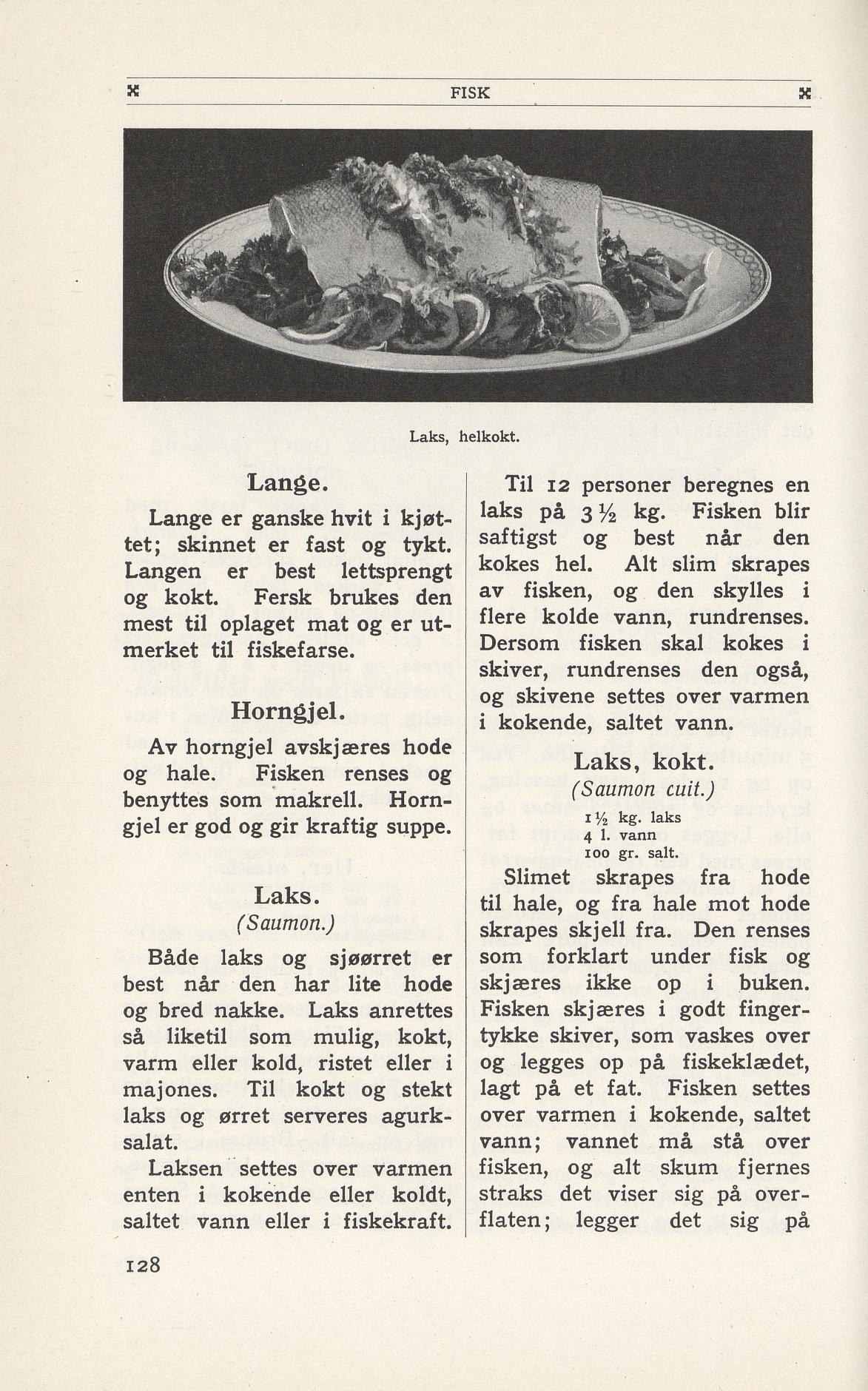
Salmon, boiled (saumon cuit)

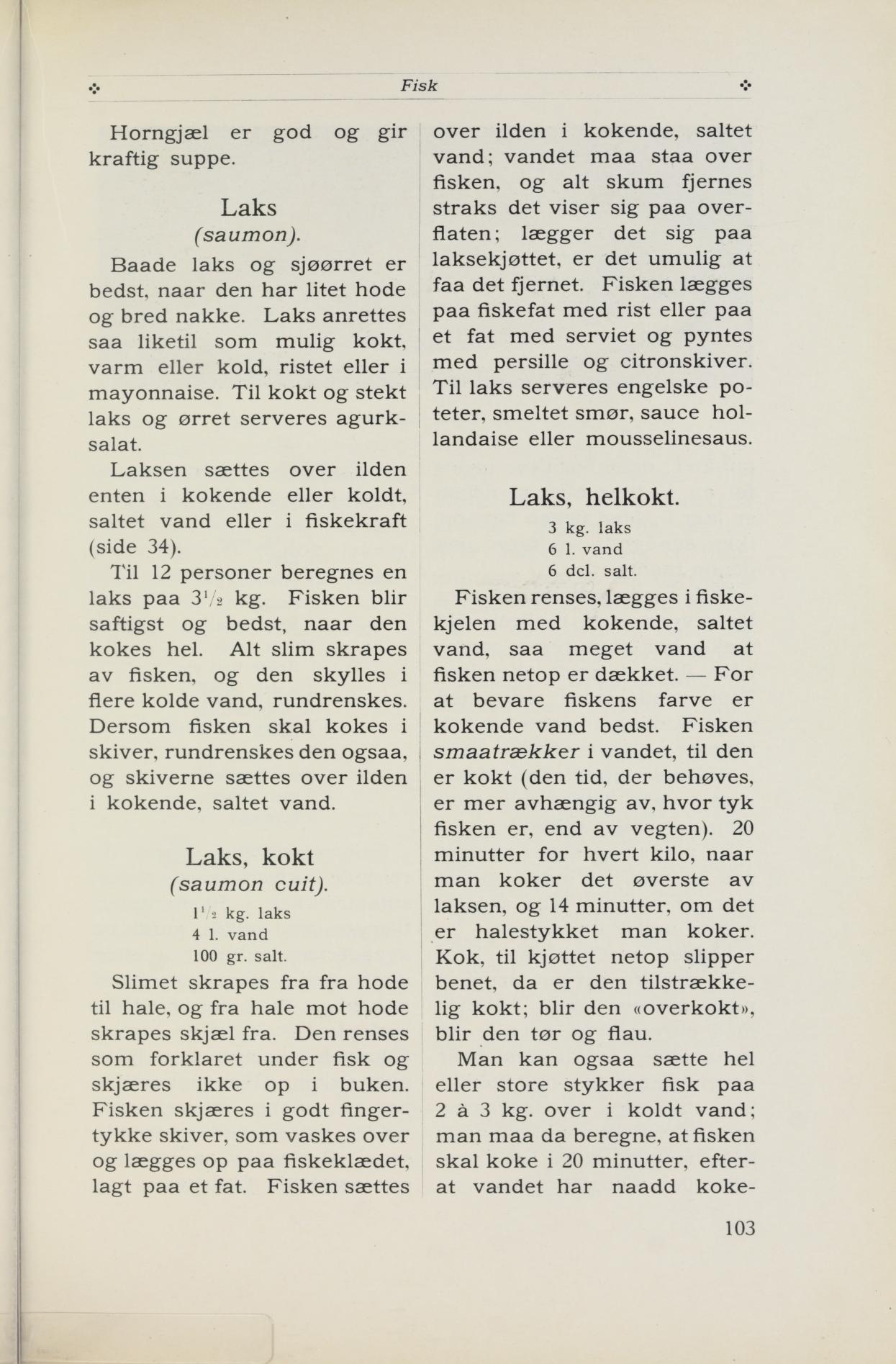
Erken's boiled salmon (1.5 kg) with an explanation of two cooking methods: cold water heated slowly (preserves the color less well, best for thin-skinned fish) or boiling salted water for salmon and fish pieces. Arranged with melted butter, lemon, parsley, tomato, chopped cooked roe, and lettuce; served with hollandaise or mousseline sauce.

Source: Henriette Schønberg Erken, Stor kokebok, 1914-utg. s. 103 (falt i det fri)

Be the first to rate

About the dish

This variant shows Erken's alternative method: putting the fish on to cook in cold water and letting it slowly reach the boiling point. She notes that the color does not turn out as fine, but the method suits fish with thin skin. The recipe ends with a period-typical presentation of cooked roe and tomato slices.

How to make it

  1. 1

    Clean the fish

    Scrape the slime and scales off the fish, rinse it well in cold water, and gut it without slitting the belly. If the fish is to be cooked in slices, cut it into good finger-thick slices and rinse them.

  2. 2

    Score the skin

    On whole-poached fish, make a couple of small cuts in the skin along the back, so it does not split as easily during cooking.

  3. 3

    Cold or boiling water

    Whole fish or large pieces of 2–3 kg can be put on to cook in cold, salted water. Fish with thin skin that splits easily (mackerel, herring) is always put on in cold or lukewarm water, while salmon and fish cut into pieces are put on in boiling, salted water.

  4. 4

    Bring to a boil slowly

    With the cold-water method, the water should not reach the boiling point until about 45 minutes after the fish has been put in. Then allow 20 minutes of cooking after the water has reached the boiling point. The water must never boil hard.

  5. 5

    Skim

    Remove all scum as soon as it appears on the surface, otherwise it sticks to the fish flesh.

  6. 6

    Plating

    Place the salmon on a platter with a warm napkin, drizzle melted butter over it, and garnish with lemon slices, parsley, and tomato slices. Lay a strip of finely chopped cooked roe and finely cut lettuce diagonally across the fish.

  7. 7

    Serve

    Serve with hollandaise sauce, melted butter with parsley, or mousseline sauce.

Changes from the original

The measurements are kept, but water and salt are given in modern units (liters/grams). Accompaniments (roe, salad, lemon, tomato) have been entered as separate ingredients with 'as needed.' The method is divided into numbered steps.

In stores now

Clean, minimally processed groceries matched to the ingredients — approximate prices.

Product data and prices via Kassalapp. Prices are updated daily and may vary.

Time machine – what changed?

Pick two editions and see what Henriette Schønberg Erken added, removed or changed between them.

1949 (proofread, p. 128) → Modernised~87% of the text changedremovedadded
i % kg. 1,5 kg laks (hel eller i skiver). 4 1. vann ioo gr. l vann. 100 g salt. Slimet skrapes fra hode smeltet smør (til å dryppe over og til hale, servering). sitronskiver (til pynt). persille (til pynt). tomatskiver (til pynt). kokt rogn (finhakket, til pynt). salat (finskåret, til pynt). Skrap slim og fra hale mot hode skrapes skjell fra. Den renses som forklart under fisk av fisken, skyll den godt i kaldt vann og skjæres ikke op rundrens den. Skal fisken kokes i buken. Fisken skiver, skjæres den i godt fingertykke skiver, skiver som vaskes over.. På helkokt fisk gjøres et par små snitt i skinnet langs ryggen, så det ikke så lett revner under kokingen.. Hel fisk eller store stykker på 2–3 kg kan settes over i kaldt, saltet vann. Fisk med tynt skinn som lett revner (makrell, sild) settes alltid over i kaldt eller lunkent vann, mens laks og legges op på fiskeklædet, lagt på et fat. Fisken fisk skåret i stykker settes over varmen i kokende, saltet vann; vann.. Ved kaldtvannsmetoden bør vannet ikke nå kokepunktet før ca. 45 minutter etter at fisken er lagt i. Regn deretter 20 minutters koking etter at vannet har nådd kokepunktet. Vannet må stå over fisken, og aldri fosskoke.. Fjern alt skum fjernes straks det viser sig på overflaten; legger det sig seg på laksekjøttet, er det umulig å få overflaten, ellers setter det fjernet. Fisken legges seg fast på fiskefat med rist eller fiskekjøttet.. Legg laksen på et fat med serviett varm serviett, drypp over smeltet smør og pyntes pynt med sitronskiver, persille og sitronskiver. Til laks serveres engelske poteter, tomatskiver. Legg en stripe finhakket, kokt rogn og finskåret salat på skrå over fisken.. Server med hollandsk saus, smeltet smør, sauce hollandaise, mousselinesaus eller smørsaus: 250 gr. smør irøres 2 eggeplommer, salt, 2 spiseskjeer hakket med persille og saft av y 2 sitron. eller mousselinesaus.

Note on Modernised

Målene er beholdt, men vann og salt er angitt i moderne enheter (liter/gram). Tilbehør (rogn, salat, sitron, tomat) er ført inn som egne ingredienser med «etter behov». Metoden er delt i nummererte trinn.

Community interpretations

Be the first to share your own version.

See interpretations →

Frequently asked questions

Should the salmon be put in boiling or cold water?
Salmon has tough skin and is usually put in boiling water – the same goes for fish cut into pieces. Fish with thin skin that splits easily, e.g. mackerel and herring, are put on in cold or lukewarm water.
How much salt and water should I use?
The recipe uses 4 liters of water and 100 grams of salt for 1½ kg of salmon.
How long does a whole salmon cook?
If you put whole fish or large pieces (2–3 kg) in cold water, it should cook 20 minutes after the water has reached the boiling point, and the boiling point should not be reached until about ¾ hour after the fish has been put in. The drawback is that the fish does not keep its color as well.
How do I keep the skin from splitting?
Make a couple of small cuts in the skin along the back of whole-poached fish, and let the water steep/simmer so the fish becomes tender without the water boiling hard.

Related recipes

More dishes in the same category from the archive

Read also

Kommentarer

Ingen kommentarer ennå. Bli den første til å dele!