Skip to content

Croquettes and Rissoles

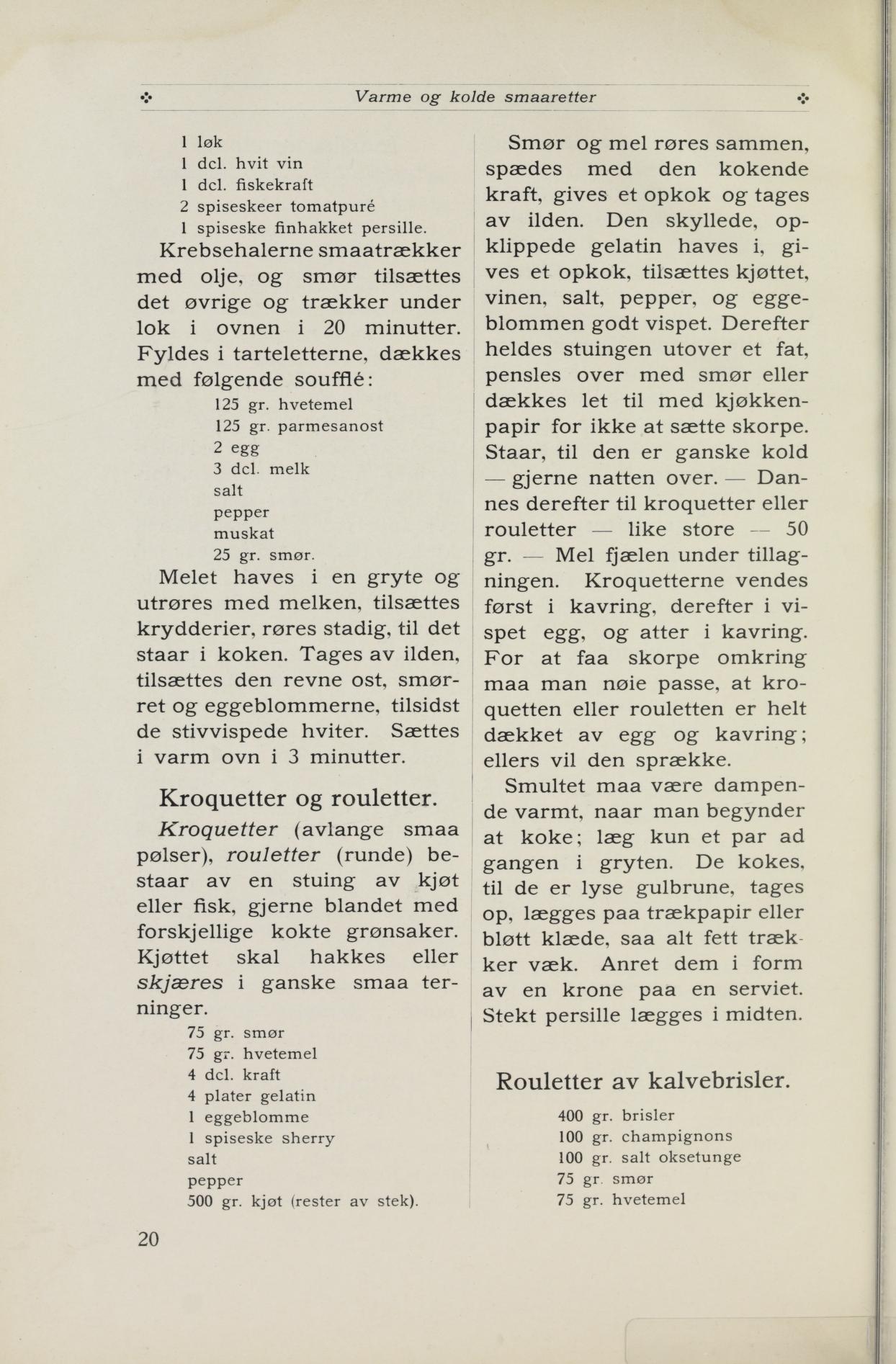
Erken's basic recipe for croquettes and rissoles: a thick stew of roux, meat stock, gelatin, egg yolk, sherry and 500 g finely chopped roast leftovers is cooled completely, shaped into 50 g pieces, breaded in breadcrumbs-egg-breadcrumbs and deep-fried golden brown. Served in a wreath with deep-fried parsley.

Source: Henriette Schønberg Erken, Stor kokebok, 1914-utg. s. 20 (falt i det fri)

Be the first to rate

About the dish

The basic recipe for croquettes and rissoles in the chapter "Varme og kolde smaaretter" (Hot and Cold Small Dishes). Erken uses roast leftovers – a typical thrift dish from the household around 1914, in which a set stew is shaped, breaded and deep-fried in lard.

How to make it

  1. 1

    Prepare the meat

    Chop or cut the cooked/roasted meat into fairly small dice. Any cooked vegetables can be mixed in.

  2. 2

    Make the stew

    Stir together butter and flour in a pot, thin with the boiling stock and bring to a boil. Take the pot off the heat.

  3. 3

    Gelatin and seasoning

    Rinse the gelatin sheets, cut them up and stir them into the stew. Bring to a boil so the gelatin is completely dissolved. Add the meat, the sherry, salt, pepper and a well-beaten egg yolk.

  4. 4

    Cool

    Pour the stew out over a platter, brush the surface with butter or cover loosely with kitchen paper so no skin forms. Let it stand until completely cold, preferably overnight.

  5. 5

    Shape the croquettes

    Divide the mass into equal pieces of about 50 g and shape them on a floured board into small oblong logs (croquettes) or round balls (rissoles).

  6. 6

    Bread

    Turn first in breadcrumbs, then in beaten egg, and finally in breadcrumbs again. Take care that the entire surface is covered, or they will burst during deep-frying.

  7. 7

    Deep-fry

    Heat the frying oil well (about 180 °C (355 °F)). Add only a couple of croquettes at a time and deep-fry them light golden brown.

  8. 8

    Plating

    Lift them out and place them on absorbent paper or a soft cloth so all the fat drains off. Arrange in a wreath on a napkin with deep-fried parsley in the center.

Changes from the original

Deciliters and grams are kept, but "4 del. kraft" is written as 4 dl. Gelatin sheets are given as sheets (about 2 g each). Lard for deep-frying has been replaced with neutral frying oil (or lard if preferred). "Kavring" is modernized to crushed rusks/breadcrumbs. Breading in egg requires 1–2 eggs, which is not specified in the original.

In stores now

Clean, minimally processed groceries matched to the ingredients — approximate prices.

Product data and prices via Kassalapp. Prices are updated daily and may vary.

Time machine – what changed?

Pick two editions and see what Henriette Schønberg Erken added, removed or changed between them.

Pick two different editions to see a comparison.

Community interpretations

Be the first to share your own version.

See interpretations →

Frequently asked questions

What is the difference between croquettes and rissoles?
According to the recipe, croquettes are oblong, small log shapes, while rissoles are round. Both are made from the same stew of meat or fish, preferably mixed with cooked vegetables.
Why is gelatin used in the stew?
The 4 sheets of gelatin make the cooled stew set firmly enough to be shaped into croquettes or rissoles. The gelatin is rinsed, cut up and brought to a boil in the finished, off-the-heat sauce.
Why is the total time so long (12 hours)?
The preparation itself goes quickly, but the stew must stand until it is completely cold and firm before it is shaped – which is why it is usually made the day before.
Which meat can be used?
The recipe uses 500 g meat, preferably roast leftovers. The meat should be chopped or cut into fairly small dice; fish can be used instead.

Related recipes

More dishes in the same category from the archive

Read also

Kommentarer

Ingen kommentarer ennå. Bli den første til å dele!