Skip to content

Meat aspic

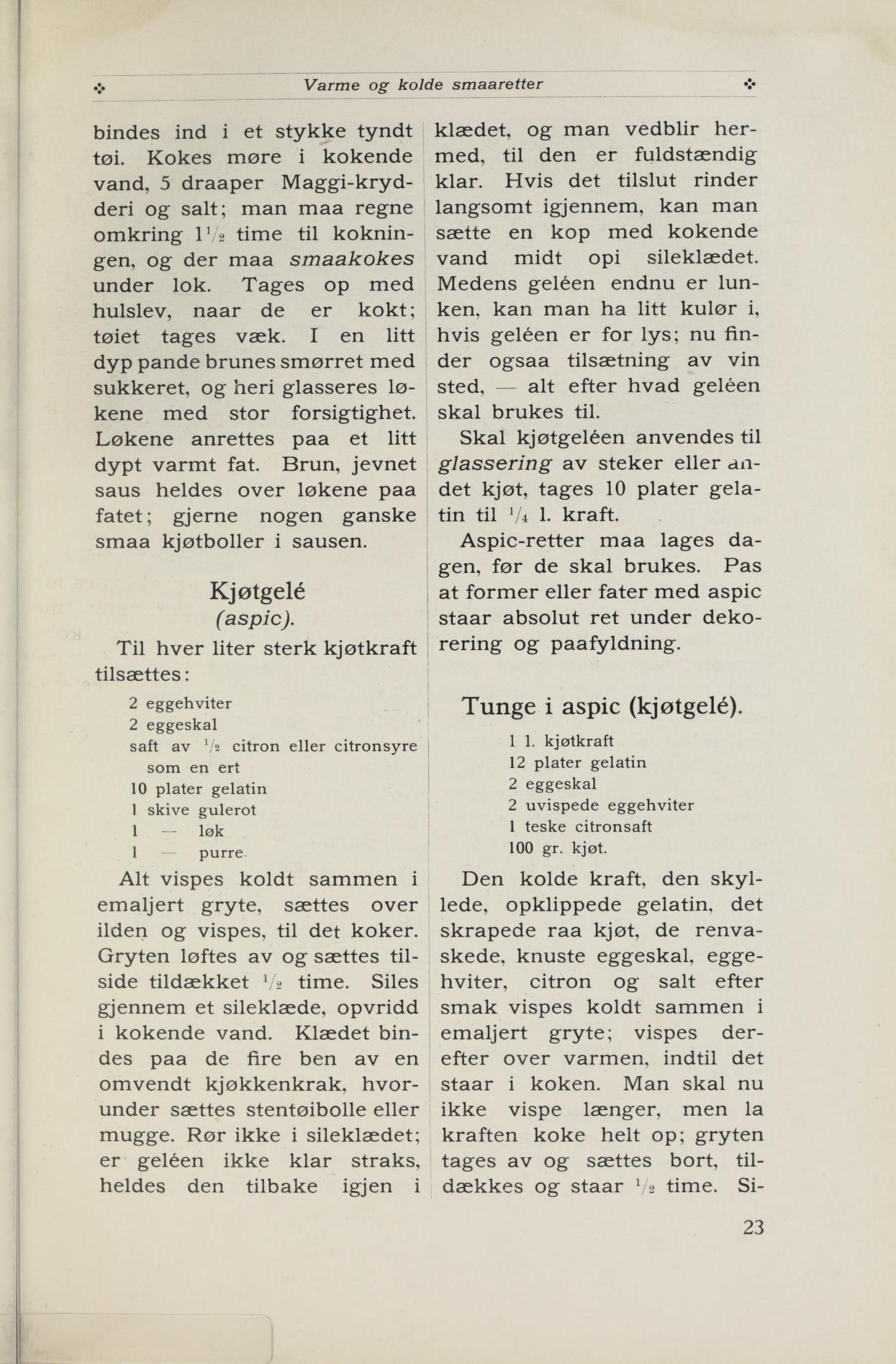
Classic clarified meat aspic from Erken's Stor kokebok 1914: meat stock is clarified with egg white and eggshell, gelatin, lemon and vegetables are added, it is brought to a boil, strained through a cloth and seasoned with wine and optionally coloring. Used for glazing and aspic molds.

Source: Henriette Schønberg Erken, Stor kokebok, 1914-utg. s. 23 (falt i det fri)

Be the first to rate

About the dish

Meat aspic was the foundation of the cold kitchen around 1914. Clear aspic was used to glaze roasts, mold shapes and garnish cold platters, and clarifying with egg white and eggshell was the housewife's test of craft. Erken stresses that aspic dishes must be made the day before.

How to make it

  1. 1

    Mix everything cold

    Put cold meat stock, egg whites, crushed eggshells, lemon juice, cut-up gelatin, carrot slice, onion and leek in an enameled pot and whisk everything well together while it is cold.

  2. 2

    Boil while whisking

    Set the pot over the heat and whisk steadily until the stock boils. Stop whisking and let it come fully to a boil.

  3. 3

    Let the clarification settle

    Lift off the pot, cover it and set it aside for about 30 minutes.

  4. 4

    Strain the aspic

    Strain the stock through a cloth wrung out in boiling water. Do not stir in the cloth. If the aspic is not clear at once, pour it back into the cloth and repeat until it is completely clear. If it finally runs slowly, a cup of boiling water can be set in the middle of the cloth.

  5. 5

    Season

    While the aspic is still lukewarm, it can be colored with a little caramel coloring if it is too pale, and wine can be added depending on what it is to be used for.

  6. 6

    For glazing

    If the aspic is to be used to glaze roasts or other meat, use 10 gelatin sheets to 2.5 dl stock.

  7. 7

    Set

    Aspic dishes are made the day before they are to be used. Make sure the molds and platters stand perfectly level during decorating and filling.

Changes from the original

Amounts are converted to modern measures (gelatin given as number of sheets, about 1.7 g per sheet), 'citric acid the size of a pea' is given as a knife point, and the method is rewritten in steps. Straining over an upturned kitchen stool is described as straining through a cloth in a sieve or over a stand.

In stores now

Clean, minimally processed groceries matched to the ingredients — approximate prices.

Product data and prices via Kassalapp. Prices are updated daily and may vary.

Time machine – what changed?

Pick two editions and see what Henriette Schønberg Erken added, removed or changed between them.

1949 (proofread, p. 32) → Modernised~81% of the text changedremovedadded
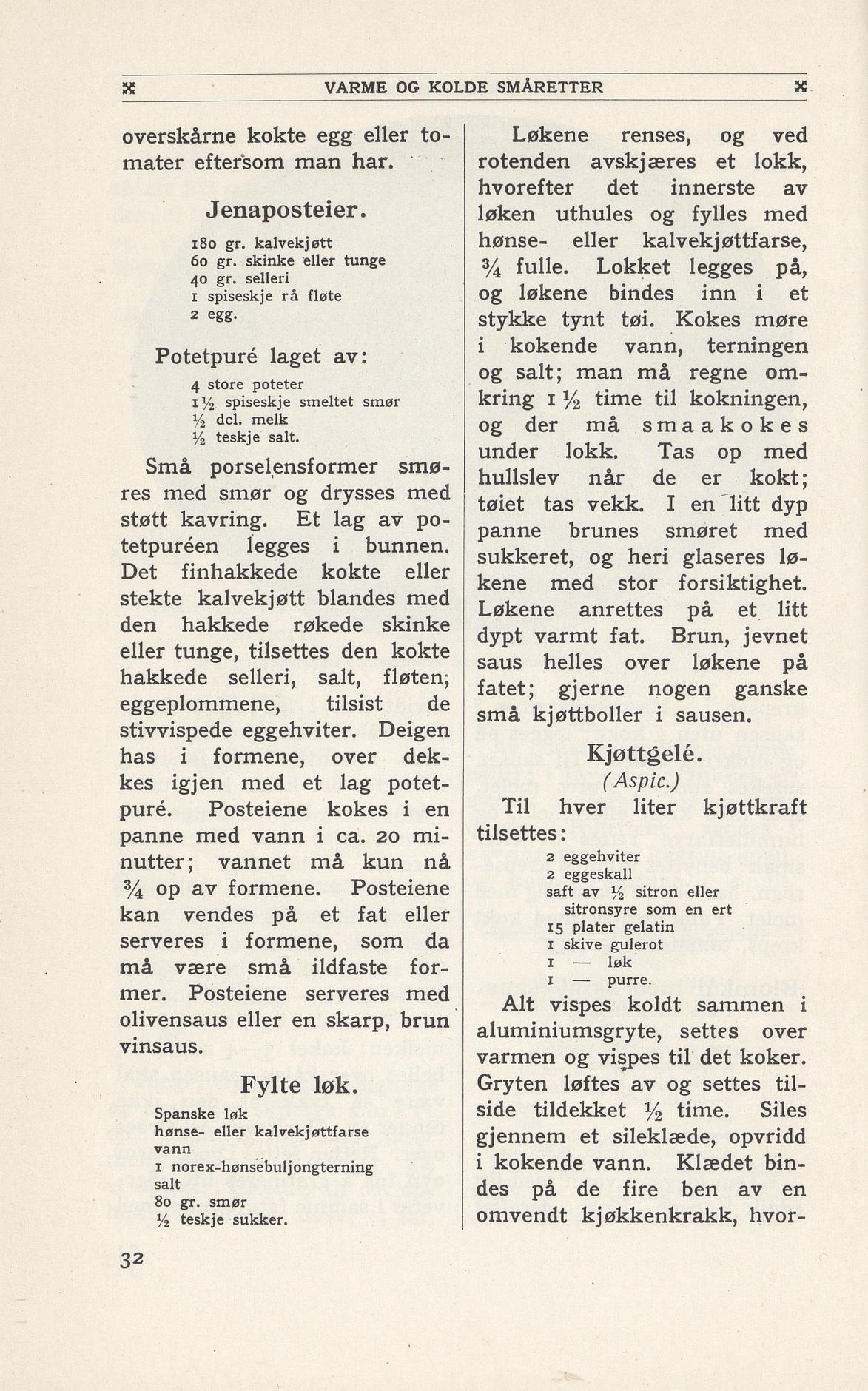
( Aspic.) Til hver liter 1 l sterk kjøttkraft tilsettes: (kald og godt avfettet). 2 stk eggehviter (uvispede). 2 stk eggeskall saft av ½ (godt renvasket og knust). 0,5 stk sitron (saften; eller sitronsyre som en ert 15 knivsodd sitronsyre). 10 plater gelatin (skylt og klippet opp). 1 skive gulerot gulrot. 1 — løk stk løk. 1 — stk purre. Alt vispes koldt sammen salt (etter smak). sukkerkulør (om geléen er for lys). vin (etter hva geléen skal brukes til). Ha kald kjøttkraft, eggehviter, knuste eggeskall, sitronsaft, oppklippet gelatin, gulrotskive, løk og purre i aluminiumsgryte, settes en emaljert gryte og visp alt godt sammen mens det er kaldt.. Sett gryten over varmen og vispes visp jevnt til det kraften koker. Gryten løftes av Slutt å vispe og settes la den koke helt opp.. Løft gryten av, dekk den til og la den stå til side tildekket ½ time. Siles gjennem i ca. 30 minutter.. Sil kraften gjennom et sileklæde, opvridd klede vridd opp i kokende vann. Klædet bindes på de fire ben av en omvendt kjøkkenkrakk, hvorunder settes stentøibolle eller mugge. Rør ikke i sileklædet; er kledet. Er geléen ikke klar straks, helles med én gang, hell den tilbake igjen i klædet, kledet og man vedblir hermed gjenta til den er fullstendig helt klar. Hvis det tilslutt renner langsomt igjennem, Renner den til slutt langsomt, kan man sette en kopp med kokende vann settes midt opi sileklædet. Hvis i kledet.. Mens geléen ennå er for lys, lunken, kan man mens den ennu er lunken, ha i farges med litt kulør. Nu kan også tilsetning av sukkerkulør om den er for lys, og tilsettes vin finne sted — alt efter hvad geléen etter hva den skal brukes til. til.. Skal kjøttgeléen anvendes geléen brukes til glasering av å glasere steker eller annet kjøtt, tas brukes 10 plater gelatin gelatinplater til ¾ 1 kraft. 2,5 dl kraft.. Aspikretter lages dagen før de skal brukes. Pass på at former og fat står helt vannrett under dekorering og påfylling.

Note on Modernised

Mengder er omregnet til moderne mål (gelatinplater angitt i antall, ca. 1,7 g pr. plate), «citronsyre som en ert» er angitt som en knivsodd, og fremgangsmåten er skrevet om i trinn. Silingen over en omvendt kjøkkenkrakk er beskrevet som siling gjennom klede i sil eller over stativ.

Community interpretations

Be the first to share your own version.

See interpretations →

Frequently asked questions

Why are egg whites and eggshells used in the aspic?
They clarify the stock. Egg whites and crushed eggshells are whisked cold into the stock and coagulate when it is boiled — impurities bind to this foam, which is then strained off. The result is a completely clear aspic.
How much gelatin and acid are needed per liter of stock?
Per liter of strong meat stock: 10 sheets gelatin, 2 egg whites, 2 eggshells and the juice of ½ lemon (or citric acid the size of a pea), plus a slice of carrot, an onion and a leek for flavor.
What do I do if the aspic does not come out clear?
Do not stir in the straining cloth. Pour the aspic gently back into the cloth and strain again, repeating until it is completely clear. If it finally runs slowly, you can set a cup of boiling water in the middle of the cloth. The cloth is wrung out in boiling water before use and tied to the legs of an upturned kitchen stool with a bowl underneath.
How long does the recipe take?
Reckon on about 5 hours in all: boiling and clarifying, ½ hour covered resting before straining, then straining and the time for the aspic to set.

Related recipes

More dishes in the same category from the archive

Read also

Kommentarer

Ingen kommentarer ennå. Bli den første til å dele!