Skip to content

Caramel Custard II (pouding au caramel)

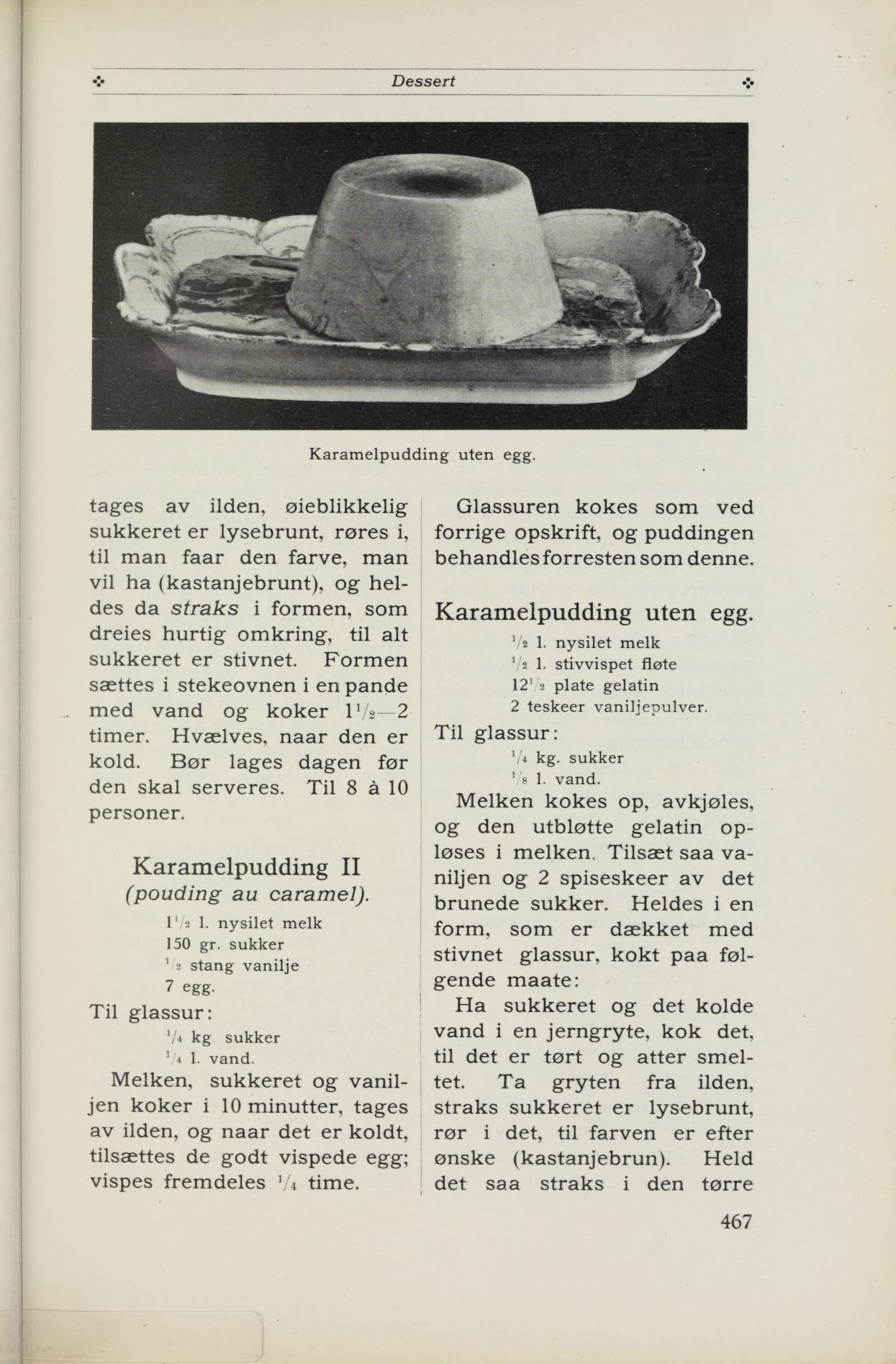
Classic caramel custard (crème caramel) from Erken 1914: 1.5 l milk boiled with 150 g sugar and vanilla bean, cooled, 7 beaten eggs stirred in and whisked half an hour. Poured into a mold glazed with caramel from 250 g sugar and 1 dl water, steamed in a water bath 1½–2 hours and turned out cold. Serves 8–10.

Source: Henriette Schønberg Erken, Stor kokebok, 1914-utg. s. 467 (falt i det fri)

Be the first to rate

About the dish

Caramel custard is one of the classic desserts in Erken's "Stor kokebok." This variant is listed as no. II in a series of caramel custards, and refers to the preceding recipe for cooking the caramel glaze and for steaming in a water bath in the oven.

How to make it

  1. 1

    Boil the milk

    Boil the milk, sugar and the split vanilla bean for 10 minutes. Take the pot off the burner and let the mixture become completely cold.

  2. 2

    Whisk in the eggs

    Whisk the eggs well and stir them into the cold milk. Continue whisking for half an hour, and strain the mixture.

  3. 3

    Cook the caramel glaze

    Put the sugar and the cold water in a heavy-bottomed pot. Cook until the mixture is dry and the sugar melts again. Take the pot off the burner as soon as the sugar is light brown, and stir until the color is chestnut brown.

  4. 4

    Glaze the mold

    Pour the caramel immediately into a dry pudding mold and turn the mold around until all the sugar has set and the entire mold is glazed.

  5. 5

    Steam the custard

    Pour the egg-milk mixture into the mold. Place the mold in a roasting pan with water in the oven and let the custard cook 1½–2 hours at about 150 °C (300 °F), until it has set.

  6. 6

    Cool and turn out

    Let the custard become completely cold before turning it out. It should be made the day before it is to be served.

Changes from the original

Amounts have been converted to modern measures (dl/gram). Unclear OCR figures for the glaze are interpreted as 1/4 kg sugar and 1 dl water. The method for the glaze and steaming, which the original refers to in the "previous recipe," has been written out in the steps: caramelizing the sugar, molding, and cooking in a water bath about 1½–2 hours.

In stores now

Clean, minimally processed groceries matched to the ingredients — approximate prices.

Product data and prices via Kassalapp. Prices are updated daily and may vary.

Tidsmaskin – hva endret seg?

Velg to utgaver og se hva Henriette Schønberg Erken la til, fjernet eller endret mellom dem.

1914 (korrekturlest, s. 467)1949 (korrekturlest, s. 534)~52% av teksten endretfjernetlagt til
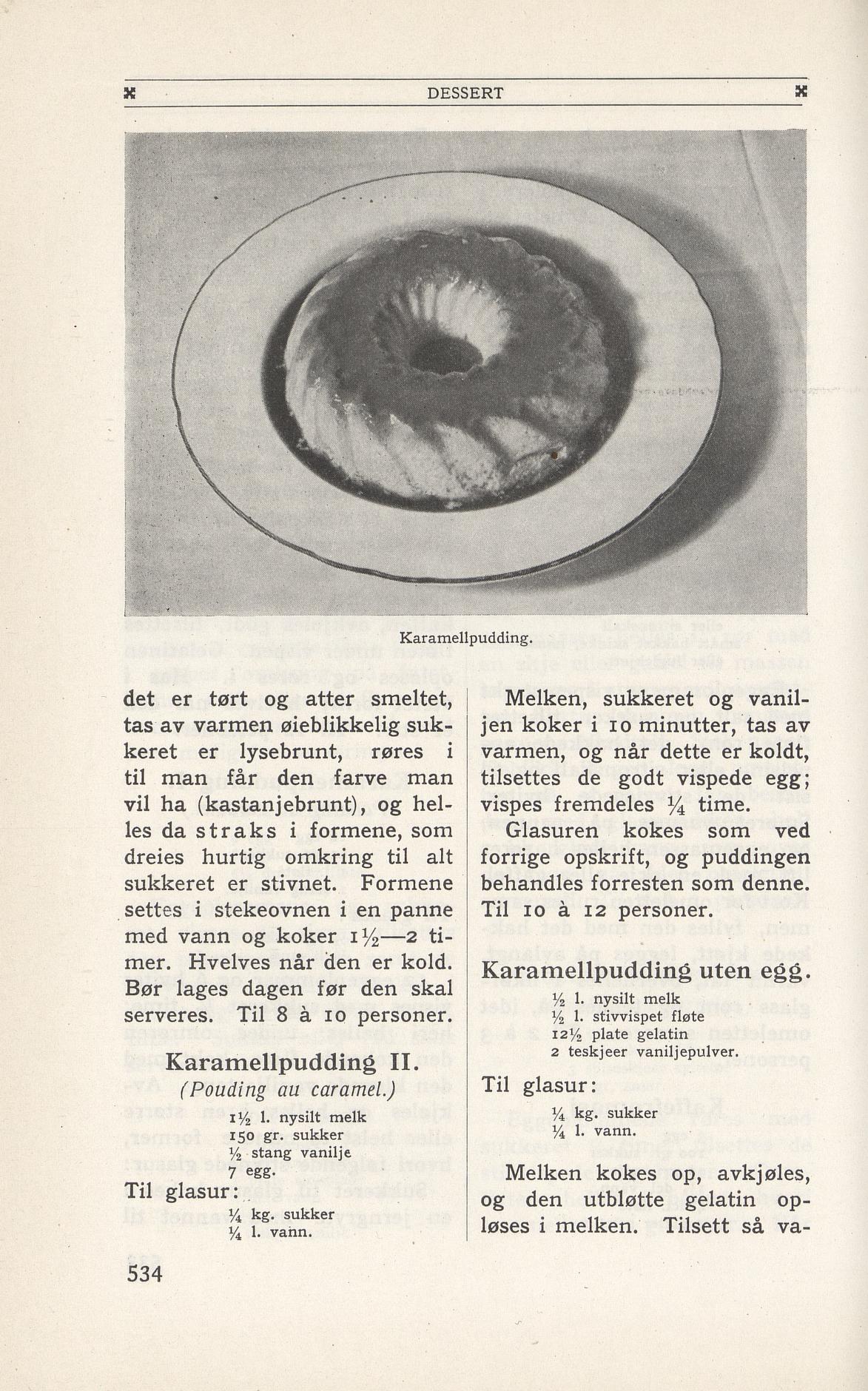
1 1/2 l. nysilet nysilt melk 150 gr. sukker 7 egg 1 ½ stang vanilje. vanilje 7 egg. Til glassur: 1/4 kg. glasur: ¾ l. sukker 1/4 ¾ l. vand. vann. Melken, sukkeret og vaniljen koker i 10 minutter, tages tas av ilden, varmen, og naar det når dette er koldt, tilsættes tilsettes de godt vispede egg; vispes fremdeles 1/2 ¾ time. Glassuren Glasuren kokes som ved forrige opskrift, og puddingen behandles forresten som denne. Til 10 å 12 personer.
Community interpretations

Be the first to share your own version.

See interpretations

Frequently asked questions

How long should the milk boil?
The milk, sugar and vanilla are boiled for 10 minutes. Then the mixture is taken off the burner and must become completely cold before the well-beaten eggs are stirred in.
Why must the eggs be added only when the milk is cold?
If the milk is too warm, the eggs coagulate and the custard becomes grainy. Once the mixture is cold, it is whisked for another half hour so that it becomes smooth and airy.
What do I need for the recipe?
1 1/2 liters of freshly strained milk, 150 g sugar, 7 eggs and 1 vanilla bean. For the caramel glaze (which is burned in the mold) use 1/4 kg sugar and 1/4 liter water.
Why is the total time so long?
The cooking itself takes little time, but the custard requires cooling of the milk, half an hour of whisking, baking in a water bath and then long chilling — preferably overnight — before it is turned out. The recipe is from Henriette Schønberg Erken's "Stor kokebok" (1914), p. 467.

Related recipes

More dishes in the same category from the archive

Read also

Kommentarer

Ingen kommentarer ennå. Bli den første til å dele!