Skip to content

Egg-Free Caramel Custard (Karamellpudding uten egg)

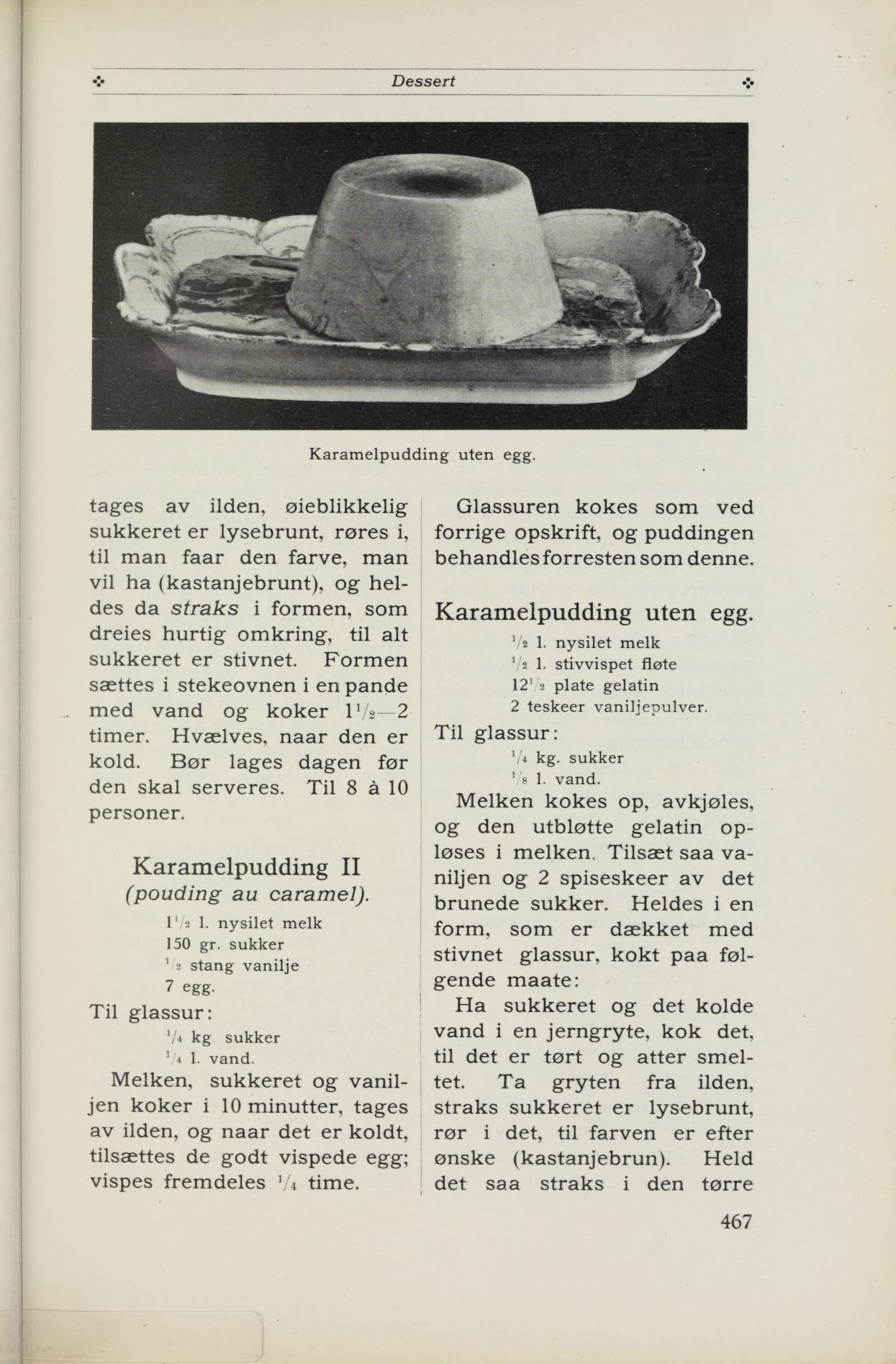
Egg-free caramel custard from Erken 1914: 5 dl boiled milk with 1½–2 gelatin sheets, vanilla powder and 2 tbsp browned sugar, folded with 5 dl stiffly whipped cream and set in a mold glazed with caramel from 250 g sugar and a little water. Make the day before serving.

Source: Henriette Schønberg Erken, Stor kokebok, 1914-utg. s. 467 (falt i det fri)

Be the first to rate

About the dish

This variant of caramel custard is made without eggs, using gelatin and stiffly whipped cream instead. It is not cooked in a water bath but sets cold in a mold glazed with caramel — an early form of caramel mousse.

How to make it

  1. 1

    Cook the caramel glaze

    Put the sugar and the cold water in a heavy-bottomed pot. Cook until the mixture is dry and the sugar melts again. Take the pot off the burner as soon as the sugar is light brown and stir until the color is chestnut brown. Set aside 2 tablespoons of the caramel.

  2. 2

    Glaze the mold

    Pour the rest of the caramel immediately into a dry mold and turn the mold around until the sugar has set and the mold is coated.

  3. 3

    Milk and gelatin

    Bring the milk to a boil and let it cool slightly. Soak the gelatin in cold water, squeeze it out and dissolve it in the warm milk.

  4. 4

    Flavor

    Stir in the vanilla powder and the 2 tablespoons of browned sugar. Let the mixture cool until it begins to thicken.

  5. 5

    Fold in the cream

    Gently fold the stiffly whipped cream into the half-set milk mixture.

  6. 6

    Chill

    Pour the mixture into the glazed mold and chill until firm. The custard should be made the day before serving, and turned out just before serving.

Changes from the original

Measurements have been converted to dl and grams, and gelatin sheets are given by count. Unclear OCR figures are interpreted as 1/2 l milk, 1/2 l cream, 1½ sheet gelatin, 1/4 kg sugar and 1¼ dl water. The steps clarify that the cream is folded into the half-set milk mixture, and that the custard must be kept cold.

In stores now

Clean, minimally processed groceries matched to the ingredients — approximate prices.

Product data and prices via Kassalapp. Prices are updated daily and may vary.

Tidsmaskin – hva endret seg?

Velg to utgaver og se hva Henriette Schønberg Erken la til, fjernet eller endret mellom dem.

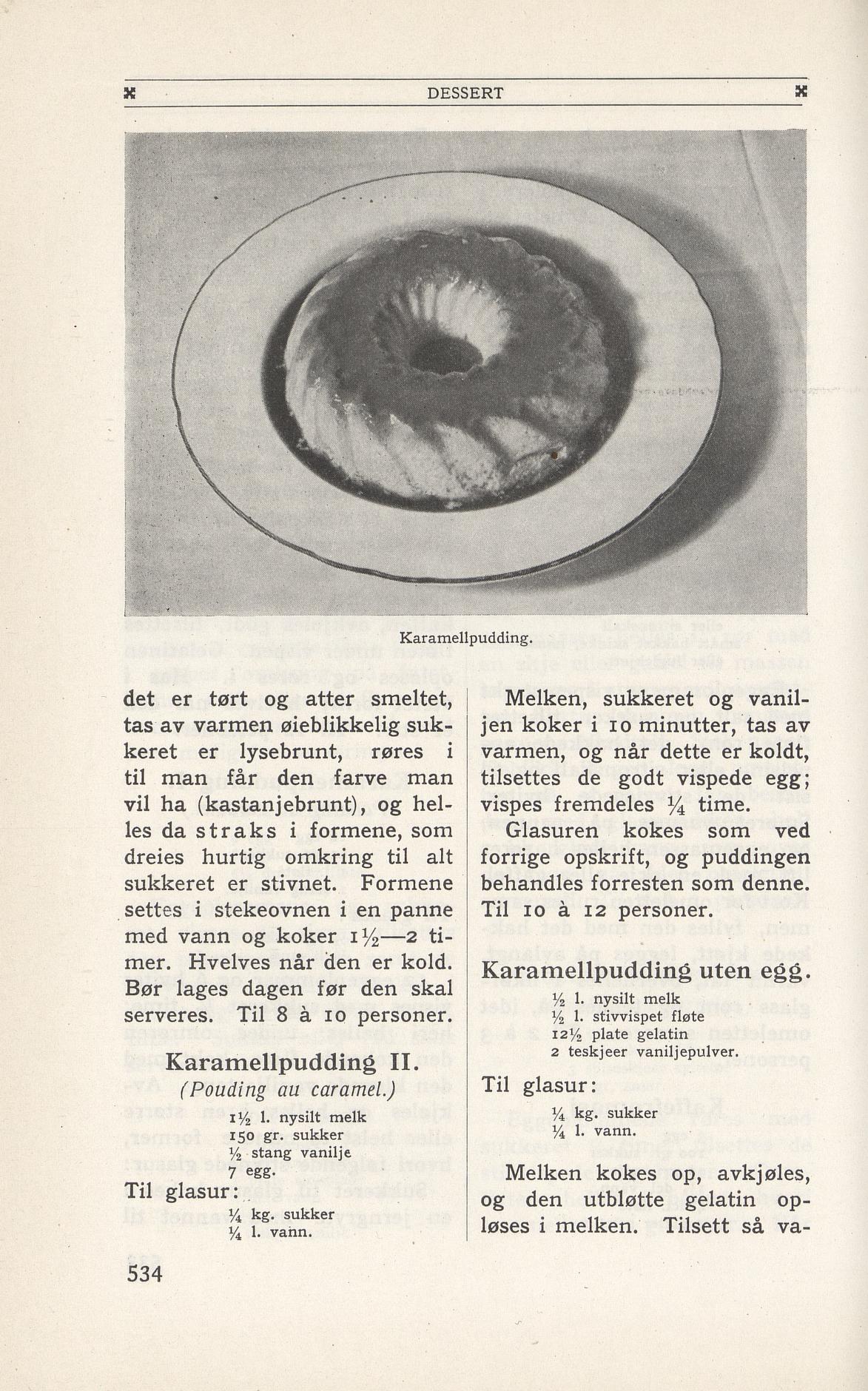
1914 (korrekturlest, s. 467)1949 (korrekturlest, s. 534)~48% av teksten endretfjernetlagt til
1/2 ½ l. nysilet nysilt melk 1/2 ½ l. stivvispet fløte 1 1/2 12½ plate gelatin 2 teskeer teskjeer vaniljepulver. Til glassur: 1/4 glasur: ¾ kg. sukker 1/8 ¼ l. vand. vann. Melken kokes op, avkjøles, og den utbløtte gelatin opløses i melken. Tilsæt saa Tilsett så vaniljen og 2 spiseskeer av det brunede sukker. Heldes i en form, som er dækket med stivnet glassur, kokt paa følgende maate: Ha sukkeret fløten. Sukkeret og det kolde vand vann i en jerngryte, kok det, det til det er tørt og atter smeltet. Ta gryten fra ilden, varmen straks sukkeret er lysebrunt, rør i det, det til farven er efter ønske (kastanjebrun). Held (kastanjebrunt). Hell det saa straks i den tørre form og drei den omkring, omkring til sukkeret er stivnet. Puddingen bør lages dagen før den skal serveres. Til 8 å 10 personer.
Community interpretations

Be the first to share your own version.

See interpretations

Frequently asked questions

How does this egg-free caramel custard set?
It is set with gelatin — 1½ sheet of gelatin is soaked and dissolved in the boiled, cooled milk. Then it is combined with stiffly whipped cream, vanilla and a little of the browned sugar.
How far in advance should the custard be made?
The recipe recommends making it the day before serving, that is, about 12 hours in the refrigerator, so that it sets completely.
How do I make the caramel glaze in the mold?
Boil 1/4 kg sugar with 1/8 l cold water in an iron pot until it is dry and melts again. Take the pot off as soon as the sugar is light brown, stir until the color is chestnut brown, pour it immediately into the dry mold and turn the mold around until the sugar sets.
Where does the recipe come from?
From Henriette Schønberg Erken's "Stor kokebok" (1914), page 467. It is intended for 6 servings.

Related recipes

More dishes in the same category from the archive

Read also

Kommentarer

Ingen kommentarer ennå. Bli den første til å dele!