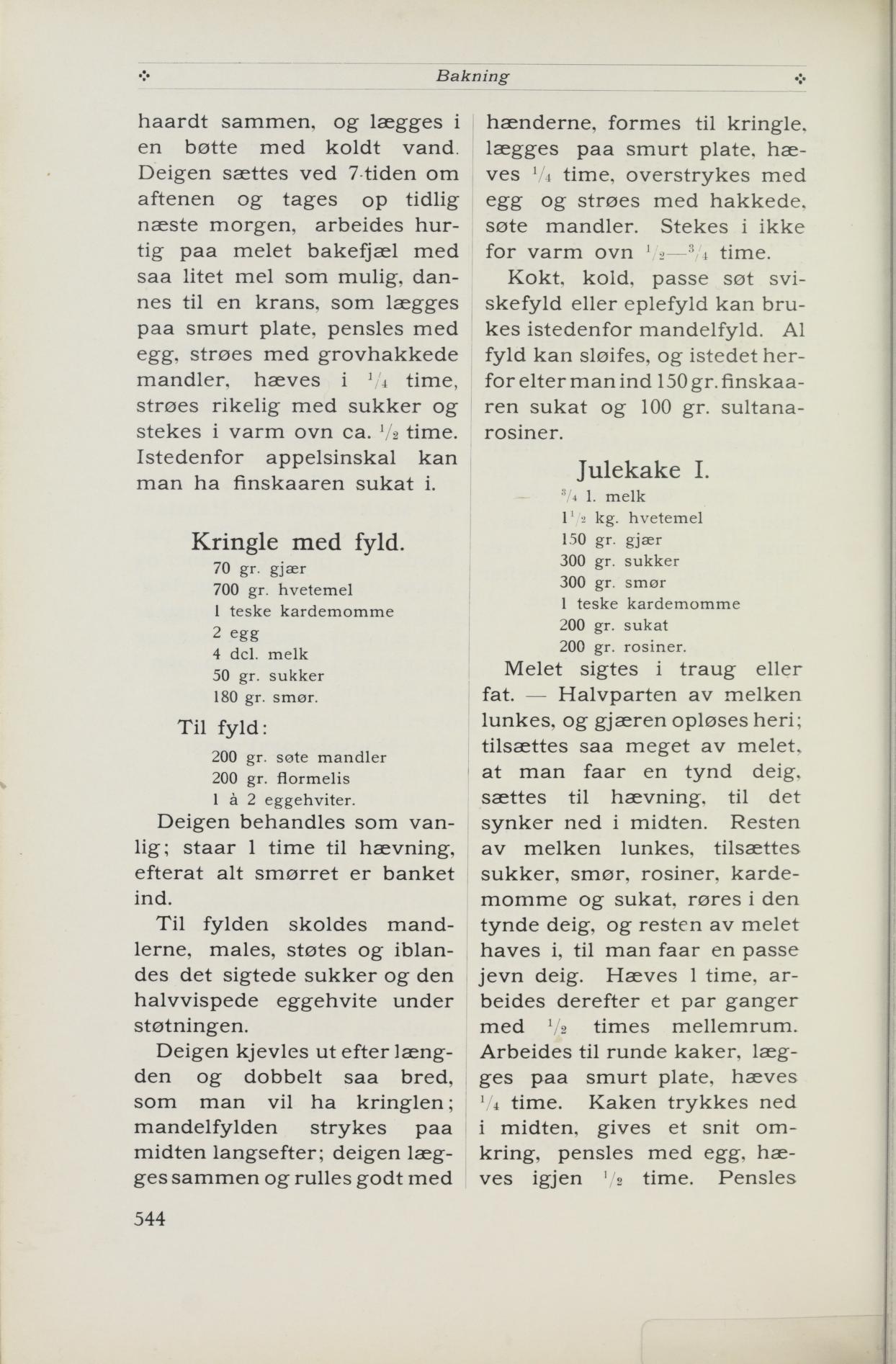
Erken's Julekake I (1914): a large yeasted bake with 1.5 kg all-purpose flour, 7.5 dl milk, 150 g yeast, 300 g sugar, 300 g butter, 1 tsp cardamom, 200 g candied peel, and 200 g raisins. A pre-dough of half the milk and yeast rises until it sinks, the rest is stirred in, the dough rises 1 hour and is worked a couple of times. Shaped into round cakes on a sheet, pressed down in the center with a cut around, brushed with egg, and baked about 1 hour in a hot oven.
Source: Henriette Schønberg Erken, Stor kokebok, 1914-utg. s. 544 (falt i det fri)
Be the first to rate
About the dish
The first of Erken's three julekaker (Norwegian Christmas breads) in the baking chapter. This is the traditional, large pre-dough-baked julekake with candied peel and raisins, baked as several round cakes on a sheet and shaped with a cut around the edge – the way julekake was baked in large batches for the Christmas holiday.
How to make it
1
Make the pre-dough
Sift the flour into a large mixing bowl. Warm half of the milk and dissolve the yeast in it. Stir in enough of the flour to make a thin dough, and let it rise until it sinks in the center.
2
Mix the dough
Warm the rest of the milk and mix in the sugar, butter, raisins, cardamom, and candied peel. Stir the mixture into the pre-dough, and work in the rest of the flour to a suitably smooth dough.
3
Rise and work
Let the dough rise for 1 hour. Then work it together a couple of times at half-hour intervals.
4
Shape the cakes
Work the dough into round cakes, place them on a greased baking sheet, and let them rise for 15 minutes. Press the cake down in the center and cut a slit around it.
5
Brush and proof
Brush with beaten egg and let the cakes rise for about 30 more minutes. Brush again with egg and poke a hole in the center.
6
Bake
Bake in a hot oven (about 200 °C (390 °F)) for about 1 hour, until the cakes are baked through and nicely browned.
Changes from the original
The quantities have been gathered from the narrow columns of the original and put into modern measurements. 'Traug eller fat' (trough or basin) has been kept as a mixing bowl, and the oven heat is given as about 200 °C (390 °F). Egg for brushing has been listed in the ingredients even though the original only mentions it in the method. The method has been divided into numbered steps.
📖1914
Original 1914 recipe
Verbatim from the first edition of the Big Cookbook.
Foto: Faksimile: Nasjonalbiblioteket
ProofreadPage 544
¾ l. melk
1½ kg. hvetemel
150 gr. gjær
300 gr. sukker
300 gr. smør
1 teske kardemomme
200 gr. sukat
200 gr. rosiner.
Melet sigtes i traug eller fat. — Halvparten av melken lunkes, og gjæren opløses heri; tilsættes saa meget av melet, at man faar en tynd deig, sættes til hævning, til det synker ned i midten. Resten av melken lunkes, tilsættes sukker, smør, rosiner, kardemomme og sukat, røres i den tynde deig, og resten av melet haves i, til man faar en passe jevn deig. Hæves 1 time, arbeides derefter et par ganger med ½ times mellemrum. Arbeides til runde kaker, lægges paa smurt plate, hæves ¼ time. Kaken trykkes ned i midten, gives et snit omkring, pensles med egg, hæves igjen ½ time. Pensles igjen med egg, stikkes i midten og stekes i varm ovn ca. 1 time.
📖1949
Revised 1949 recipe
From the revised edition of the Big Cookbook.
Foto: Faksimile: Nasjonalbiblioteket
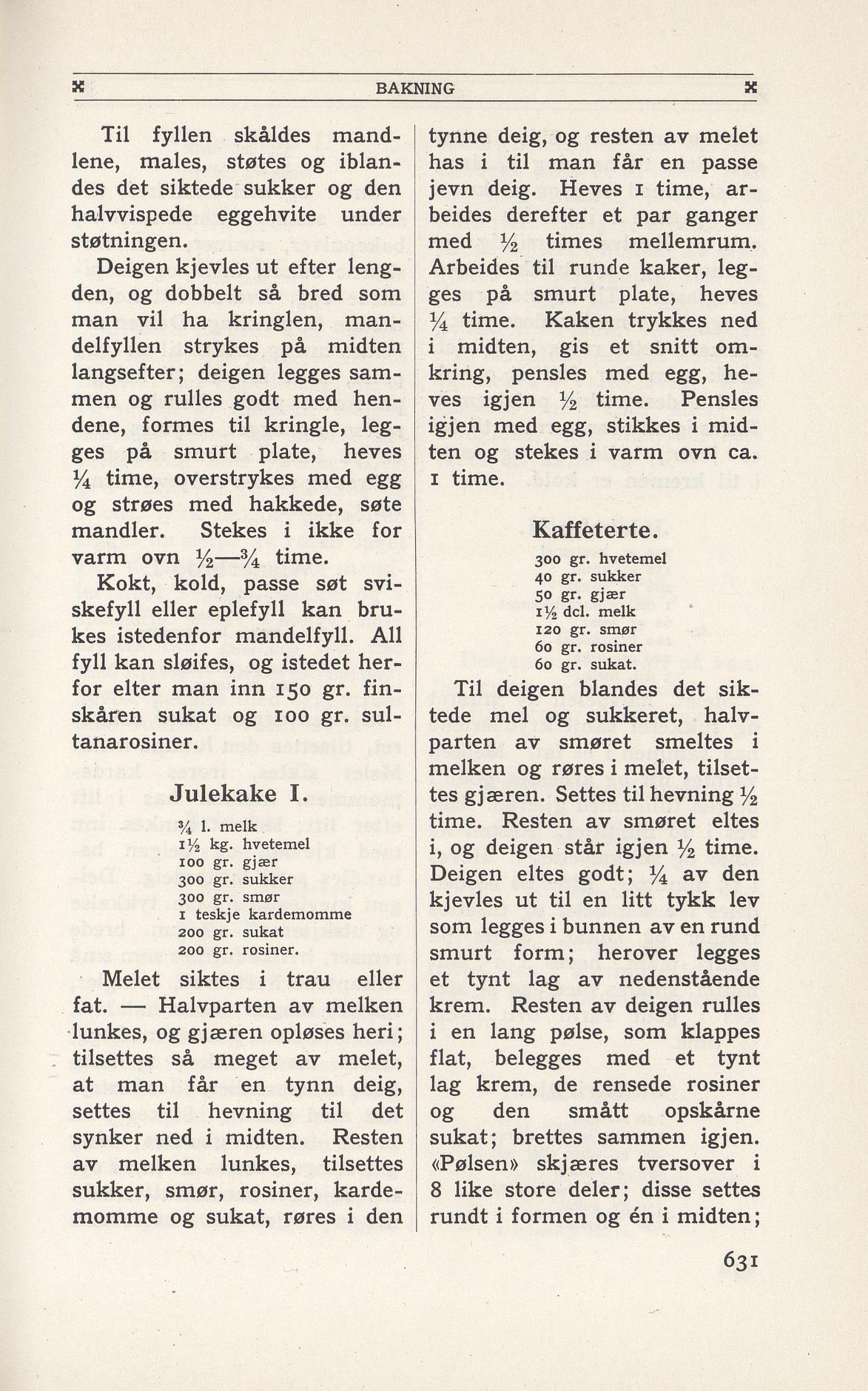
ProofreadPage 631
Julekake I.
% 1. melk
1y 2 kg. hvetemel
100 gr. gjær
300 gr. sukker
300 gr. smør
1 teskje kardemomme
200 gr. sukat
200 gr. rosiner.
Melet siktes i trau eller fat. — Halvparten av melken lunkes, og gjæren opløses heri; tilsettes så meget av melet, at man får en tynn deig, settes til hevning til det synker ned i midten. Resten av melken lunkes, tilsettes sukker, smør, rosiner, kardemomme og sukat, røres i den tynne deig, og resten av melet has i til man får en passe jevn deig. Heves i time, arbeides derefter et par ganger med y 2 times mellemrum.
Arbeides til runde kaker, legges på smurt plate, heves Y é time. Kaken trykkes ned i midten, gis et snitt omkring, pensles med egg, heves igjen y 2 time. Pensles igjen med egg, stikkes i midten og stekes i varm ovn ca. i time.
Deigen kjevles ut efter længden, og dobbelt så bred som man vil ha kringlen, mandelfyllen strykes på midten langsefter; deigen legges sammen og rulles godt med hendene, formes til kringle, legges på smurt plate, heves 34 time, overstrykes med egg og strøes med hakkede, søte mandler. Stekes i ikke forvarm ovn y 2 —% time.
Kokt, kold, passe søt sviskefyll eller eplefyll kan brukes istedenfor mandelfyll. Allfyll kan sløifes, og istedet herfor elter man inn 150 gr. finskåren sukat og 100 gr. sultanarosiner.
In stores now
Clean, minimally processed groceries matched to the ingredients — approximate prices.
1914 (korrekturlest, s. 544) → 1949 (korrekturlest, s. 631)~57% av teksten endretfjernetlagt til
¾ l. Julekake I. % 1. melk 1½ 1y 2 kg. hvetemel 150 100 gr. gjær 300 gr. sukker 300 gr. smør 1 teske teskje kardemomme 200 gr. sukat 200 gr. rosiner. Melet sigtes siktes i traug trau eller fat. — Halvparten av melken lunkes, og gjæren opløses heri; tilsættes saa tilsettes så meget av melet, at man faar får en tynd tynn deig, sættes settes til hævning, hevning til det synker ned i midten. Resten av melken lunkes, tilsættes tilsettes sukker, smør, rosiner, kardemomme og sukat, røres i den tynde tynne deig, og resten av melet haves i, has i til man faar får en passe jevn deig. Hæves 1 Heves i time, arbeides derefter et par ganger med ½ y 2 times mellemrum. Arbeides til runde kaker, lægges paa legges på smurt plate, hæves ¼ heves Y é time. Kaken trykkes ned i midten, gives gis et snit snitt omkring, pensles med egg, hæves heves igjen ½ y 2 time. Pensles igjen med egg, stikkes i midten og stekes i varm ovn ca. 1 i time. Deigen kjevles ut efter længden, og dobbelt så bred som man vil ha kringlen, mandelfyllen strykes på midten langsefter; deigen legges sammen og rulles godt med hendene, formes til kringle, legges på smurt plate, heves 34 time, overstrykes med egg og strøes med hakkede, søte mandler. Stekes i ikke forvarm ovn y 2 —% time. Kokt, kold, passe søt sviskefyll eller eplefyll kan brukes istedenfor mandelfyll. Allfyll kan sløifes, og istedet herfor elter man inn 150 gr. finskåren sukat og 100 gr. sultanarosiner.
The dough rises in several stages: pre-rising the thin dough until it sinks in the center, then 1 hour of rising, working a couple of times at half-hour intervals, ¼ hour after shaping, and ½ hour after brushing with egg. Allow around 4½ hours in total.
What gives this julekake its flavor?
1 teaspoon cardamom, 200 g candied peel, and 200 g raisins, together with 300 g sugar and 300 g butter.
Why should the cake be pressed down in the center and slit?
This is how Schønberg Erken does it in 'Stor kokebok' (1914): the cake is shaped round, pressed down in the center, and given a cut around it before brushing with egg and the final rise – this gives the cake its shape and an attractive appearance when baked.
How much dough does this make?
The recipe uses 1½ kg all-purpose flour and ¾ liter milk, enough for several round cakes and about 24 servings.