Skip to content

Lobster au naturel (homards au naturel)

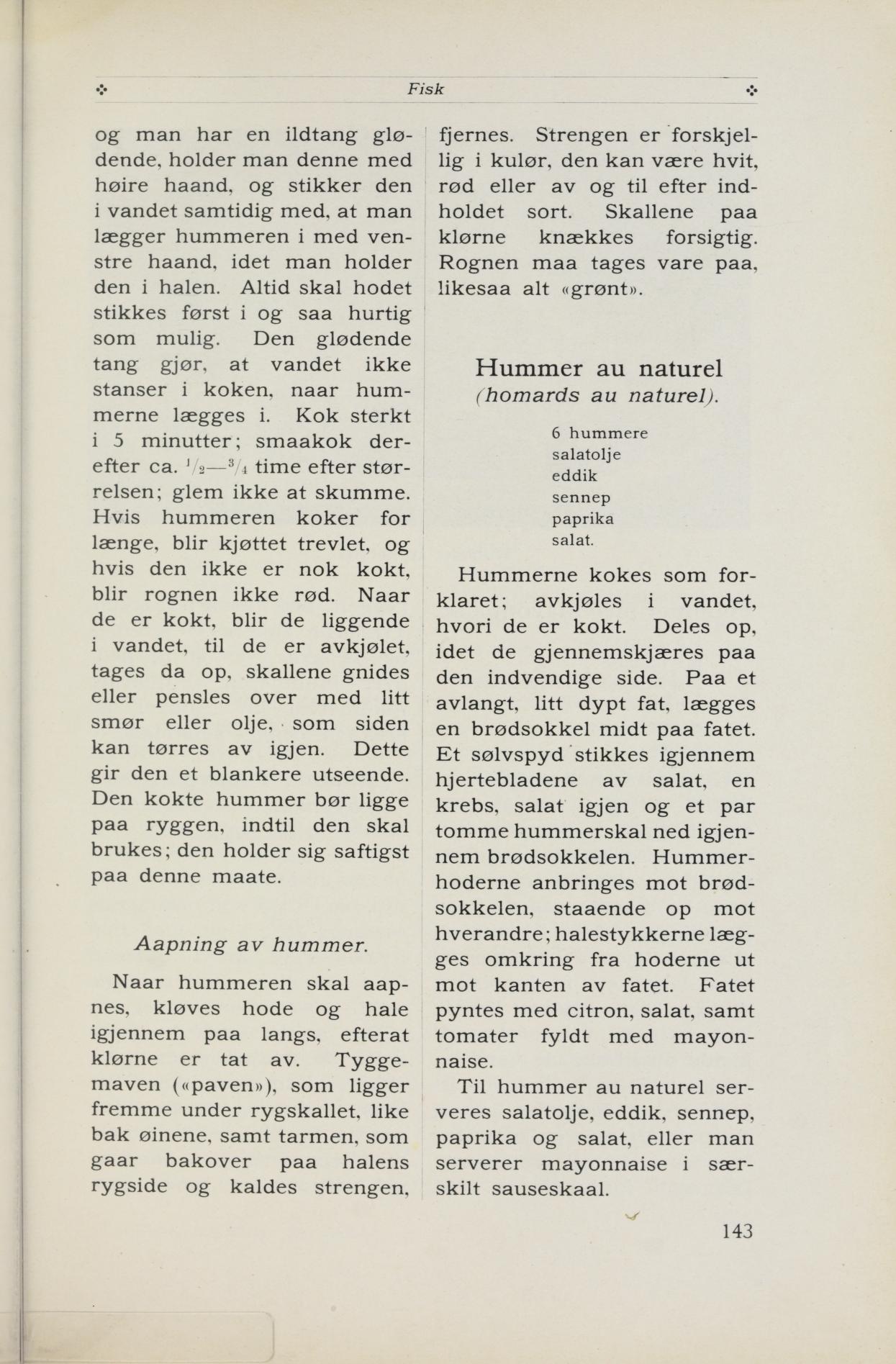
Erken's "Lobster au naturel" (1914): 6 lobsters are boiled and cooled in the cooking water, split, and arranged on an oblong platter around a bread base with a silver skewer holding lettuce, crayfish, and empty lobster shells. The heads are stood up against the base, and the tail pieces are laid in a ring. Garnished with lemon, lettuce, and tomatoes filled with mayonnaise. Served with oil, vinegar, mustard, paprika, and lettuce, or mayonnaise in a separate bowl.

Source: Henriette Schønberg Erken, Stor kokebok, 1914-utg. s. 143 (falt i det fri)

Be the first to rate

About the dish

A showpiece from the era of festive fare: the lobster is arranged around a bread base with a silver skewer, crayfish, and empty shells as decoration. Such "au naturel" presentations belonged to the cold buffets of well-to-do Norwegian homes around 1914.

How to make it

  1. 1

    Boil the lobster

    Boil the lobster as described: place it head first into strongly boiling, well-salted water, boil hard for 5 minutes, and then let it simmer about 30–45 minutes depending on size. Skim as you go.

  2. 2

    Cool

    Leave the lobster in the cooking water until completely cooled. Take it out and rub or brush the shell with a little butter or oil for a shiny gloss.

  3. 3

    Split it

    Split the lobster by cutting through on the underside. Remove the stomach and intestinal tract.

  4. 4

    Set up the platter

    Place a bread base in the middle of an oblong, somewhat deep platter. Push a silver skewer through the lettuce heart leaves, a crayfish, more lettuce, and a couple of empty lobster shells, and down through the bread base.

  5. 5

    Arrange the lobster

    Stand the lobster heads up against the bread base so they support each other, and lay the tail pieces in a ring from the heads out toward the edge of the platter.

  6. 6

    Garnish

    Garnish the platter with lemon, lettuce leaves, and tomatoes filled with mayonnaise.

  7. 7

    Serve

    Serve olive oil, vinegar, mustard, paprika, and lettuce on the side—or mayonnaise in a separate sauce bowl.

Changes from the original

Quantities are estimated for the accompaniments, which appear without measures in the original. "Salad oil" has been modernized to olive oil, and the crayfish and empty shells are kept as optional garnish. The boiling refers to Erken's own lobster-boiling method (hard boil for 5 minutes, then simmer 30–45 minutes depending on size).

Time machine – what changed?

Pick two editions and see what Henriette Schønberg Erken added, removed or changed between them.

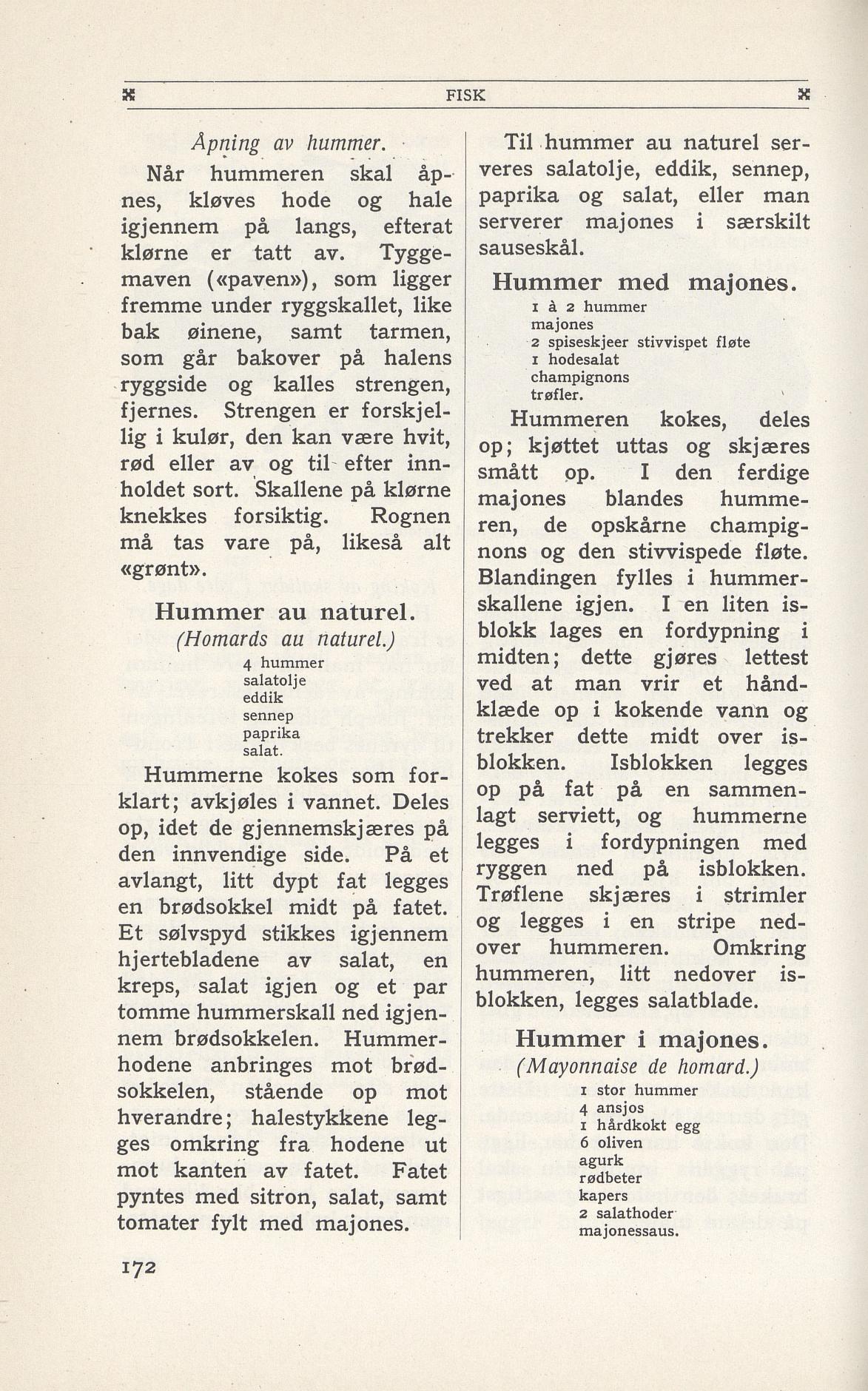
Modernised → 1949 (proofread, p. 172)~86% of the text changedremovedadded
6 stk (Homard au naturel.) 4 hummer (levende, til koking). 1 stk kreps (kokt, til pynt på spydet). 2 stk hodesalat (hjerteblader til pynt). 2 stk sitron (i båter). 6 stk tomater (uthulet og fylt med majones). 2 dl majones (til fylling og evt. som saus). 1 dl olivenolje (salatolje, som tilbehør). 0,5 dl salatolje eddik (som tilbehør). 1 ss sennep (som tilbehør). 1 ts paprikapulver (som tilbehør). 1 stk brødsokkel (fast brød skåret til, som fundament på fatet). Kok hummeren paprika salat. Hummerne kokes som forklart: legg den hodet først i sterkt kokende, godt saltet vann, kok kraftig i 5 minutter og la den så småkoke ca. 30–45 minutter etter størrelsen. Skum underveis.. La hummeren bli liggende forklart; avkjøles i kokevannet til den er helt avkjølt. Ta vannet. Deles op, idet de gjennemskjæres på den opp og gni eller pensle skallet med innvendige side. På et avlangt, litt smør eller olje for blank glans.. Kløv hummeren ved å skjære gjennom på innsiden. Fjern magesekk og tarm.. Legg dypt fat legges en brødsokkel midt på et avlangt, litt dypt fat. Stikk et fatet. Et sølvspyd gjennom stikkes igjennem hjertebladene av salat, en kreps, salat igjen og et par tomme hummerskall, og hummerskall ned gjennom brødsokkelen.. Sett hummerhodene opp igjennem brødsokkelen. Hummerhofedene anbringes mot brødsokkelen så de støtter hverandre, og legg halestykkene i en krans brødsokkelen, stående op mot hverandre; halestykknene legges omkring fra hodene ut mot utmot kanten av fatet.. Pynt fatet fatet. Fatet pyntes med sitron, salatblader og salat, samt tomater fylt med majones.. Server olivenolje, majones. Til hummer au naturel serveres salatolje, eddik, sennep, paprika og salat ved siden av – salat, eller man serverer majones i egen sausebolle. særskilt sauseskål.

Note on Modernised

Mengder er anslått for tilbehøret, som i originalen står uten mål. «Salatolje» er modernisert til olivenolje, og krepsen og de tomme skallene er beholdt som valgfri pynt. Kokingen henviser til Erkens egen hummerkoking (sterk koking 5 minutter, deretter småkoking 30–45 minutter etter størrelse).

Community interpretations

Be the first to share your own version.

See interpretations →

Frequently asked questions

What does "au naturel" mean here?
That the lobster is served boiled and cooled, without sauce over it—the accompaniments (salad oil, vinegar, mustard, paprika, and lettuce, and optionally mayonnaise) are set alongside in separate bowls.
How is the lobster prepared before plating?
The lobsters are boiled as described in the cookbook and cooled in the cooking water. Then they are cut up by slicing through them on the underside.
How is the dish arranged on the platter?
A bread base is placed in the middle of an oblong, somewhat deep platter. A silver skewer is pushed through lettuce heart leaves, a crayfish, more lettuce, and a couple of empty lobster shells, down through the bread base. The lobster heads are stood up against each other by the base, and the tail pieces are laid around toward the platter's edge. Garnished with lemon, lettuce, and tomatoes filled with mayonnaise.
How many lobsters are needed?
The recipe is intended for 6 servings and uses 6 lobsters—one per person. The recipe is from Henriette Schønberg Erken's "Stor kokebok" (1914), p. 143.

Related recipes

More dishes in the same category from the archive

Read also

Kommentarer

Ingen kommentarer ennå. Bli den første til å dele!