Skip to content

Lobster in a mold

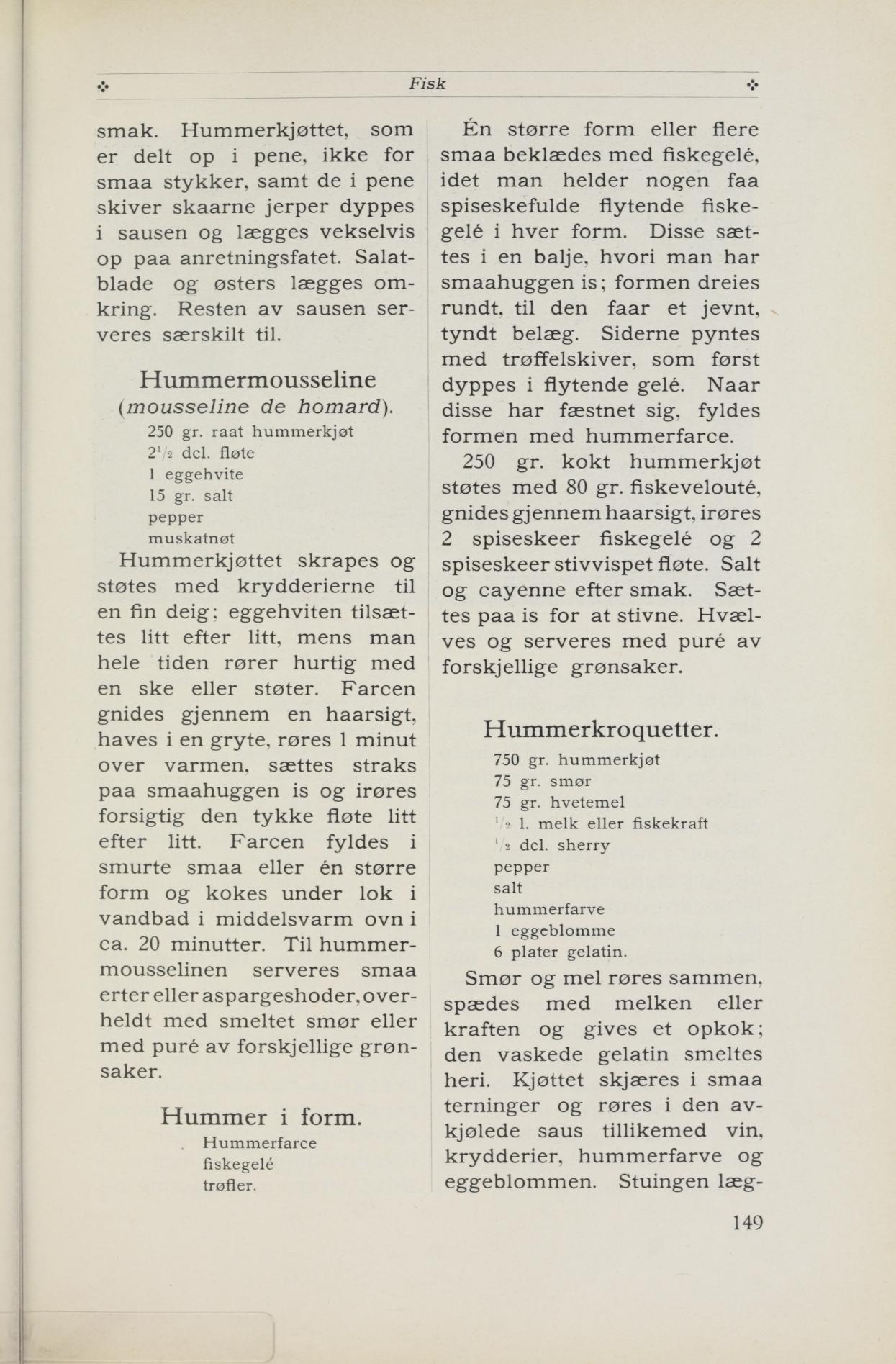
A cold lobster mold from Erken (1914): the mold is lined with fish aspic over ice and garnished with truffle slices, then filled with a forcemeat of 250 g boiled lobster meat pounded with 80 g fish velouté, sieved and stirred with 2 tbsp fish aspic and 2 tbsp stiffly whipped cream, seasoned with salt and cayenne. It sets cold, is turned out, and served with vegetable purée.

Source: Henriette Schønberg Erken, Stor kokebok, 1914-utg. s. 149 (falt i det fri)

Be the first to rate

About the dish

A cold preparation from the fish chapter of "Stor kokebok" (1914). Aspic-lined molds garnished with truffle were typical of the representative cuisine around the turn of the century; the dish is served cold as an appetizer or cold-buffet dish.

How to make it

  1. 1

    Line the mold with aspic

    Pour a few tablespoons of liquid fish aspic into one larger mold or several small ones. Set the molds in ice water and turn them around until the aspic settles into an even, thin coating.

  2. 2

    Garnish with truffle

    Dip truffle slices in liquid aspic and fix them along the sides of the mold. Let them set.

  3. 3

    Make the forcemeat

    Pound the boiled lobster meat with the fish velouté and rub the mixture through a fine-mesh sieve.

  4. 4

    Add aspic and cream

    Stir in 2 tablespoons fish aspic and 2 tablespoons stiffly whipped cream. Season with salt and cayenne pepper.

  5. 5

    Fill and set

    Fill the forcemeat into the mold and set it cold on ice until completely firm, preferably a few hours.

  6. 6

    Serving

    Turn the mold out onto a platter and serve with a purée of assorted vegetables.

Changes from the original

Measurements are modernized (tablespoons, grams), "haarsigt" replaced with a fine-mesh sieve and "basin of finely chopped ice" with an ice-water bath. The method has been divided into numbered steps.

In stores now

Clean, minimally processed groceries matched to the ingredients — approximate prices.

Product data and prices via Kassalapp. Prices are updated daily and may vary.

Time machine – what changed?

Pick two editions and see what Henriette Schønberg Erken added, removed or changed between them.

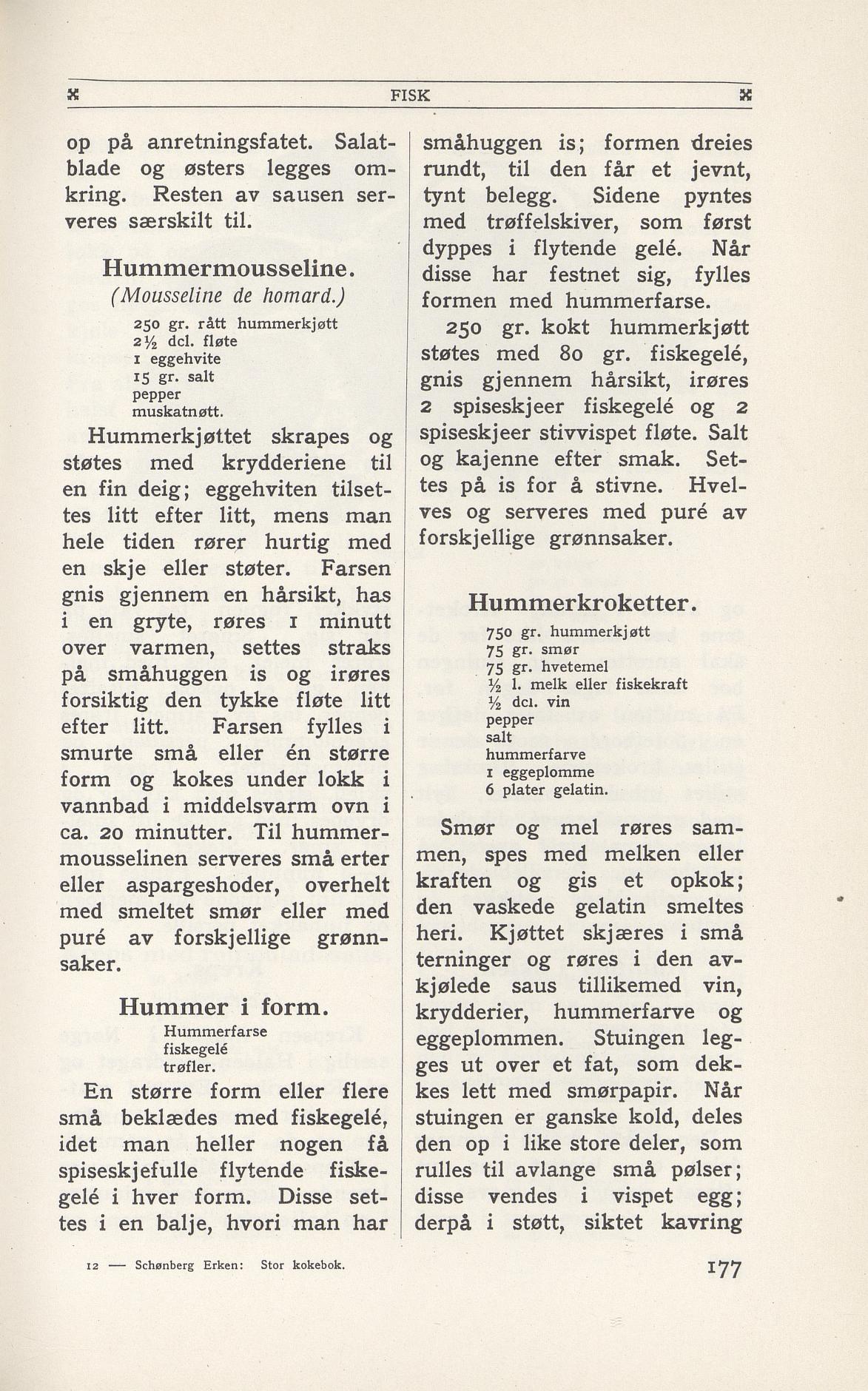
1914 (proofread, p. 149) → 1949 (proofread, p. 177)~66% of the text changedremovedadded
Hummerfarce fiskegelé trøfler 250 gr. kokt hummerkjøt 80 gr. fiskevelouté 2 spiseskeer fiskegelé 2 spiseskeer stivvispet fløte salt cayenne Én trøfler. En større form eller flere smaa små beklædes med fiskegelé, idet man helder heller nogen faa spiseskefulde få spiseskefulle flytende fiskegelé i hver form. Disse sættes settes i en balje, hvori man har smaahuggen småhuggen is; formen dreies rundt, til den faar får et jevnt, tyndt belæg. Siderne tynt belegg. Sidene pyntes med trøffelskiver, som først dyppes i flytende gelé. Naar Når disse har fæstnet festnet sig, fyldes fylles formen med hummerfarce. 250 gr. kokt hummerkjøt støtes med 80 gr. fiskevelouté, gnides gjennem haarsigt, irøres 2 spiseskeer fiskegelé og 2 spiseskeer stivvispet fløte. Salt og cayenne efter smak. Sættes paa is for at stivne. Hvælves og serveres med puré av forskjellige grønsaker. hummerfarse.
Community interpretations

Be the first to share your own version.

See interpretations →

Frequently asked questions

What is the lobster forcemeat made of?
250 g boiled lobster meat pounded with 80 g fish velouté, pressed through a fine sieve, and then stirred together with 2 tablespoons fish aspic and 2 tablespoons stiffly whipped cream. Seasoned with salt and cayenne.
How do I get an even aspic coating in the mold?
Pour a few tablespoons of liquid fish aspic into the mold, set it in a basin of finely chopped ice, and turn the mold around until the coating settles evenly and thinly.
Why does the dish take so long (about 5 hours)?
The time goes into boiling the lobster, making the fish velouté and fish aspic, and not least into letting the aspic and forcemeat set on ice before plating.
How is the mold garnished?
The sides are covered with truffle slices that are first dipped in liquid aspic, so they stick to the coating before the mold is filled with lobster forcemeat.

Related recipes

More dishes in the same category from the archive

Read also

Kommentarer

Ingen kommentarer ennå. Bli den første til å dele!