Skip to content

Whole roasted suckling pig

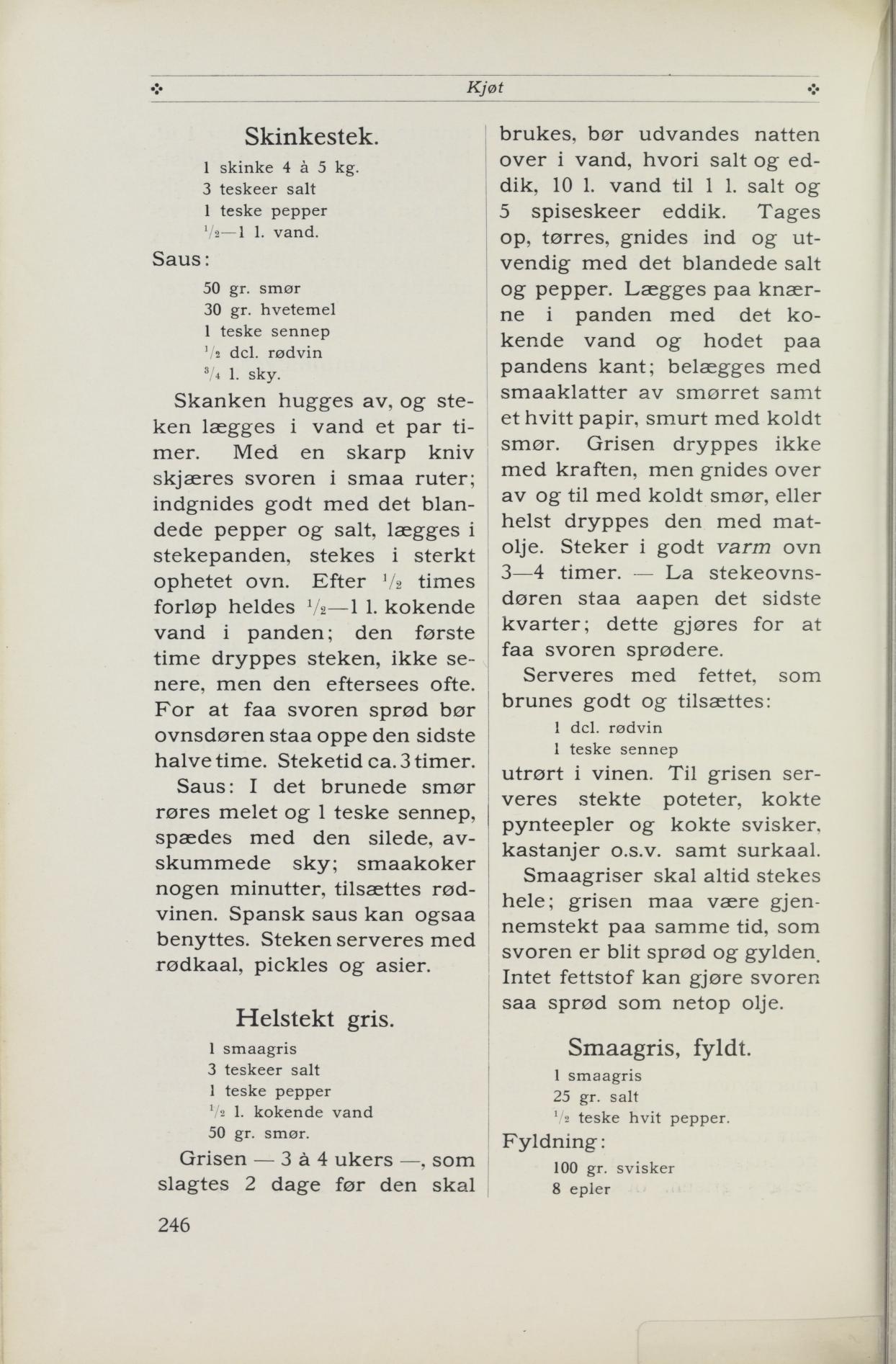
Erken's whole roasted suckling pig (1914): the pig is soaked overnight in salted, vinegared water, rubbed with salt and white pepper, placed on its knees in a roasting pan with boiling water, covered with pats of butter and greased paper and roasted 3–4 hours while brushed with cooking oil for crisp crackling. Sauce of browned pan drippings with red wine and mustard; served with roast potatoes, garnish apples, prunes, chestnuts and sauerkraut.

Source: Henriette Schønberg Erken, Stor kokebok, 1914-utg. s. 246 (falt i det fri)

Be the first to rate

About the dish

Whole roasted suckling pig was the showpiece of older Norwegian festive cooking, often for Christmas and large gatherings. Erken emphasizes that the crackling must become crisp while the pig is cooked through, and recommends cooking oil for brushing.

How to make it

  1. 1

    Soaking

    Soak the pig overnight in water with salt and vinegar: 10 liters water, 1 liter salt and 5 tablespoons vinegar.

  2. 2

    Season

    Take the pig out, dry it well and rub it inside and out with salt mixed with white pepper.

  3. 3

    Place in the pan

    Place the pig on its knees in the roasting pan with the head resting on the edge of the pan. Pour in the boiling water.

  4. 4

    Cover

    Place small pats of butter over the pig and cover with a sheet of white paper greased with cold butter.

  5. 5

    Roasting

    Roast in a good hot oven (about 180 °C (355 °F)) for 3–4 hours. Do not baste with the drippings, but rub the pig occasionally with cold butter, preferably brush it with cooking oil – nothing gives crisper crackling than oil.

  6. 6

    Crisp crackling

    Leave the oven door open for the last quarter hour so the crackling becomes extra crisp. The pig should be cooked through while the crackling is crisp and golden.

  7. 7

    Sauce

    Brown the fat in the pan well and add 1 dl red wine with 1 tsp mustard stirred in.

  8. 8

    Serving

    Serve with roast potatoes, boiled garnish apples, boiled prunes, chestnuts and sauerkraut.

Changes from the original

Quantities given in modern units. The original's amount of salt for soaking («1 l. salt to 10 l. water») has been kept as a volume measure. Oven temperature has been specified (about 180 °C (355 °F)). The sauce has been separated out as its own ingredients.

In stores now

Clean, minimally processed groceries matched to the ingredients — approximate prices.

Product data and prices via Kassalapp. Prices are updated daily and may vary.

Time machine – what changed?

Pick two editions and see what Henriette Schønberg Erken added, removed or changed between them.

Pick two different editions to see a comparison.

Community interpretations

Be the first to share your own version.

See interpretations →

Frequently asked questions

How old should the pig be, and when should it be slaughtered?
The recipe uses a suckling pig of 3–4 weeks, slaughtered 2 days before it is to be used.
How is the pig soaked?
It is placed in water overnight with salt and vinegar: 10 liters water to 1 liter salt and 5 tablespoons vinegar. Then it is taken out, dried and rubbed inside and out with the mixture of 25 g salt and ¼ tsp white pepper.
How long does the pig roast, and how do you get crisp crackling?
It roasts for 3–4 hours in a good hot oven. Leave the oven door open for the last quarter hour to make the crackling crisp.
Should the pig be basted with the drippings?
No, it is not basted with the drippings. It is rubbed occasionally with cold butter, or preferably brushed with cooking oil. During roasting it lies on its knees in the pan with ½ liter boiling water, the head on the edge of the pan, covered with pats of butter and a sheet of white paper greased with cold butter.

Related recipes

More dishes in the same category from the archive

Read also

Kommentarer

Ingen kommentarer ennå. Bli den første til å dele!