Skip to content

Goose à l'italienne

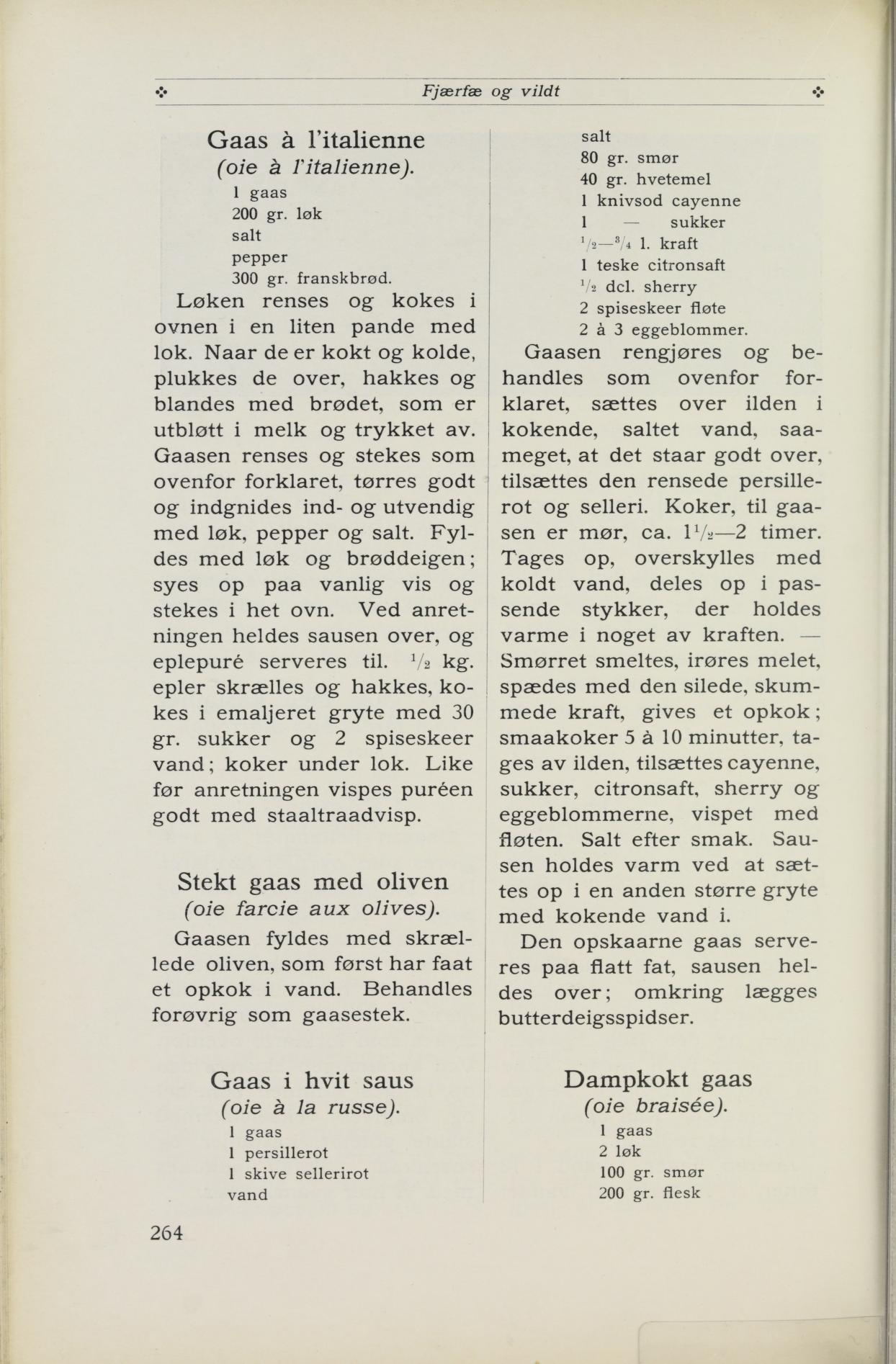
Erken's goose à l'italienne from 1914: goose stuffed with oven-baked chopped onion mixed with milk-soaked white bread, rubbed with onion, salt and pepper, roasted in a hot oven and served with pan juices and whipped apple purée.

Source: Henriette Schønberg Erken, Stor kokebok, 1914-utg. s. 264 (falt i det fri)

Be the first to rate

About the dish

From the chapter "Fjærfæ og vildt" (Poultry and game) in Henriette Schønberg Erken's "Stor kokebok" (1914). The page is set in two columns with narrow ingredient columns alongside the method, so the OCR mixes up the order. The ingredient list of onion and French bread has here been linked to the method describing oven-baked onion and bread stuffing, which appears in the same column area.

How to make it

  1. 1

    Bake the onion

    Clean the onion and place it in a small pan with a lid. Bake it tender in the oven. Once the onion is cooked and cooled, pull it apart and chop it.

  2. 2

    Make the filling

    Soak the white bread in milk, squeeze it well and mix it with the chopped onion. Season with salt and pepper.

  3. 3

    Prepare the goose

    Clean the goose, dry it well and rub it inside and out with onion, pepper and salt.

  4. 4

    Stuff and sew

    Fill the goose with the onion-and-bread stuffing, sew it up in the usual way and truss it.

  5. 5

    Roast

    Roast the goose in a hot oven (about 200 °C (390 °F)) until it is tender and cooked through, about 2 to 2½ hours. Baste with the pan juices along the way.

  6. 6

    Apple purée

    Peel and chop the apples, boil them covered in an enameled pot with sugar and water. Just before serving, whisk the purée well with a wire whisk.

  7. 7

    Plating

    Carve the goose, pour the sauce (pan juices) over it and serve the apple purée alongside.

Changes from the original

The ingredients have been listed in modern measures and names (French bread → white loaf, grams/deciliters). The amount of milk for soaking is estimated, and the apple purée has been separated out as its own ingredients as given in the original text. The method has been divided into numbered steps and "hot oven" is given as 200 °C (390 °F).

In stores now

Clean, minimally processed groceries matched to the ingredients — approximate prices.

Product data and prices via Kassalapp. Prices are updated daily and may vary.

Tidsmaskin – hva endret seg?

Velg to utgaver og se hva Henriette Schønberg Erken la til, fjernet eller endret mellom dem.

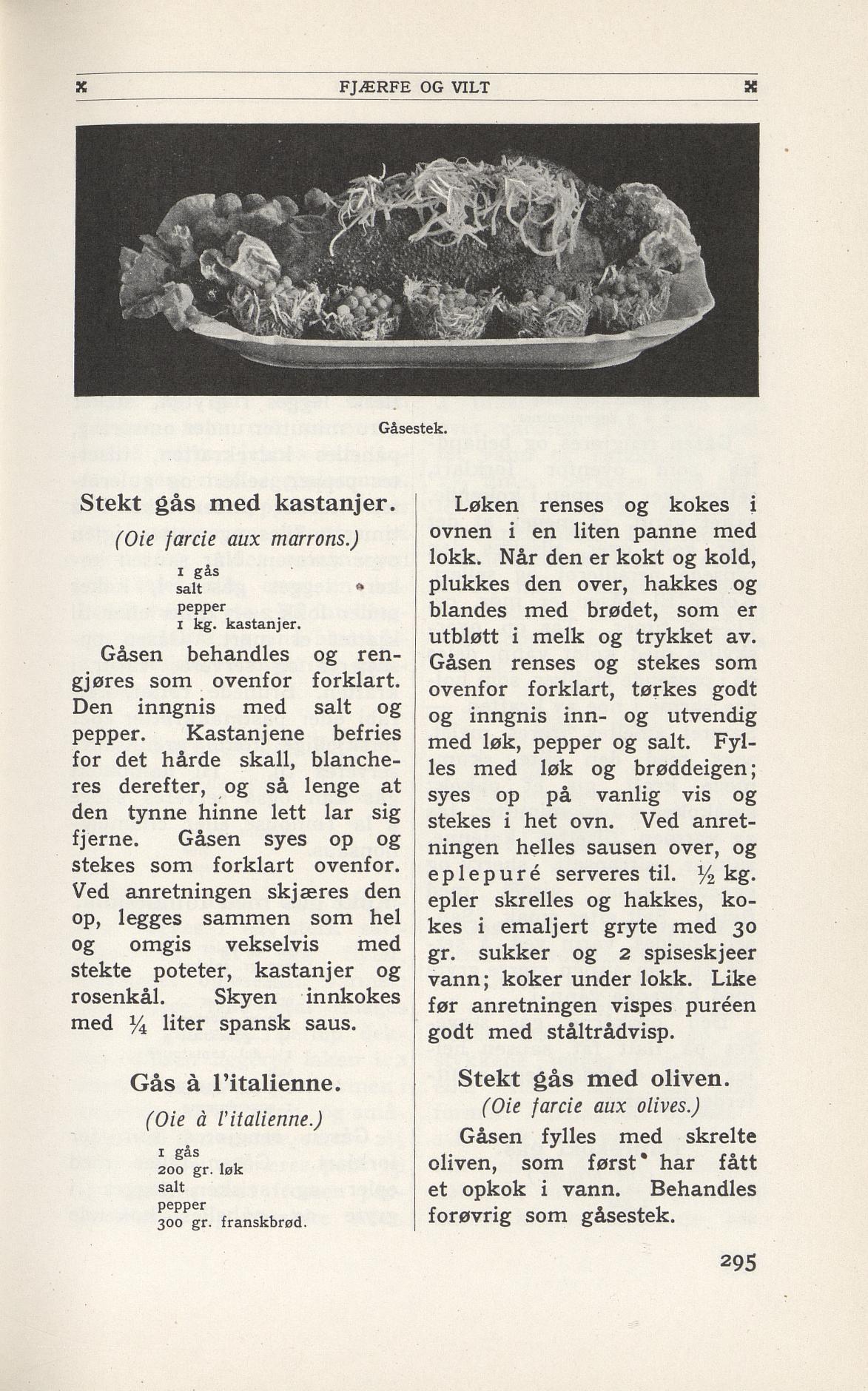
1914 (korrekturlest, s. 264)1949 (korrekturlest, s. 295)~97% av teksten endretfjernetlagt til
1 gaas 200 gr. løk salt pepper 300 gr. franskbrød. Løken renses og kokes i ovnen i en liten pande med lok. Naar de er kokt og kolde, plukkes de over, hakkes og blandes Gåsen fylles med brødet, skrelte oliven, som er utbløtt først har fått et opkok i melk og trykket av. Gaasen renses og stekes vann. Behandles forøvrig som ovenfor forklaret, tørres godt og indgnides ind- og utvendig med løk, pepper og salt. Fyldes med løk og brøddeigen; syes op paa vanlig vis og stekes i het ovn. Ved anretningen heldes sausen over, og eplepuré serveres til. ½ kg. epler skrælles og hakkes, kokes i emaljeret gryte med 30 gr. sukker og 2 spiseskeer vand; koker under lok. Like før anretningen vispes pureen godt med staaltraadvisp. gåsestek.
Community interpretations

Be the first to share your own version.

See interpretations

Frequently asked questions

What is the filling made of?
The filling is 200 g of onion, first cooked tender in the oven in a small pan with a lid, then chopped and mixed with 300 g of French bread soaked in milk and squeezed out. The goose is rubbed inside and out with onion, pepper and salt before it is stuffed and sewn up.
How long does the dish take?
Allow about 3.5 hours in all (210 minutes) for 8 servings, including pre-cooking the onion and roasting the goose in a hot oven.
What is served alongside?
The sauce is poured over at plating, and apple purée is served alongside: ½ kg of apples are peeled, chopped and boiled covered in an enameled pot with 30 g sugar and 2 tablespoons of water. Just before serving, the purée is whisked well with a wire whisk.
Where does the recipe come from?
From Henriette Schønberg Erken's "Stor kokebok" (1914), page 264.

Related recipes

More dishes in the same category from the archive

Read also

Kommentarer

Ingen kommentarer ennå. Bli den første til å dele!