Skip to content

Tongue in aspic (meat jelly)

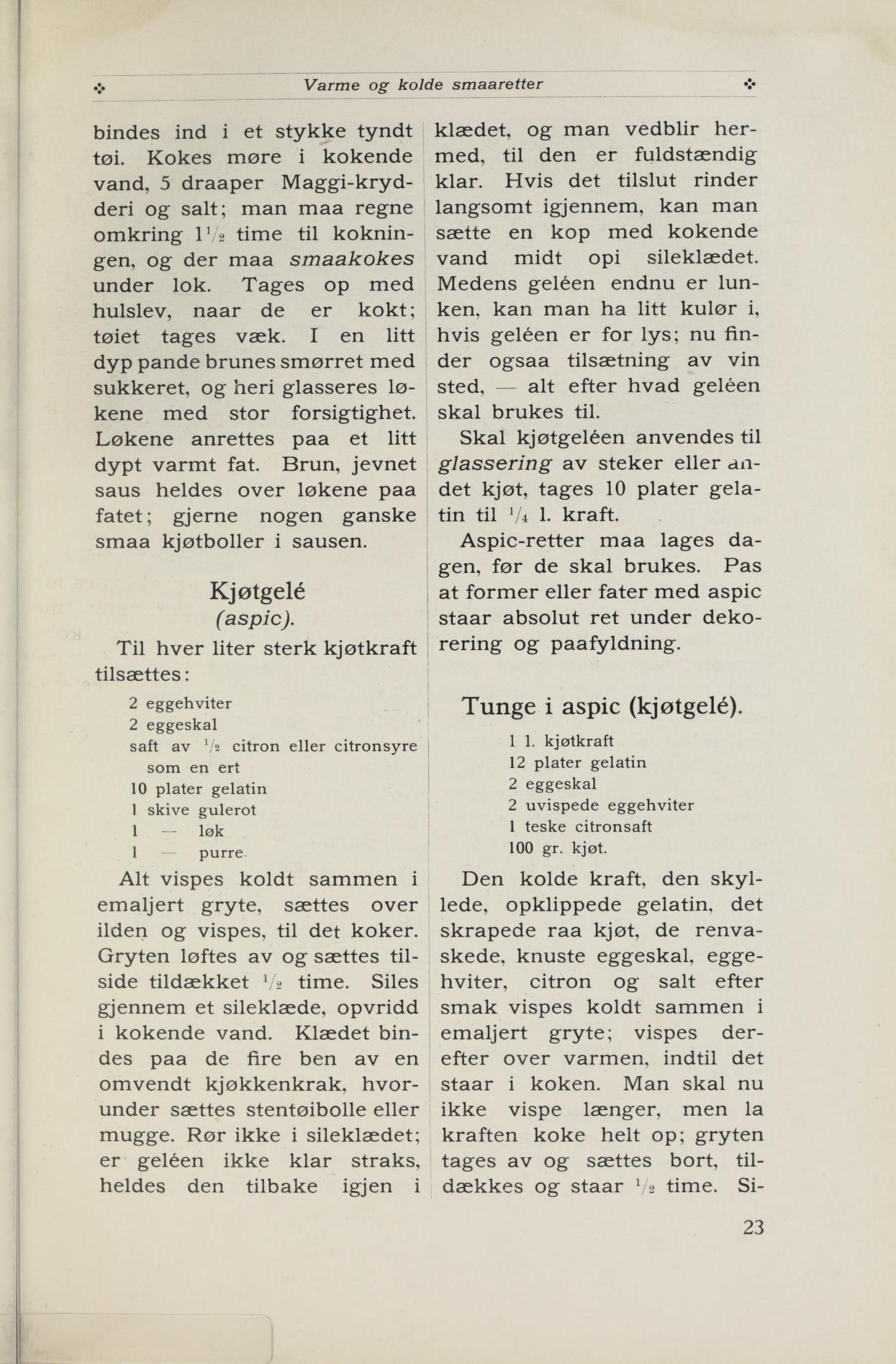
Cold party dish from Erken 1914: slices of cooked salted tongue garnished with cooked root vegetables and parsley, set in clarified meat jelly made from stock, gelatin, egg white, eggshell, scraped raw meat and lemon juice. Sets overnight and is served on a rice base or around Italian salad.

Source: Henriette Schønberg Erken, Stor kokebok, 1914-utg. s. 23 (falt i det fri)

Be the first to rate

About the dish

A festive cold small dish from the pre-World War I party table: slices of cooked salted tongue set in clear meat jelly, garnished with root vegetables and served on a rice base or in a ring around ice-cold Italian salad. The dish shows how aspic both preserved and adorned cold food.

How to make it

  1. 1

    Mix the clarification cold

    Whisk cold meat stock, the snipped gelatin, the scraped raw meat, crushed eggshells, egg whites, lemon juice and salt to taste well together in an enameled pot while everything is cold.

  2. 2

    Bring to a boil

    Whisk over the heat until it comes to a boil. Stop whisking and let the stock boil right up. Take the pot off, cover it and let it stand about 30 minutes.

  3. 3

    Strain the jelly

    Strain the stock through a cloth wrung out in boiling water, so the jelly becomes completely clear.

  4. 4

    Arrange the tongue

    Cut the cooked tongue into not-too-thick slices slightly on the diagonal and lay them out on a platter with a little space between the slices.

  5. 5

    Garnish

    Place cooked, neatly cut root vegetables — not too much — and a little parsley or finely cut lettuce on the tongue slices.

  6. 6

    Set in jelly

    Pour a little of the strained meat jelly over, and keep pouring on a little at a time until the slices are completely covered.

  7. 7

    Set and plate

    Leave until the jelly is completely firm, preferably until the next day. Then cut the tongue slices neatly out and arrange them on a rice base, or in a ring on the platter with ice-cold Italian salad in the center.

Changes from the original

Measurements are modernized (grams, deciliters, teaspoon), gelatin sheets given by count, and 'skrapet raa kjøt' is specified as lean, finely scraped beef. The ingredient list has been cleared of items that in the OCR belonged to the neighboring recipe 'Duer i gele' (pigeons in jelly). The method is divided into numbered steps.

In stores now

Clean, minimally processed groceries matched to the ingredients — approximate prices.

Product data and prices via Kassalapp. Prices are updated daily and may vary.

Time machine – what changed?

Pick two editions and see what Henriette Schønberg Erken added, removed or changed between them.

Pick two different editions to see a comparison.

Community interpretations

Be the first to share your own version.

See interpretations →

Frequently asked questions

Why are raw meat, egg whites and eggshell whisked into the stock?
It is a clarification method: meat, unbeaten egg whites and crushed, cleaned eggshells bind impurities in the stock so the jelly becomes clear. The mixture is whisked together cold, then over the heat until it comes to a boil – then you stop whisking and let the stock boil right up.
How much gelatin is needed, and how is it treated?
12 sheets of gelatin per 1 liter of meat stock. The sheets are rinsed and snipped up before being whisked together with the cold stock.
Why does the dish take so long?
The cooking itself is quick, but the stock must stand covered for ½ hour after clarifying, be strained through a straining cloth wrung out in boiling water, and then the aspic must set in the cold – hence the long total time (often overnight).
How is the tongue plated?
The cooked salted tongue is cut into not-too-thick slices slightly on the diagonal and laid out on a platter with a little space between the slices, garnished with cooked vegetables and parsley or lettuce before the jelly is poured over.

Related recipes

More dishes in the same category from the archive

Read also

Kommentarer

Ingen kommentarer ennå. Bli den første til å dele!