Skip to content

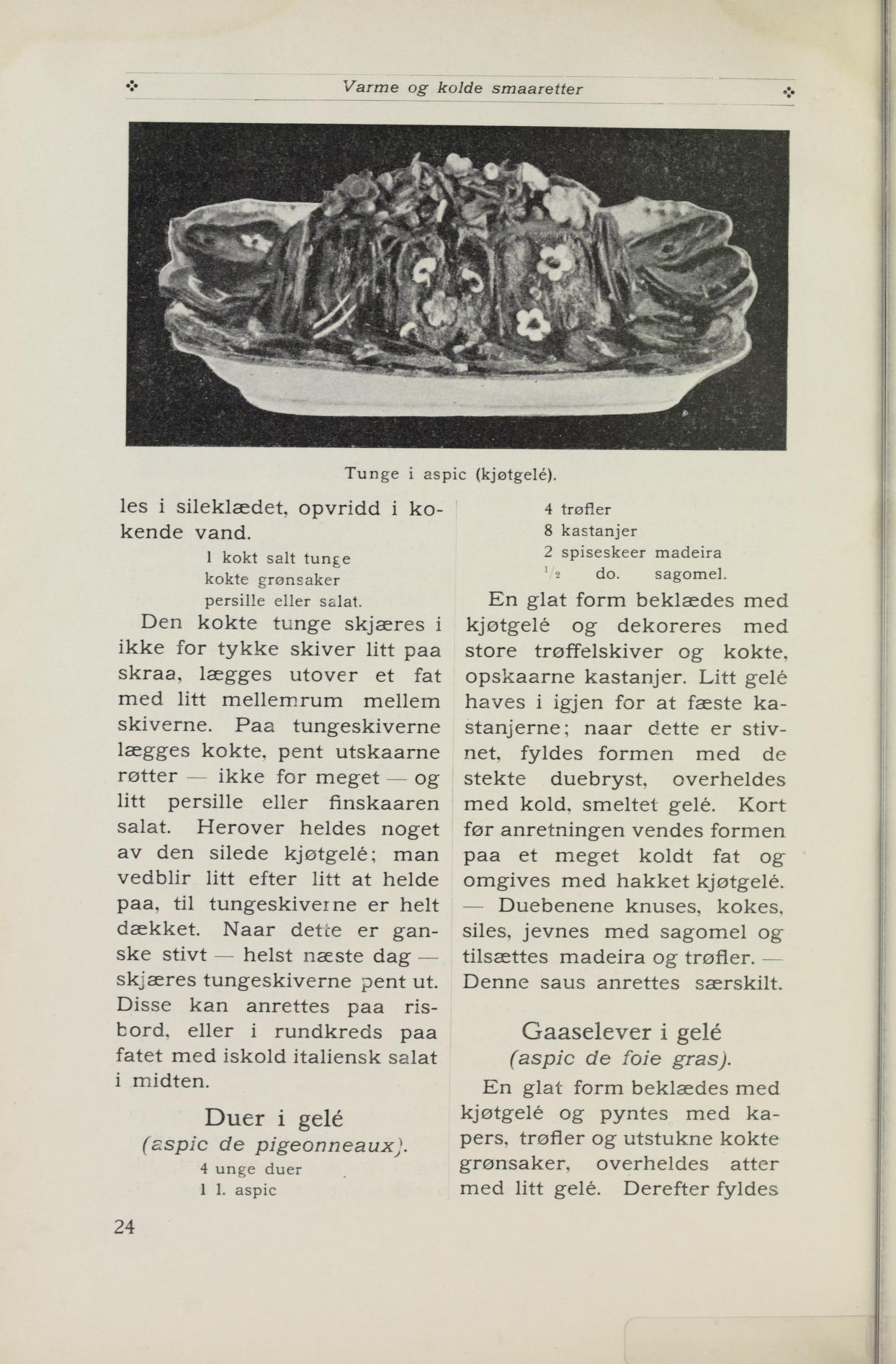
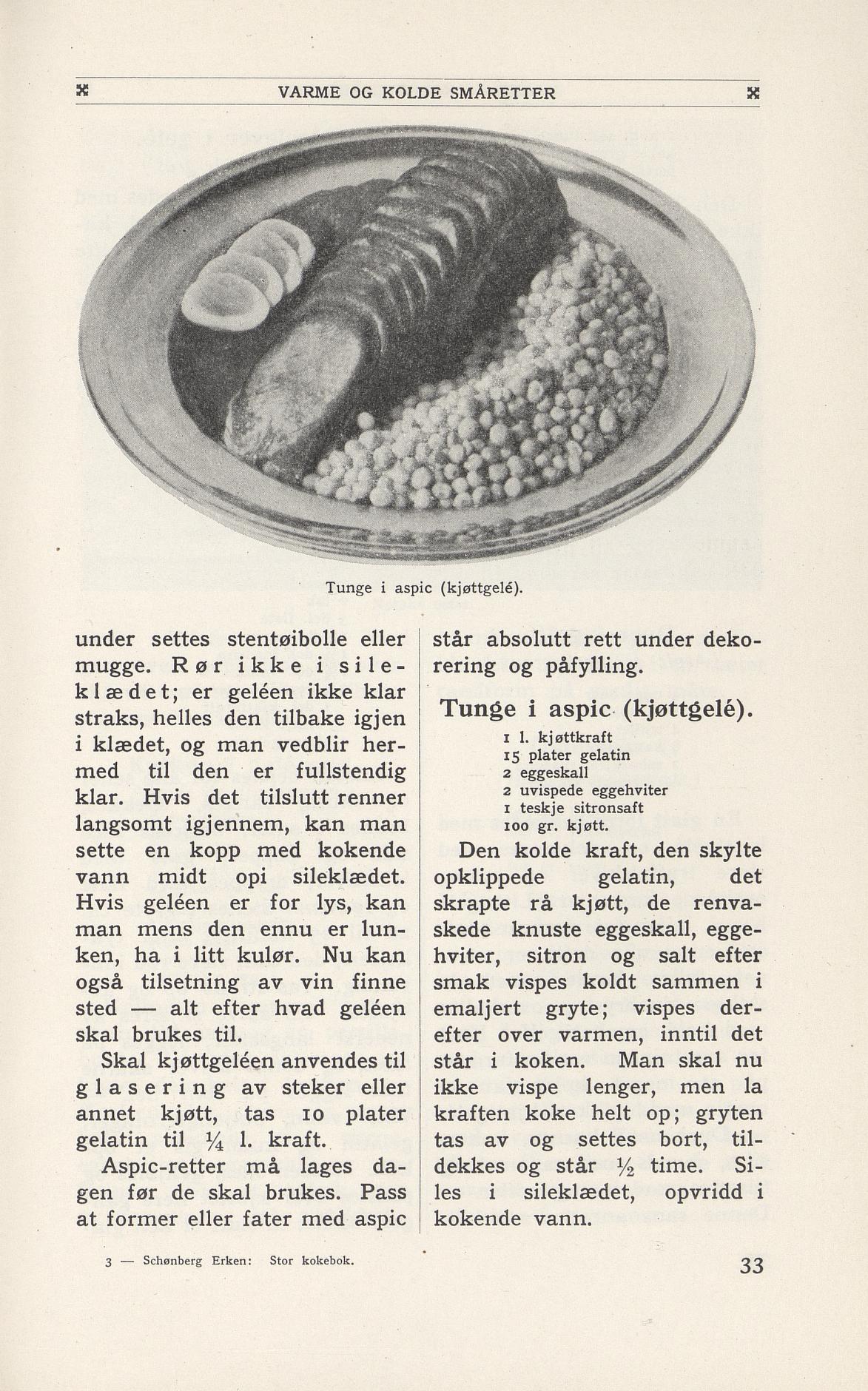
Tongue in aspic (meat jelly)

Erken's cold small dish: slices of cooked salted tongue arranged on a platter, garnished with cooked root vegetables and parsley/lettuce and glazed layer by layer with strained meat jelly until covered; set overnight, cut out and served on a rice base or in a ring with Italian salad.

Source: Henriette Schønberg Erken, Stor kokebok, 1914-utg. s. 24 (falt i det fri)

Be the first to rate

About the dish

A classic cold presentation from the chapter 'Varme og kolde smaaretter' (hot and cold small dishes), where cooked salted tongue is glazed with clear meat jelly (aspic) and garnished with cooked vegetables. The dish assumes you have made meat jelly according to the recipe earlier in the book, which is strained through a straining cloth wrung out in boiling water.

How to make it

  1. 1

    Slice the tongue

    Cut the cooked tongue into not-too-thick slices, slightly on the diagonal.

  2. 2

    Arrange

    Lay the slices out on a platter with a little space between each slice.

  3. 3

    Garnish

    Place cooked, neatly cut root vegetables on the tongue slices – not too much – and a little parsley or finely cut lettuce.

  4. 4

    Glaze with jelly

    Pour a little of the strained meat jelly over. Keep pouring on a little at a time until the slices are completely covered.

  5. 5

    Set

    Leave in a cool place until the jelly is completely firm, preferably until the next day.

  6. 6

    Plate

    Cut the tongue slices neatly out of the jelly and arrange them on a rice base, or in a ring on the platter with ice-cold Italian salad in the center.

Changes from the original

Quantities are estimated for an ordinary salted tongue; 'kjøtgelé' is given as about 1 liter of clear meat-stock jelly. The method is divided into numbered steps in modern Norwegian, but the content is unchanged.

Tidsmaskin – hva endret seg?

Velg to utgaver og se hva Henriette Schønberg Erken la til, fjernet eller endret mellom dem.

1914 (korrekturlest, s. 24)1949 (korrekturlest, s. 33)~79% av teksten endretfjernetlagt til
1 kokt l. kjøttkraft 15 plater gelatin 2 eggeskall 2 uvispede eggehviter 1 teskje sitronsaft 100 gr. kjøtt. Den kolde kraft, den skylte opklippede gelatin, det skrapte rå kjøtt, de renvaskede knuste eggeskall, eggehaviter, sitron og salt tunge kokte grønsaker persille eller salat kjøtgelé efter smak vispes koldt sammen i emaljert gryte; vispas derefter over varmen, inntil det står i koken. Man skal nu ikke vispe lenger, men la kraften koke helt op; gryten tas av og settes bort, tildeckes og står ½ time. Siles i sileklædet, opvridd i kokende vann. Den kokte tunge skjæres i ikke for tykke skiver litt paa skraa, lægges på skrå, legges utover et fat med litt mellemrum mellem skiverne. Paa tungeskiverne lægges kokte, pent utskaarne røtter — ikke for meget — og litt persille eller finskaaren salat. skivene. Herover heldes helles noget av den silede kjøtgelé; silte kjøttgelé; man vedblir litt efter litt at helde paa, å helle på, til tungeskiverne tungeskivene er helt dækket. Naar dekket. Når dette er ganske stivt — helst næste dag — skjæres tungeskiverne pent ut. Disse serveres tungen med erter og spinat. Den kokte kolde tunge kan anrettes paa risbord, eller serveres hel i rundkreds paa fatet aspic og med iskold hakket aspic til pynt. Iskold italiensk salat i midten. serveres til.

Community interpretations

Be the first to share your own version.

See interpretations

Frequently asked questions

Why does the dish take so long – 12 hours?
The work itself is quick, but the meat jelly must set completely. The recipe recommends leaving the platter until the next day before the tongue slices are neatly cut out.
How do I get the jelly to cover the tongue slices evenly?
Use strained meat jelly and pour it on a little at a time, in several layers, until the slices are completely covered. That way the garnish stays in place and the layer becomes even.
What is placed on the tongue slices, and how is the dish plated?
Cooked salted tongue is cut into not-too-thick slices on the diagonal, and garnished with cooked, neatly cut root vegetables (not too much) and a little parsley or finely cut lettuce. Served on a rice base or in a ring on the platter with ice-cold Italian salad in the center.
Where does the recipe come from?
From Henriette Schønberg Erken's 'Stor kokebok' (1914), page 24, in the chapter on hot and cold small dishes.

Related recipes

More dishes in the same category from the archive

Read also

Kommentarer

Ingen kommentarer ennå. Bli den første til å dele!