Skip to content

Pork tenderloin with parsley (filet de porc)

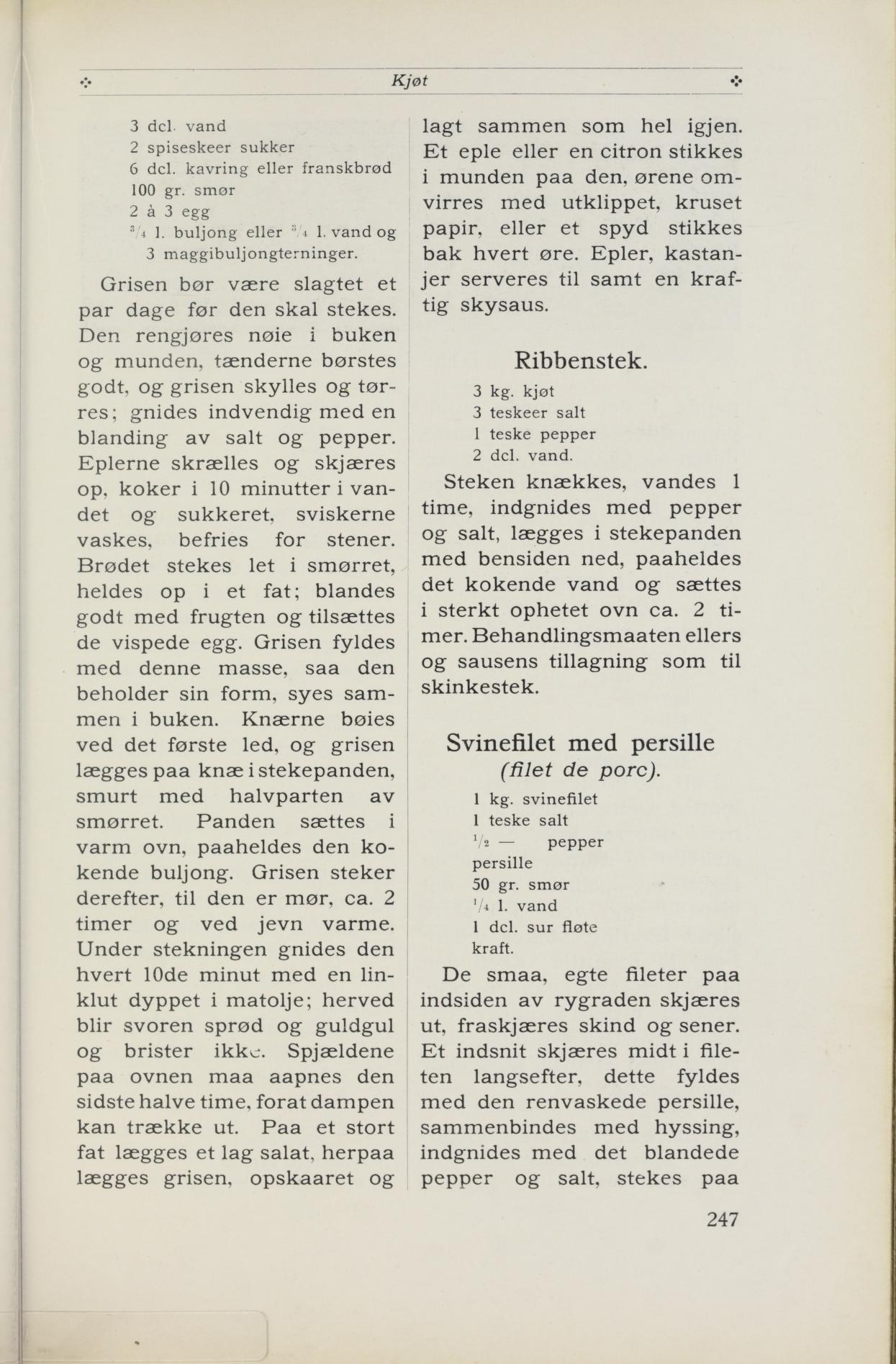
Erken's pork tenderloin with parsley (1914): tenderloin slit lengthwise, filled with parsley, tied up, browned in butter, and braised about 30 min in water, sour cream, and stock; the stock is reduced into a sauce.

Source: Henriette Schønberg Erken, Stor kokebok, 1914-utg. s. 247 (falt i det fri)

Be the first to rate

About the dish

One of Erken's finer pork dishes, listed with a French name as was the fashion in 1914. "De egte fileter" is the tenderloin that lies along the inside of the backbone; it is filled with parsley and braised tender in a creamy stock.

How to make it

  1. 1

    Clean the tenderloin

    Cut out the small, true tenderloins that lie along the inside of the backbone, and remove skin and sinews.

  2. 2

    Fill with parsley

    Cut a lengthwise slit in the middle of the tenderloin and fill it with the well-washed parsley. Tie the tenderloin together with kitchen twine.

  3. 3

    Season and brown

    Rub the tenderloin with mixed salt and pepper, and brown it in the butter in a pan.

  4. 4

    Braise tender

    Thin with boiling water, the cream, and about 2½ dl stock. Let the meat braise gently under a lid for about 30 minutes.

  5. 5

    Cook the sauce

    Take up the tenderloin and keep it warm. Continue cooking the sauce until it has thickened somewhat, season to taste, and pour it over the meat when serving.

Changes from the original

Measurements are converted to modern units (grams, dl, teaspoon). Twine is kept as kitchen twine, and "sour cream" is interpreted as mountain sour cream/cultured cream. The method is broken into steps and modernized in language.

In stores now

Clean, minimally processed groceries matched to the ingredients — approximate prices.

Product data and prices via Kassalapp. Prices are updated daily and may vary.

Time machine – what changed?

Pick two editions and see what Henriette Schønberg Erken added, removed or changed between them.

Modernised → 1914 (proofread, p. 247)~85% of the text changedremovedadded
1 kg kg. svinefilet (indrefilet, renskåret). 1 ts salt. 1 ts teske salt pepper (etter smak). 1 bunt persille (godt vasket). 50 g smør. 2,5 dl vann (kokende). gr. smør 1/4 1. vand 1 dl del. sur fløte (kulturfløte eller seterrømme). 2,5 dl kjøttkraft. Skjær ut de små, ekte filetene som ligger på innsiden kraft. De smaa, egte fileter paa indsiden av ryggraden, og fjern hud rygraden skjæres ut, fraskjæres skind og sener.. Skjær et snitt på langs sener. Et indsnit skjæres midt i fileten og fyll det langsefter, dette fyldes med den godt vaskede persillen. Bind fileten sammen renvaskede persille, sammenbindes med steketråd.. Gni fileten inn hyssing, indgnides med blandet salt og pepper, det blandede pepper og brun den i smøret salt, stekes paa pande i en panne.. Spe med det brunede smør, paaspædes det kokende vann, vand, fløten og ca. 2½ dl kraft. La kjøttet småsurre under lokk 1/4 1. kraft, smaasurrer ca. 30 minutter.. Ta opp fileten og hold den varm. Kok 1/2 time; sausen videre til koker, indtil den har jevnet seg noe, smak til, og hell den over kjøttet ved anretningen. sig noget.

Note on Modernised

Mål er omregnet til moderne enheter (gram, dl, teskje). Hyssing er beholdt som steketråd, og «sur fløte» er tolket som seterrømme/kulturfløte. Fremgangsmåten er delt i trinn og modernisert språklig.

Community interpretations

Be the first to share your own version.

See interpretations →

Frequently asked questions

Which part of the pig is used?
The small, true tenderloins that lie along the inside of the backbone (the tenderloin). Skin and sinews are cut away before preparation.
How is the tenderloin filled with parsley?
Cut a lengthwise incision in the middle of the tenderloin, fill it with clean-washed parsley, and tie it together with string. Then rub it with salt and pepper.
How long should the meat cook?
The tenderloin is browned in 50 g butter in a pan, thinned with boiling water, 1 dl sour cream, and about 1/4 liter of stock, and braises gently for about 1/2 hour. The sauce is cooked further until it has thickened somewhat.
Where does the recipe come from?
From Henriette Schønberg Erken's "Stor kokebok" from 1914, page 247. The quantity given is 1 kg pork tenderloin, enough for four servings.

Related recipes

More dishes in the same category from the archive

Read also

Kommentarer

Ingen kommentarer ennå. Bli den første til å dele!