Skip to content

Ptarmigan Pâté

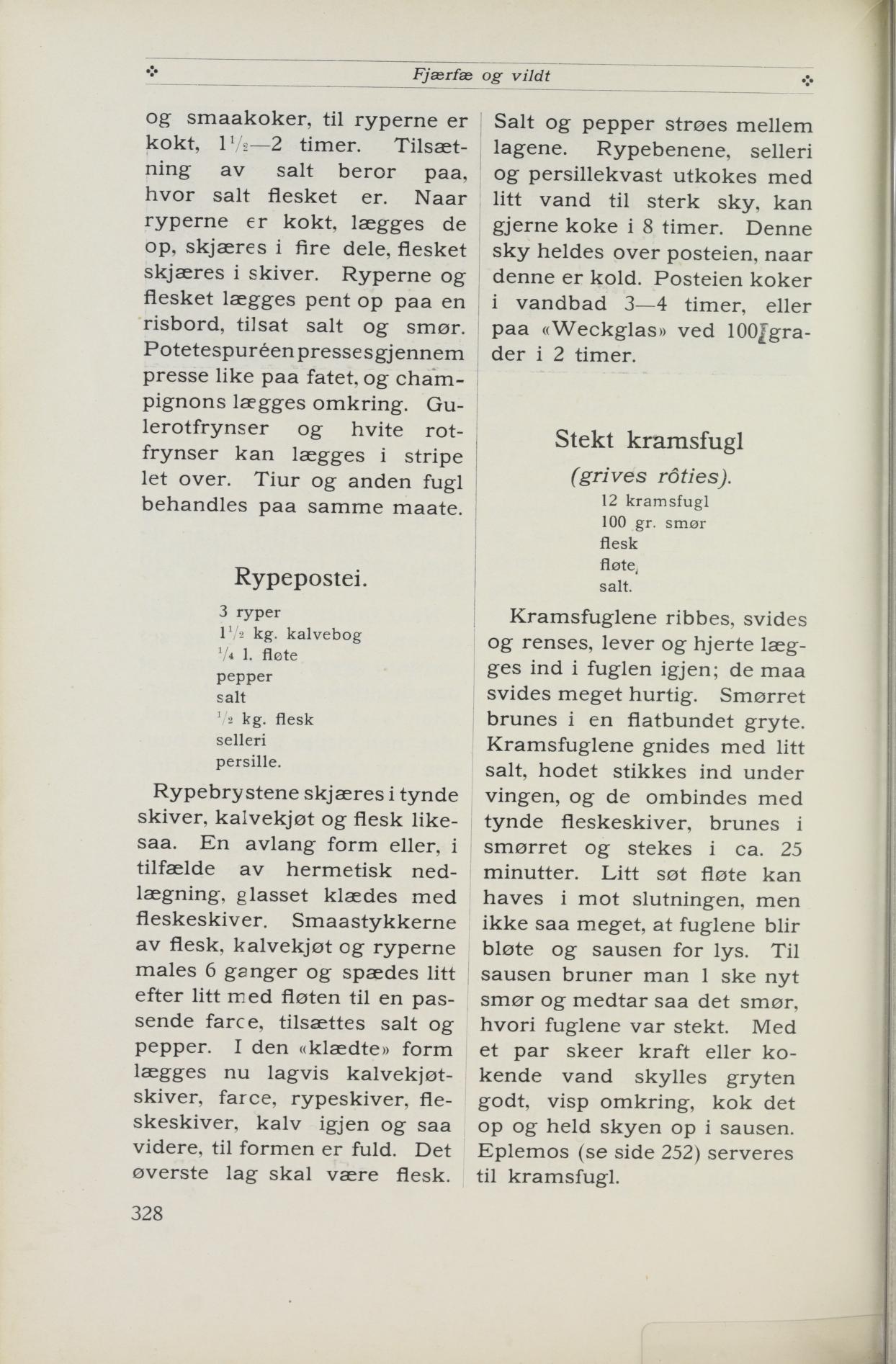
Classic ptarmigan pâté from Erken's Stor kokebok 1914: layers of ptarmigan breast, veal and pork slices with a forcemeat of ground ptarmigan, veal and pork thinned with cream, baked in a water bath 3–4 hours and covered with a strong jus cooked from ptarmigan bones, celeriac and parsley.

Source: Henriette Schønberg Erken, Stor kokebok, 1914-utg. s. 328 (falt i det fri)

Be the first to rate

About the dish

From the chapter on poultry and game in "Stor kokebok" (1914). Ptarmigan pâté was festive fare and a way to use the whole bird – the breasts in slices, the rest for forcemeat, the bones for a rich jus. Erken also mentions canning in "Weck jars," which were fashionable in Norwegian households at this time.

How to make it

  1. 1

    Cut up the birds

    Cut the ptarmigan breasts free and slice them thin. Cut the veal into thin slices, and cut the pork slices thin. Set the ptarmigan bones aside.

  2. 2

    Line the mold

    Line an oblong mold (or canning jars) with thin pork slices.

  3. 3

    Make the forcemeat

    Run the small pieces of pork, veal and ptarmigan meat through a meat grinder several times (the original says 6 times) into a fine forcemeat. Thin gradually with the cream to a suitable consistency, and season with salt and pepper.

  4. 4

    Layer up

    Layer veal slices, forcemeat, ptarmigan slices, pork slices, veal again and so on until the mold is full. Sprinkle salt and pepper between the layers. The top layer should be pork.

  5. 5

    Cook the jus

    Boil the ptarmigan bones with celeriac and a sprig of parsley in a little water into a strong jus – preferably 3 hours. Strain the jus.

  6. 6

    Bake in a water bath

    Set the mold in a water bath and let the pâté cook 3–4 hours (about 150 °C (300 °F) in the oven with a water bath). If canning in jars: 100 °C (210 °F) for 2 hours.

  7. 7

    Pour over the jus

    When the pâté is cold, pour the strong jus over it so that it sets around and over the pâté. Serve cold, in slices.

Changes from the original

Amounts have been converted to modern measures (grams, dl). "Flesk" (pork) is interpreted as fresh, fatty pork belly/fatback in slices. "Ground 6 times" has been modernized to a meat grinder/food processor. Oven temperature and water bath have been specified.

In stores now

Clean, minimally processed groceries matched to the ingredients — approximate prices.

Product data and prices via Kassalapp. Prices are updated daily and may vary.

Time machine – what changed?

Pick two editions and see what Henriette Schønberg Erken added, removed or changed between them.

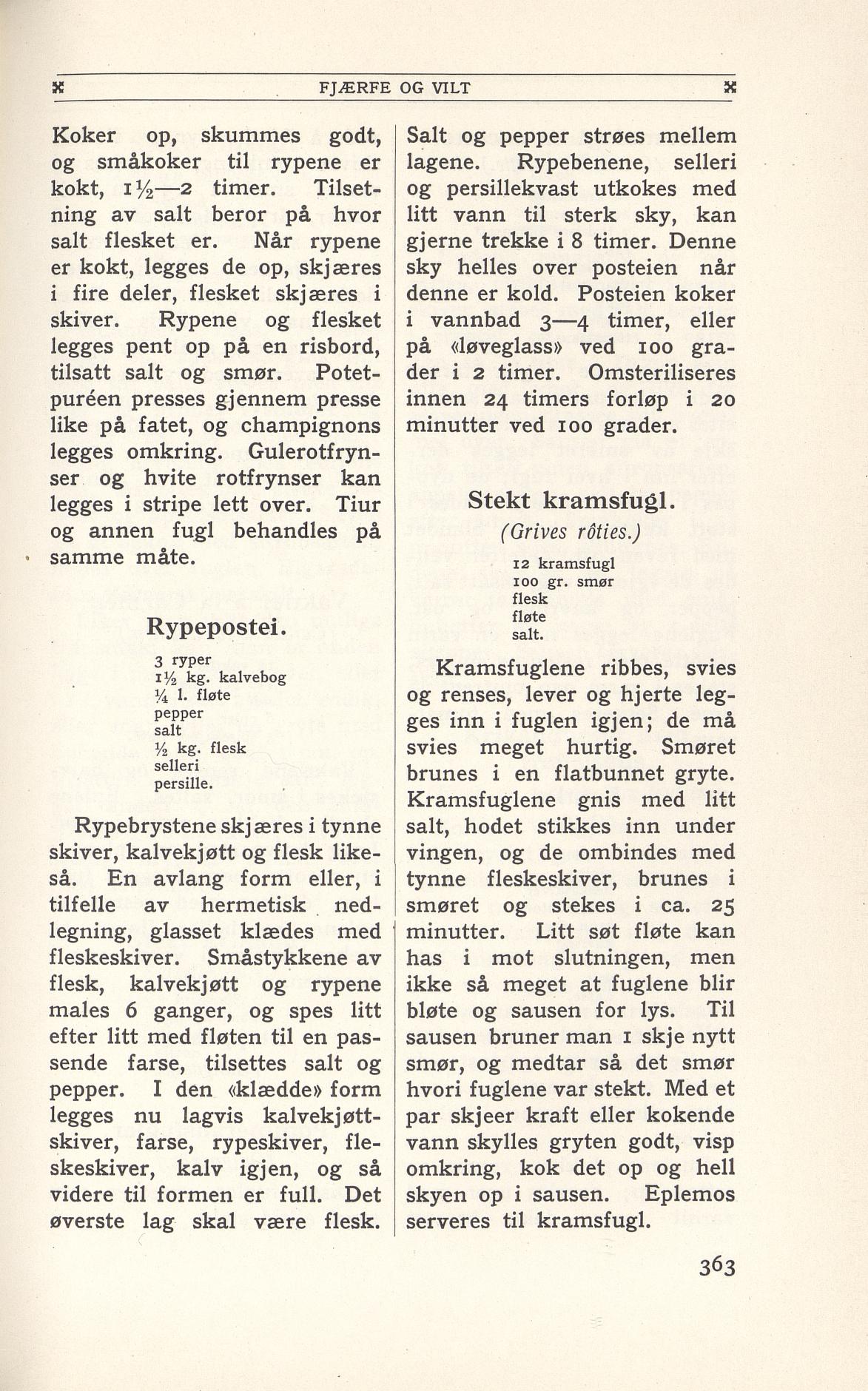
1949 (proofread, p. 363) → Modernised~81% of the text changedremovedadded
3 stk ryper 1 1/2 kg. (renset). 500 g kalvebog 1/4 l. fløte pepper (uten ben). 250 g fersk sideflesk (i tynne skiver). 2,5 dl fløte. 1 stk sellerirot (lite stykke, til kraften). 1 bunt persille (til kraften). 2 ts salt 1/2 kg. flesk selleri persille. Rypebrystene skjæres (etter smak). 0,5 ts pepper (etter smak). Skjær rypebrystene fri og skjær dem i tynne skiver. Skjær kalvekjøttet i tynne skiver, kalvekjøtt og flesk likeså. En skjær fleskeskivene tynne. Sett rypebeina til side.. Kle en avlang form eller, i tilfelle av hermetisk nedlegning, glasset klædes (eller glass til hermetisering) med fleskeskiver. Småstykkene tynne fleskeskiver.. Kjør småstykkene av flesk, kalvekjøtt og rypene males rypekjøtt gjennom kjøttkvern flere ganger (originalen sier 6 ganger, og spes ganger) til en fin farse. Spe litt efter om litt med fløten til en passende farse, tilsettes konsistens, og smak til med salt og pepper. I den «klædde» form legges nu pepper.. Legg lagvis kalvekjøttskiver, farse, rypeskiver, fleskeskiver, kalv igjen, igjen og så videre til formen er full. Det øverste lag skal være flesk. Salt Strø salt og pepper strøes mellem mellom lagene. Rypebenene, selleri Øverste lag skal være flesk.. Kok rypebeina med sellerirot og persillekvast utkokes med i litt vann til en sterk sky, kan sky – gjerne trekke i 8 3 timer. Denne sky helles over posteien når denne er kold. Posteien koker Sil skyen.. Sett formen i vannbad 3—4 timer, eller og la posteien koke 3–4 timer (ca. 150 °C i ovn med vannbad). Ved hermetisering på «løveglass» ved glass: 100 grader °C i 2 timer. Omsteriliseres innen 24 timers forløp timer.. Når posteien er kald, helles den sterke skyen over, slik at den stivner rundt og over posteien. Serveres kald i 20 minutter ved 100 grader. skiver.

Note on Modernised

Mengder er omregnet til moderne mål (gram, dl). «Flesk» er tolket som fersk, fet sideflesk/spekk i skiver. «Males 6 ganger» er modernisert til kjøttkvern/foodprosessor. Bakeovnstemperatur og vannbad er presisert.

Community interpretations

Be the first to share your own version.

See interpretations →

Frequently asked questions

Which cuts of meat are used in the ptarmigan pâté?
3 ptarmigan (the breasts sliced thin), ½ kg veal shoulder and ¼ kg pork. The rest of the meat is ground into a forcemeat with ¼ l cream.
How is the pâté layered in the mold?
The mold (or jar, if canned) is lined with pork slices. Then layers of veal slices, forcemeat, ptarmigan slices, pork slices, veal again and so on are added until the mold is full. The top layer should be pork, and salt and pepper are sprinkled between the layers.
What are the ptarmigan bones used for?
The ptarmigan bones are cooked out with celeriac, a sprig of parsley and a little water into a strong jus – it can boil for 3 hours – and the jus is poured over the pâté.
How many times should the forcemeat be ground?
The small pieces of pork, veal and ptarmigan are ground 6 times and thinned little by little with the cream into a suitable forcemeat, with salt and pepper.

Equipment for this dish

Advertisement

We may earn a commission if you buy through these links. It does not affect the price.

Related recipes

More dishes in the same category from the archive

Read also

Kommentarer

Ingen kommentarer ennå. Bli den første til å dele!