Skip to content

Ptarmigan Pâté

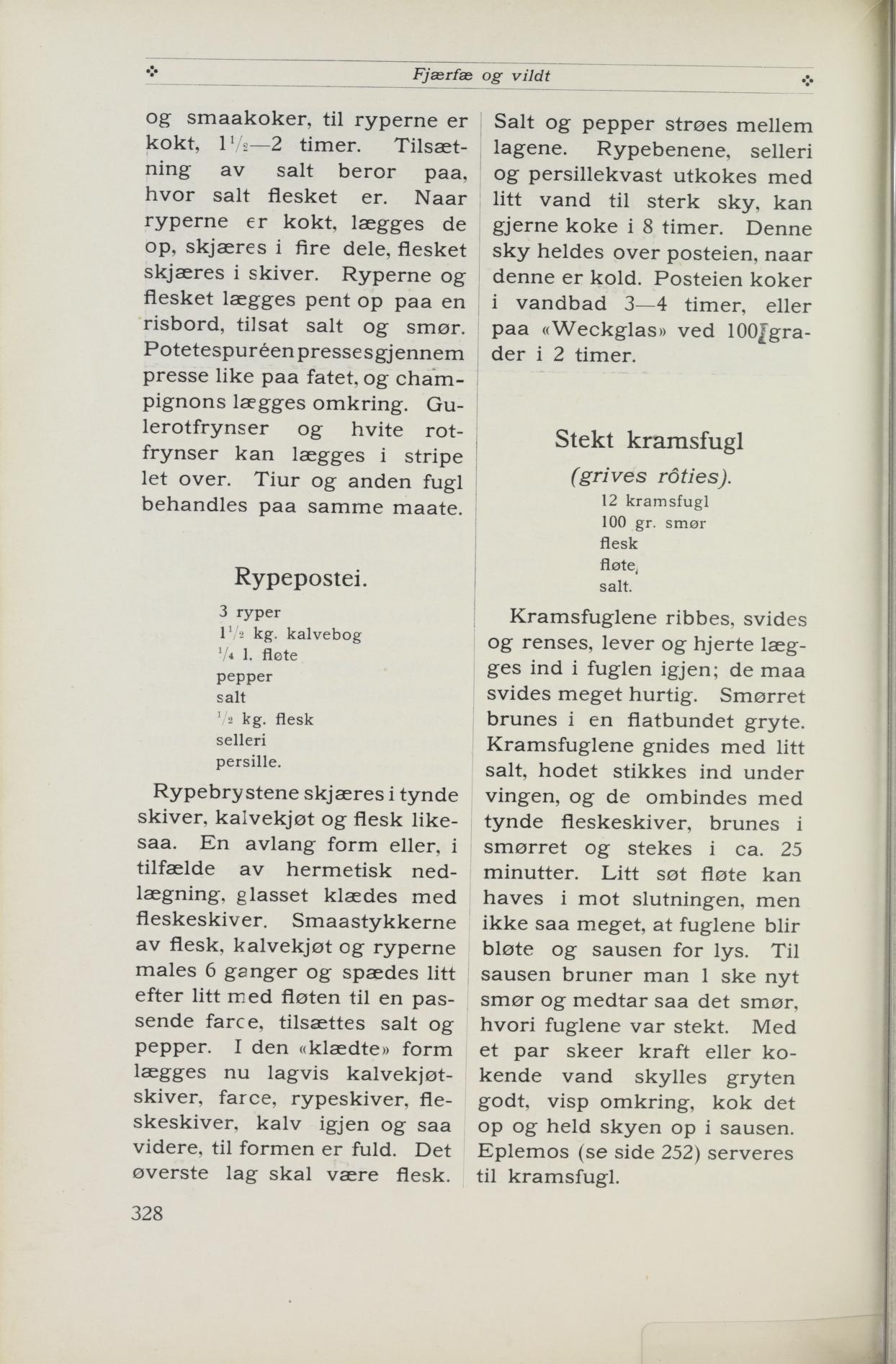
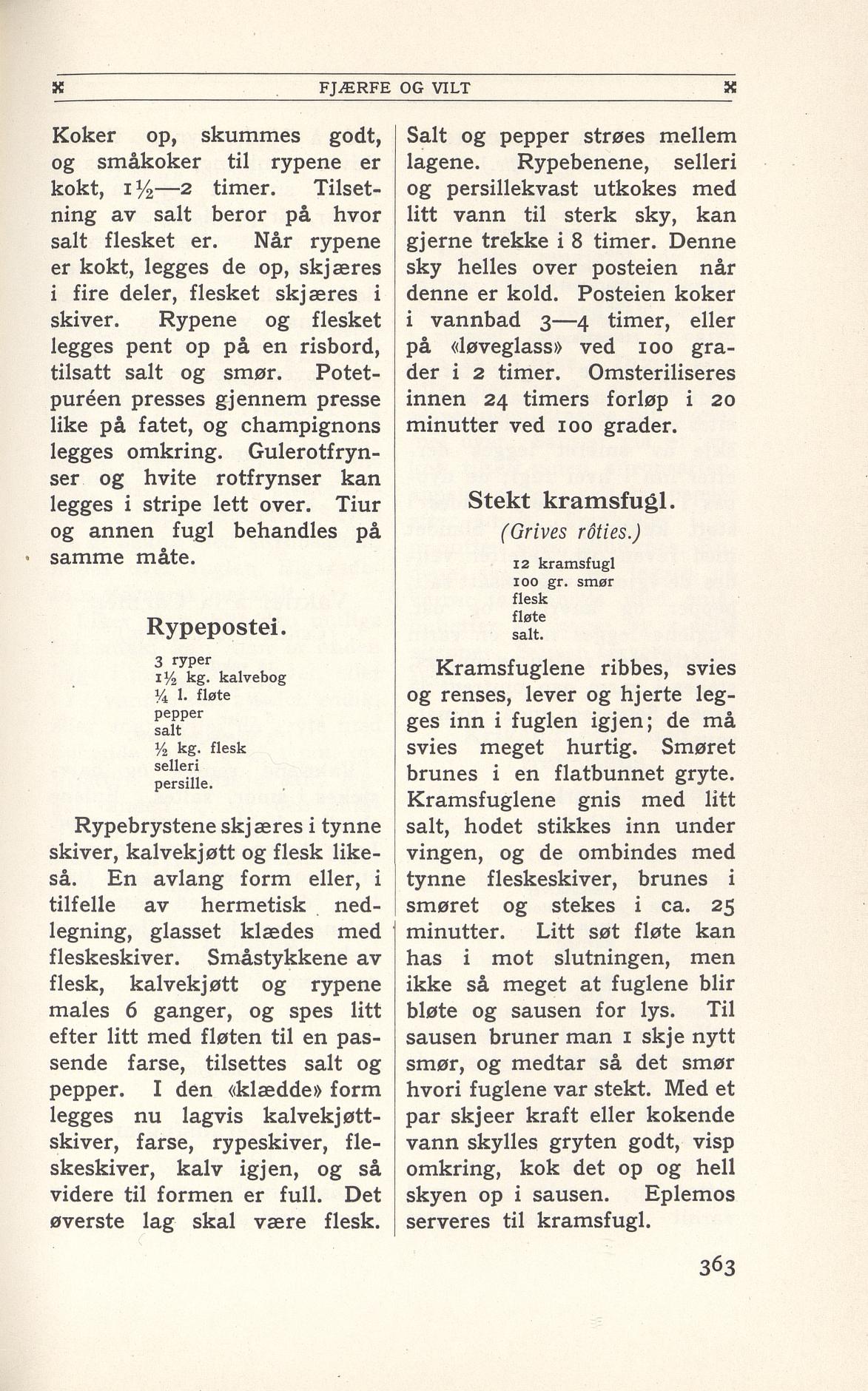
Classic ptarmigan pâté from Erken's Stor kokebok 1914: layers of ptarmigan breast, veal and pork slices with a forcemeat of ground ptarmigan, veal and pork thinned with cream, baked in a water bath 3–4 hours and covered with a strong jus cooked from ptarmigan bones, celeriac and parsley.

Source: Henriette Schønberg Erken, Stor kokebok, 1914-utg. s. 328 (falt i det fri)

Be the first to rate

About the dish

From the chapter on poultry and game in "Stor kokebok" (1914). Ptarmigan pâté was festive fare and a way to use the whole bird – the breasts in slices, the rest for forcemeat, the bones for a rich jus. Erken also mentions canning in "Weck jars," which were fashionable in Norwegian households at this time.

How to make it

  1. 1

    Cut up the birds

    Cut the ptarmigan breasts free and slice them thin. Cut the veal into thin slices, and cut the pork slices thin. Set the ptarmigan bones aside.

  2. 2

    Line the mold

    Line an oblong mold (or canning jars) with thin pork slices.

  3. 3

    Make the forcemeat

    Run the small pieces of pork, veal and ptarmigan meat through a meat grinder several times (the original says 6 times) into a fine forcemeat. Thin gradually with the cream to a suitable consistency, and season with salt and pepper.

  4. 4

    Layer up

    Layer veal slices, forcemeat, ptarmigan slices, pork slices, veal again and so on until the mold is full. Sprinkle salt and pepper between the layers. The top layer should be pork.

  5. 5

    Cook the jus

    Boil the ptarmigan bones with celeriac and a sprig of parsley in a little water into a strong jus – preferably 3 hours. Strain the jus.

  6. 6

    Bake in a water bath

    Set the mold in a water bath and let the pâté cook 3–4 hours (about 150 °C (300 °F) in the oven with a water bath). If canning in jars: 100 °C (210 °F) for 2 hours.

  7. 7

    Pour over the jus

    When the pâté is cold, pour the strong jus over it so that it sets around and over the pâté. Serve cold, in slices.

Changes from the original

Amounts have been converted to modern measures (grams, dl). "Flesk" (pork) is interpreted as fresh, fatty pork belly/fatback in slices. "Ground 6 times" has been modernized to a meat grinder/food processor. Oven temperature and water bath have been specified.

In stores now

Clean, minimally processed groceries matched to the ingredients — approximate prices.

Product data and prices via Kassalapp. Prices are updated daily and may vary.

Tidsmaskin – hva endret seg?

Velg to utgaver og se hva Henriette Schønberg Erken la til, fjernet eller endret mellom dem.

1914 (korrekturlest, s. 328)1949 (korrekturlest, s. 363)~47% av teksten endretfjernetlagt til
3 ryper ½ 1 1/2 kg. kalvebog ¼ kg. flesk ¼ 1/4 l. fløte selleri persille pepper salt pepper. 1/2 kg. flesk selleri persille. Rypebrystene skjæres i tynde tynne skiver, kalvekjøt kalvekjøtt og flesk likesaa. likeså. En avlang form eller, i tilfælde tilfelle av hermetisk nedlægning, nedlegning, glasset klædes med fleskeskiver. Smaastykkerne Småstykkene av flesk, kalvekjøt kalvekjøtt og ryperne rypene males 6 ganger ganger, og spædes spes litt efter litt med fløten til en passende farce, tilsættes farse, tilsettes salt og pepper. I den «klædte» «klædde» form lægges legges nu lagvis kalvekjøtskiver, farce, kalvekjøttskiver, farse, rypeskiver, fleskeskiver, kalv igjen igjen, og saa videre, så videre til formen er fuld. full. Det øverste lag skal være flesk. Salt og pepper strøes mellem lagene. Rypebenene, selleri og persillekvast utkokes med litt vand vann til sterk sky, kan gjerne koke trekke i 3 8 timer. Denne sky heldes helles over posteien, naar posteien når denne er kold. Posteien koker i vandbad vannbad 3—4 timer, eller paa «Weckglas» på «løveglass» ved 100 grader i 2 timer. Omsteriliseres innen 24 timers forløp i 20 minutter ved 100 grader.

Community interpretations

Be the first to share your own version.

See interpretations

Frequently asked questions

Which cuts of meat are used in the ptarmigan pâté?
3 ptarmigan (the breasts sliced thin), ½ kg veal shoulder and ¼ kg pork. The rest of the meat is ground into a forcemeat with ¼ l cream.
How is the pâté layered in the mold?
The mold (or jar, if canned) is lined with pork slices. Then layers of veal slices, forcemeat, ptarmigan slices, pork slices, veal again and so on are added until the mold is full. The top layer should be pork, and salt and pepper are sprinkled between the layers.
What are the ptarmigan bones used for?
The ptarmigan bones are cooked out with celeriac, a sprig of parsley and a little water into a strong jus – it can boil for 3 hours – and the jus is poured over the pâté.
How many times should the forcemeat be ground?
The small pieces of pork, veal and ptarmigan are ground 6 times and thinned little by little with the cream into a suitable forcemeat, with salt and pepper.

Related recipes

More dishes in the same category from the archive

Read also

Kommentarer

Ingen kommentarer ennå. Bli den første til å dele!