Skip to content

Rhubarb Wine I

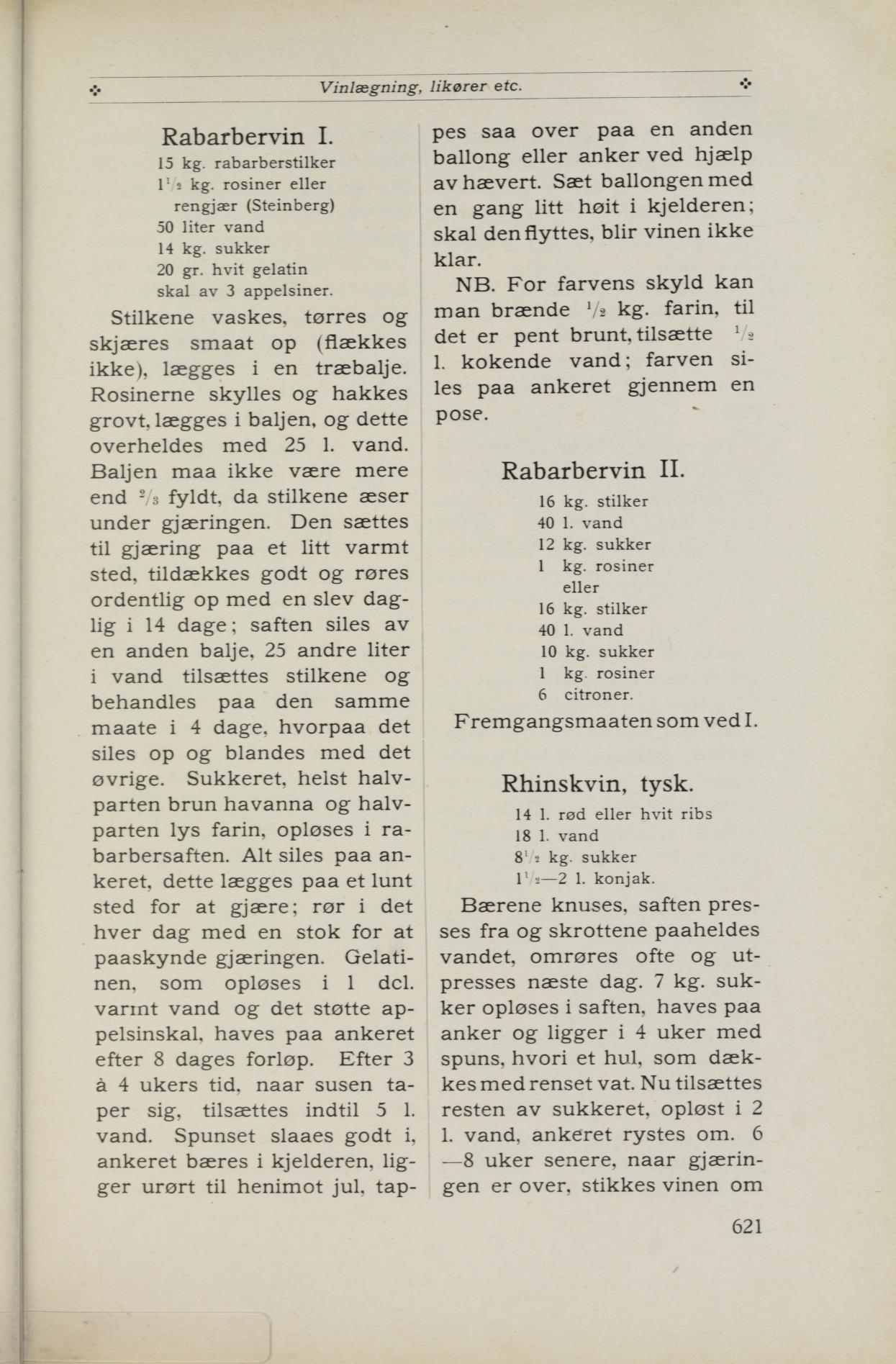
Erken's rhubarb wine I from 1914: 15 kg rhubarb stalks and 1.5 kg raisins fermented in two extractions with a total of 50 liters water, 14 kg sugar, clarified with gelatin and orange zest, aged in a cask until Christmas and racked off with a siphon.

Source: Henriette Schønberg Erken, Stor kokebok, 1914-utg. s. 621 (falt i det fri)

Be the first to rate

About the dish

Rhubarb wine was one of the most widespread homemade wines in Norwegian households around 1900, since rhubarb grew in almost every garden. Erken reckons with large quantities and the use of a cask ("anker") in the cellar.

How to make it

  1. 1

    Clean the rhubarb

    Wash the stalks, dry them, and cut them into small pieces without peeling them. Put them in a clean wooden tub or a large fermentation bucket.

  2. 2

    Raisins and water

    Rinse the raisins, chop them coarsely, and put them in the tub. Pour over 25 liters of water. The tub must not be filled more than two-thirds, as the mass swells during fermentation.

  3. 3

    First fermentation

    Set the tub in a warm place, cover it well, and stir vigorously with a ladle every day for 14 days. Then strain off the juice into another tub.

  4. 4

    Second extraction

    Pour 25 liters of fresh water over the stalks and treat the same way for 4 days. Strain off and mix with the first juice.

  5. 5

    Sugar

    Dissolve the sugar in the rhubarb juice. Strain everything into the cask or carboy and set it in a warm place to ferment. Stir it every day with a stick to speed up the fermentation.

  6. 6

    Gelatin and orange zest

    After 8 days, dissolve the gelatin in 1 dl warm water and pour it in together with the ground orange zest.

  7. 7

    Topping up

    After 3–4 weeks, when the fermentation calms down, top up with as much as 5 liters of water. Drive the bung in well.

  8. 8

    Aging

    Carry the cask down to the cellar and let it lie undisturbed until around Christmas. Then rack the wine off into another carboy or cask with a siphon. Place the carboy somewhat high in the cellar right away; if it is moved later, the wine will not become clear.

  9. 9

    Color (optional)

    For the sake of color, 250 g sugar can be burned until it is a nice brown, 0.5 liter boiling water added, and the color strained into the cask through a bag.

Changes from the original

Measurements are kept in kilos and liters, but "del." has been converted to deciliters. "Light refined sugar" and "brown havana" are given as light sugar and dark raw cane sugar. The steps have been broken up and the language modernized; fermentation temperature and hygiene are specified in modern terms.

Time machine – what changed?

Pick two editions and see what Henriette Schønberg Erken added, removed or changed between them.

Pick two different editions to see a comparison.

Community interpretations

Be the first to share your own version.

See interpretations →

Frequently asked questions

How long does the rhubarb wine take?
Allow plenty of time: 14 days of fermentation on the first water, then 4 days on fresh water, and further aging – about half a year in all (roughly 180 days) before the wine is ready.
What quantities are needed?
15 kg rhubarb stalks, 1½ kg raisins (or pure yeast, Steinberg), 50 liters water (25 l first, 25 l on the stalks afterward), 14 kg sugar, 20 g white gelatin, and the zest of 3 oranges.
How are the rhubarb stalks treated?
They are washed, dried, and cut into small pieces – they are not peeled. Put them in a wooden tub together with coarsely chopped, rinsed raisins and pour over 25 liters of water.
Why should the tub be filled only 2/3 full?
The stalks "work" (swell and rise) during fermentation, so there must be room. The tub is set in a warm place, covered well, and stirred well with a ladle daily for 14 days.

Related recipes

More dishes in the same category from the archive

Read also

Kommentarer

Ingen kommentarer ennå. Bli den første til å dele!