Skip to content

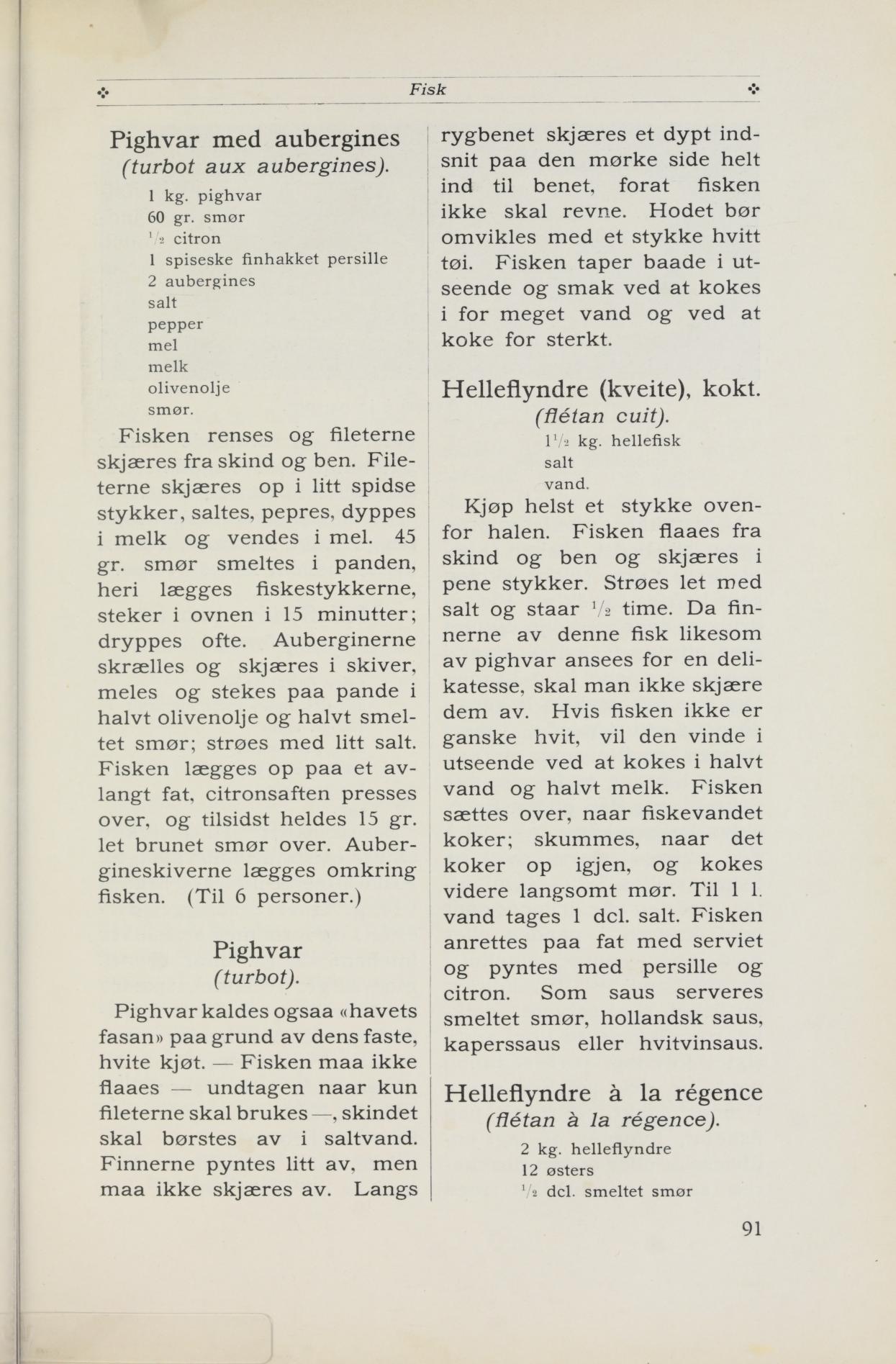
Turbot with Eggplant (turbot aux aubergines)

Erken's oven-baked turbot fillets (1914): the fillets are coated in milk and flour, baked 15 minutes in butter in the oven and served with floured, pan-fried eggplant slices, lemon juice, parsley and browned butter. Serves 6.

Source: Henriette Schønberg Erken, Stor kokebok, 1914-utg. s. 91 (falt i det fri)

Be the first to rate

About the dish

The page belongs to the fish chapter's section on turbot and halibut. Erken reminds us that turbot is called "the pheasant of the sea" for its firm, white flesh, that the fish should not be skinned (except when only the fillets are used), that the skin is brushed off in salt water, that the fins are not cut away, and that a deep cut is made along the backbone on the dark side so the fish doesn't split.

How to make it

  1. 1

    Clean the fish

    Clean the turbot and cut the fillets free from skin and bone. Cut the fillets into slightly pointed pieces.

  2. 2

    Season and coat

    Salt and pepper the fish pieces, dip them in milk and turn them in flour.

  3. 3

    Bake the fish

    Melt 45 g butter in a roasting pan or ovenproof dish, add the fish pieces and bake them in the oven at about 200 °C (390 °F) for 15 minutes. Baste often with the butter in the dish.

  4. 4

    Fry the eggplant

    Peel the eggplants, cut them into slices, flour them and fry them in a pan in half olive oil and half melted butter. Sprinkle a little salt over.

  5. 5

    Plating

    Place the fish on an oblong platter, squeeze the lemon juice over and finally pour 15 g lightly browned butter over. Sprinkle with finely chopped parsley and arrange the eggplant slices around the fish.

Changes from the original

Measurements are converted to modern units (deciliters/tablespoons, grams), unspecified amounts of flour/milk/oil are estimated, and the method is divided into steps in modern Norwegian. An oven temperature is given (about 200 °C (390 °F)), which the original does not state.

In stores now

Clean, minimally processed groceries matched to the ingredients — approximate prices.

Product data and prices via Kassalapp. Prices are updated daily and may vary.

Tidsmaskin – hva endret seg?

Velg to utgaver og se hva Henriette Schønberg Erken la til, fjernet eller endret mellom dem.

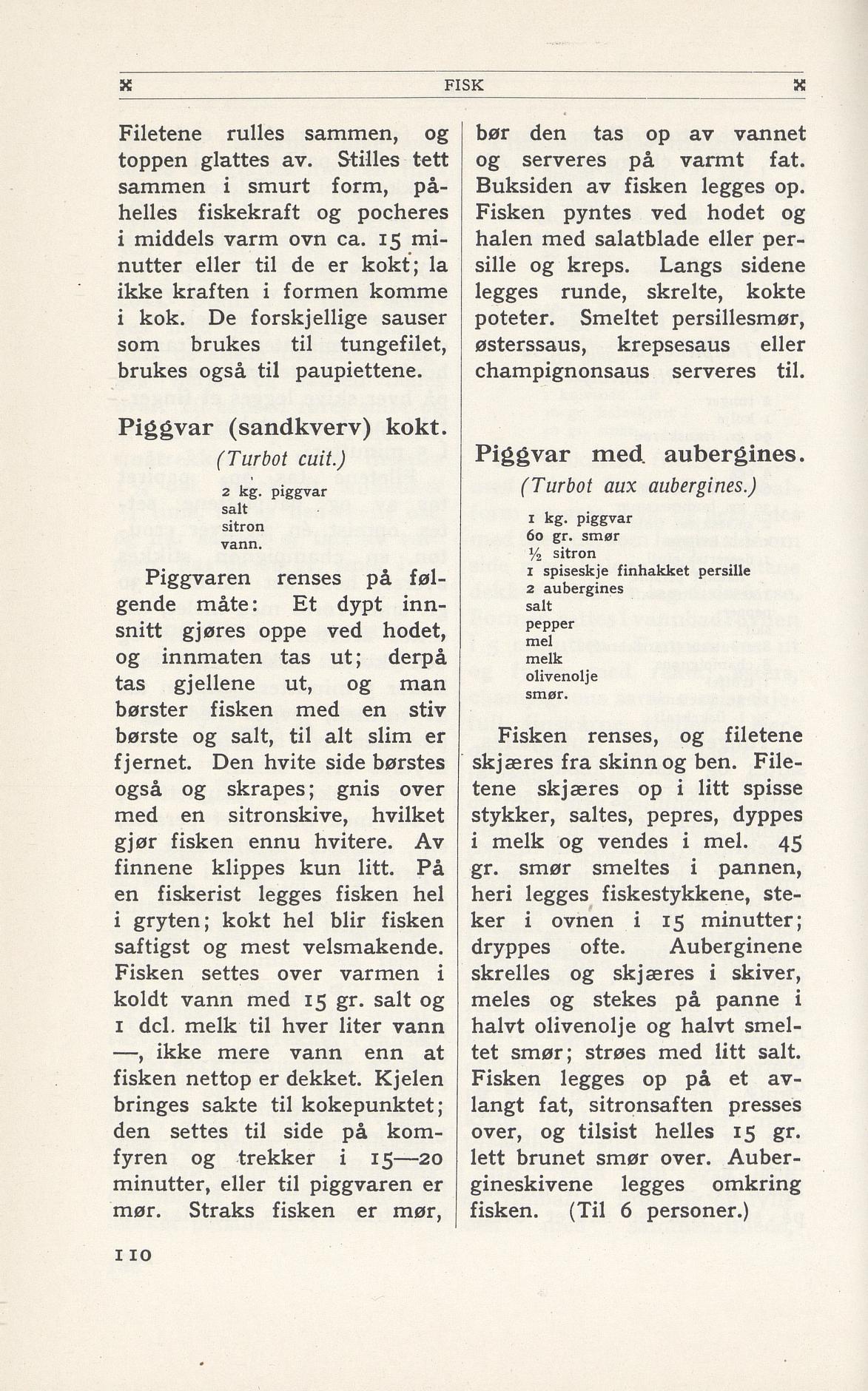
1914 (korrekturlest, s. 91)1949 (korrekturlest, s. 110)~38% av teksten endretfjernetlagt til
1 kg. pighvar piggvar 60 gr. smør 1/2 sitron 1 spiseske spiseskje finhakket persille 2 aubergines salt pepper mel melk olivenolje smør citron. smør. Fisken renses renses, og fileterne filetene skjæres fra skind skinn og ben. Fileterne Filetene skjæres op i litt spidse spisse stykker, saltes, pepres, dyppes i melk og vendes i mel. 45 gr. smør smeltes i panden, pannen, heri lægges fiskestykkerne, steker legges fiskestykkene, stekes i ovnen i 15 minutter; dryppes ofte. Auberginerne skrælles Auberginene skrelles og skjæres i skiver, meles og stekes paa pande på panne i halvt olivenolje og halvt smeltet smør; strøes med litt salt. Fisken lægges legges op paa et avlangt fat, citronsaften sitronsaften presses over, og tilsidst heldes tilsist helles 15 gr. let lett brunet smør over. Aubergineskiverne lægges Aubergineskivene legges omkring fisken. (Til 6 personer.)

Community interpretations

Be the first to share your own version.

See interpretations

Frequently asked questions

How long are the turbot fillets baked?
The fish pieces are baked in the oven for about 15 minutes in 45 g melted butter, and should be basted often with the butter along the way.
How is the eggplant prepared?
They're peeled, cut into slices, turned in flour and fried in a pan in half olive oil and half melted butter. Sprinkle a little salt over. The slices are arranged around the fish on the platter.
Why is the fish dipped in milk before the flour?
The milk makes the flour stick to the fillet, so it forms a nice crust. The fillets are salted and peppered first, then milk and then flour.
How is the dish finished at serving?
The fish is placed on an oblong platter, lemon juice is squeezed over, and finally 15 g lightly browned butter is poured over. The recipe serves 6 and is taken from Schønberg Erken's Stor kokebok (1914), p. 91.

Related recipes

More dishes in the same category from the archive

Read also

Kommentarer

Ingen kommentarer ennå. Bli den første til å dele!