Whole boiled turbot (2 kg): cleaned without skinning, brushed with salt, rubbed with lemon, a deep cut along the backbone. Placed on a fish rack in lukewarm salted water (1 tbsp salt/l), brought quickly to a boil and then poached 20–30 minutes off high heat. Served belly-up on a napkin, garnished with parsley/crayfish and boiled potatoes, with melted parsley butter, oyster, crayfish or mushroom sauce.
Source: Henriette Schønberg Erken, Stor kokebok, 1914-utg. s. 90 (falt i det fri)
Be the first to rate
About the dish
Turbot was called "the pheasant of the sea" for its firm, white flesh and was one of the most costly fish on middle-class banquet tables around 1914. Erken stresses that the fish should be boiled whole and finish poaching off high heat — a technique that still gives the juiciest result.
How to make it
1
Cleaning
Make a deep cut up by the head and remove the innards. Take out the gills.
2
Brushing
Brush the fish with a stiff brush and salt until all slime is removed. Brush and scrape the white side as well. The fish should not be skinned.
3
Lemon and fins
Rub the fish all over with a lemon slice; it makes it even whiter. Trim only a little off the fins — they should not be cut away.
4
Slit
Cut a deep slit along the backbone on the dark side, all the way to the bone, so the fish doesn't split during cooking. You may wrap the head in a piece of white cloth.
5
Cooking
Place the fish whole on a fish rack in the pot. Pour in good lukewarm water with about 1 tablespoon of salt per liter — no more water than just barely covers the fish.
6
Poaching
Set the pot over high heat and let it come quickly to the boiling point. Draw the pot aside and let the fish poach for 20–30 minutes, until tender. It must not boil hard.
7
Plating
Lift the fish out of the water as soon as it's tender. Place it belly-up on a warm fish platter lined with a folded napkin.
8
Garnish and serving
Garnish at the head and tail with lettuce leaves or parsley and, if you like, crayfish. Arrange round, peeled, boiled potatoes along the sides. Serve melted parsley butter, oyster sauce, crayfish sauce or mushroom sauce alongside.
Changes from the original
Measurements are modernized: "1 part salt to every liter of water" is converted to about 1 tablespoon of salt per liter of water. The fish rack is kept, but it's noted that a cloth can be used instead. Accompaniments and sauces are kept as optional suggestions.
📖1914
Original 1914 recipe
Verbatim from the first edition of the Big Cookbook.
Foto: Faksimile: Nasjonalbiblioteket
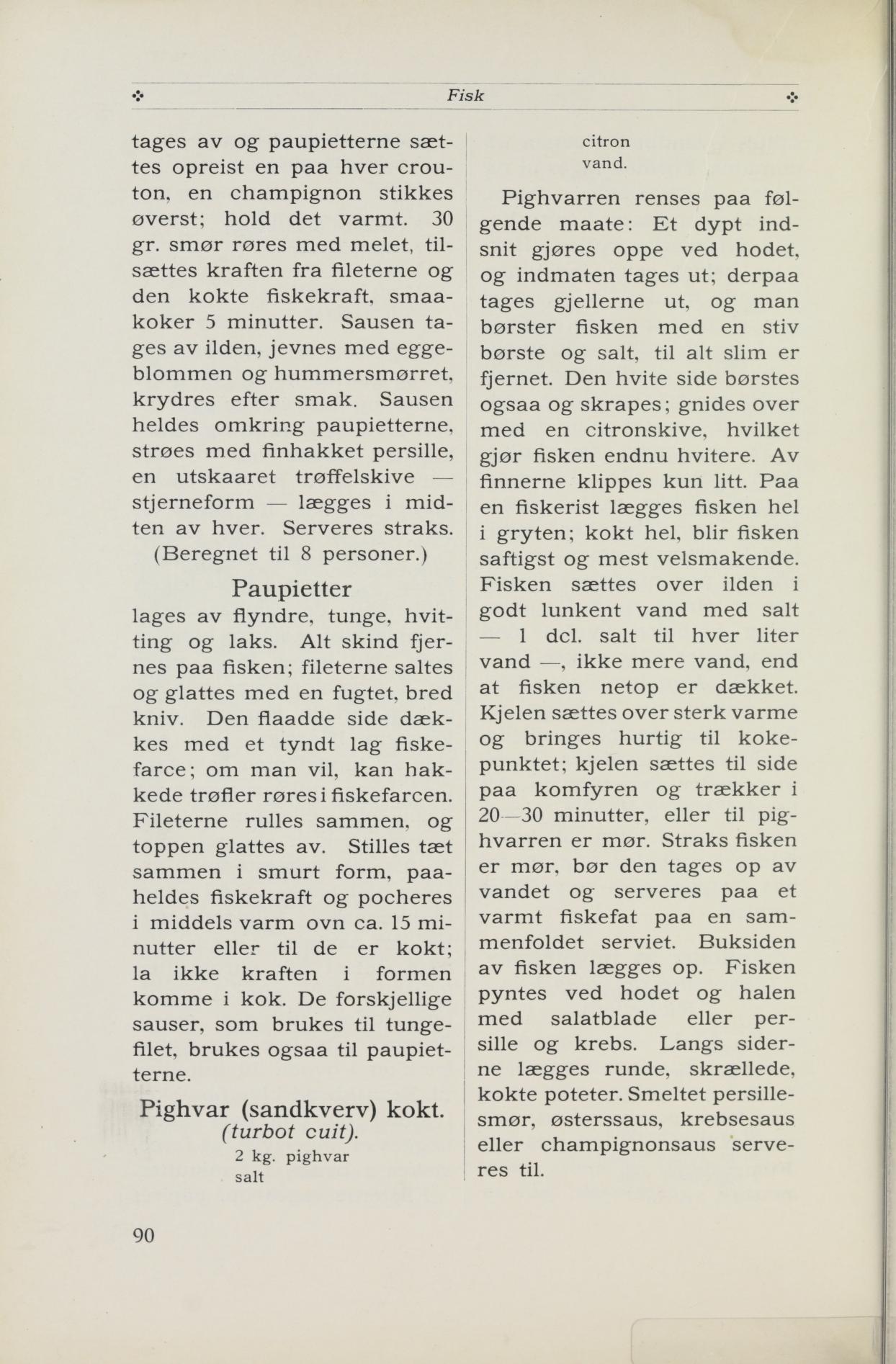
ProofreadPage 90
2 kg. pighvar
salt
citron
vand.
Pighvarren renses paa følgende maate: Et dypt indsnit gjøres oppe ved hodet, og indmaten tages ut; derpaa tages gjellerne ut, og man børster fisken med en stiv børste og salt, til alt slim er fjernet. Den hvite side børstes ogsaa og skrapes; gnides over med en citronskive, hvilket gjør fisken endnu hvitere. Av finnerne klippes kun litt. Paa en fiskerist lægges fisken hel i gryten; kokt hel, blir fisken saftigst og mest velsmakende. Fisken sættes over ilden i godt lunkent vand med salt — 1 del. salt til hver liter vand —, ikke mere vand, end at fisken netop er dækket. Kjelen sættes over sterk varme og bringes hurtig til kokepunktet; kjelen sættes til side paa komfyren og trækker i 20—30 minutter, eller til pighvarren er mør. Straks fisken er mør, bør den tages op av vandet og serveres paa et varmt fiskefat paa en sammenfoldet serviet. Buksiden av fisken lægges op. Fisken pyntes ved hodet og halen med salatblade eller persille og krebs. Langs siderne lægges runde, skrællede, kokte poteter. Smeltet persillesmør, østerssaus, krebsesaus eller champignonsaus serveres til.
Pighvar kaldes ogsaa «havets fasan» paa grund av dens faste, hvite kjøt. — Fisken maa ikke flaaes — undtagen naar kun fileterne skal brukes —, skindet skal børstes av i saltvand. Finnerne pyntes litt av, men maa ikke skjæres av. Langs rygbenet skjæres et dypt indsnit paa den mørke side helt ind til benet, forat fisken ikke skal revne. Hodet bør omvikles med et stykke hvitt tøi. Fisken taper baade i utseende og smak ved at kokes i for meget vand og ved at koke for sterkt.
📖1949
Revised 1949 recipe
From the revised edition of the Big Cookbook.
Foto: Faksimile: Nasjonalbiblioteket
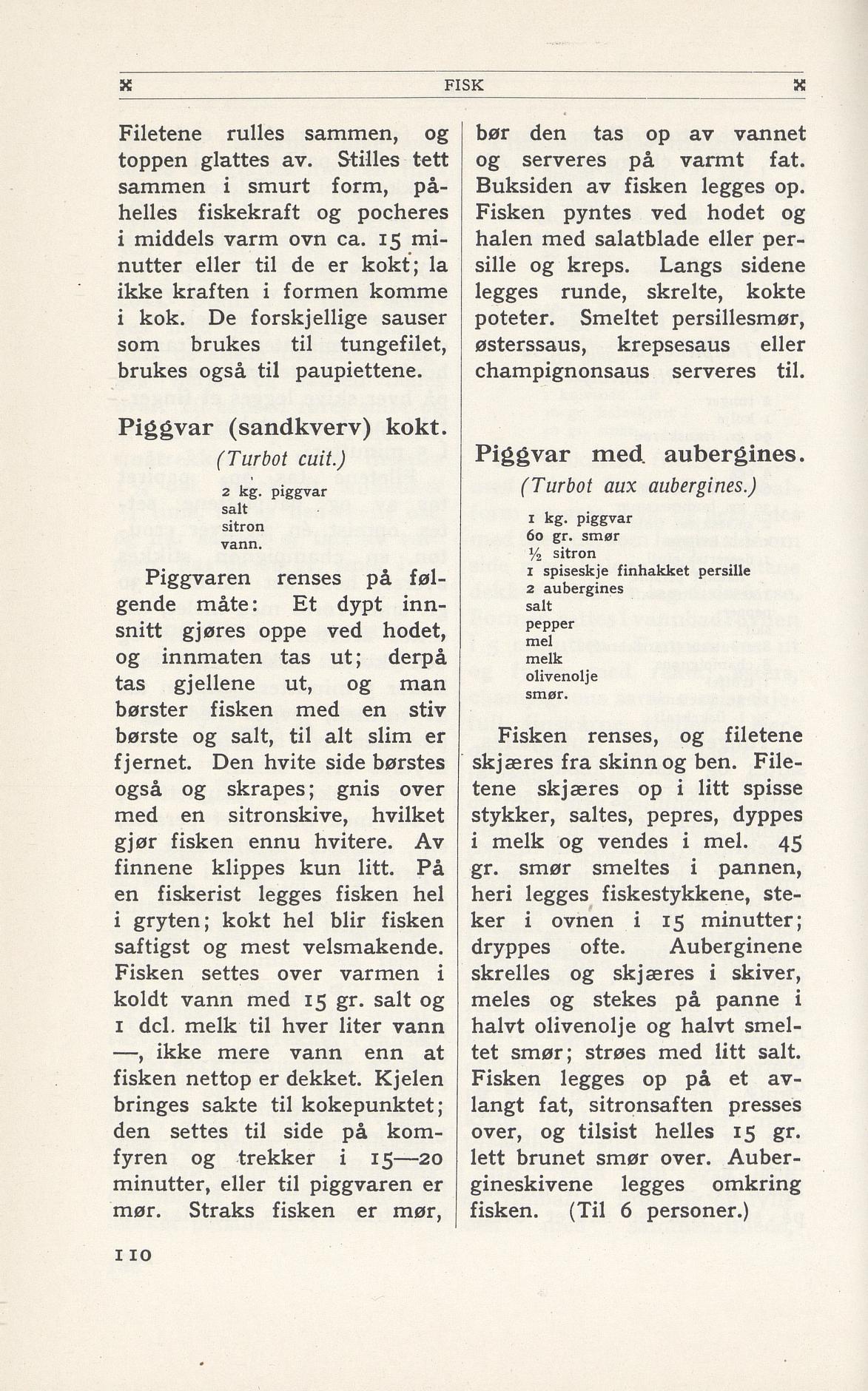
ProofreadPage 110
2 kg. piggvar
salt
sitron
vann.
Piggvaren renses på følgende måte: Et dypt insnitt gjøres oppe ved hodet, og innmaten tas ut; derpå tas gjellene ut, og man børster fisken med en stiv børste og salt, til alt slim er fjernet. Den hvite side børstes også og skrapes; gnis over med en sitronskive, hvilket gjør fisken ennu hvitere. Av finnene klippes kun litt. På en fiskerist legges fisken hel i gryten; kokt hel blir fisken saftigst og mest velsmakende. Fisken settes over varmen i koldt vann med 15 gr. salt og 1 del. melk til hver liter vann —, ikke mere vann enn at fisken nettop er dekket. Kjelen bringes sakte til kokepunktet; den settes til side på komfyren og trekker i 15—20 minutter, eller til piggvaren er mør. Straks fisken er mør, bør den tas op av vannet og serveres på varmt fat. Buksiden av fisken legges op. Fisken pyntes ved hodet og halen med salatblade eller persille og kreps. Langs sidene legges runde, skrelte, kokte poteter. Smeltet persillesmør, østerssaus, krepsesaus eller champignonsaus serveres til.
In stores now
Clean, minimally processed groceries matched to the ingredients — approximate prices.
1914 (korrekturlest, s. 90) → 1949 (korrekturlest, s. 110)~61% av teksten endretfjernetlagt til
2 kg. pighvar piggvar salt citron vand. Pighvarren sitron vann. Piggvaren renses paa på følgende maate: måte: Et dypt indsnit insnitt gjøres oppe ved hodet, og indmaten tages innmaten tas ut; derpaa tages gjellerne derpå tas gjellene ut, og man børster fisken med en stiv børste og salt, til alt slim er fjernet. Den hvite side børstes ogsaa også og skrapes; gnides gnis over med en citronskive, sitronskive, hvilket gjør fisken endnu ennu hvitere. Av finnerne finnene klippes kun litt. Paa På en fiskerist lægges legges fisken hel i gryten; kokt hel, hel blir fisken saftigst og mest velsmakende. Fisken sættes settes over ilden varmen i godt lunkent vand koldt vann med 15 gr. salt — og 1 del. salt melk til hver liter vand vann —, ikke mere vand, end vann enn at fisken netop nettop er dækket. dekket. Kjelen sættes over sterk varme og bringes hurtig sakte til kokepunktet; kjelen sættes den settes til side paa på komfyren og trækker trekker i 20—30 15—20 minutter, eller til pighvarren piggvaren er mør. Straks fisken er mør, bør den tages tas op av vandet vannet og serveres paa et på varmt fiskefat paa en sammenfoldet serviet. fat. Buksiden av fisken lægges legges op. Fisken pyntes ved hodet og halen med salatblade eller persille og krebs. kreps. Langs siderne lægges sidene legges runde, skrællede, skrelte, kokte poteter. Smeltet persillesmør, østerssaus, krebsesaus krepsesaus eller champignonsaus serveres til. Pighvar kaldes ogsaa «havets fasan» paa grund av dens faste, hvite kjøt. — Fisken maa ikke flaaes — undtagen naar kun fileterne skal brukes —, skindet skal børstes av i saltvand. Finnerne pyntes litt av, men maa ikke skjæres av. Langs rygbenet skjæres et dypt indsnit paa den mørke side helt ind til benet, forat fisken ikke skal revne. Hodet bør omvikles med et stykke hvitt tøi. Fisken taper baade i utseende og smak ved at kokes i for meget vand og ved at koke for sterkt.
According to the recipe, the fish is juiciest and most flavorful when boiled whole. Place it on a fish rack in the pot so it's easy to lift out without falling apart.
How is turbot cleaned?
Make a deep cut up by the head and remove the innards, take out the gills, and brush the fish with a stiff brush and salt until all slime is gone. The white side is brushed and scraped, and rubbed with a lemon slice – it makes the fish whiter. Only a little is trimmed off the fins.
How much salt and water should be used in the cooking water?
Use about 1 part salt per liter of water, and only enough water that the fish is just covered. The fish is put in good lukewarm water, brought quickly to a boil over high heat and then drawn aside.
What size fish and how long does the recipe reckon on?
The recipe is intended for 2 kg turbot to serve 6, with a total time of about 70 minutes. The source is Henriette Schønberg Erken's "Stor kokebok" of 1914, p. 90.