Skip to content

Macaroni Timbale

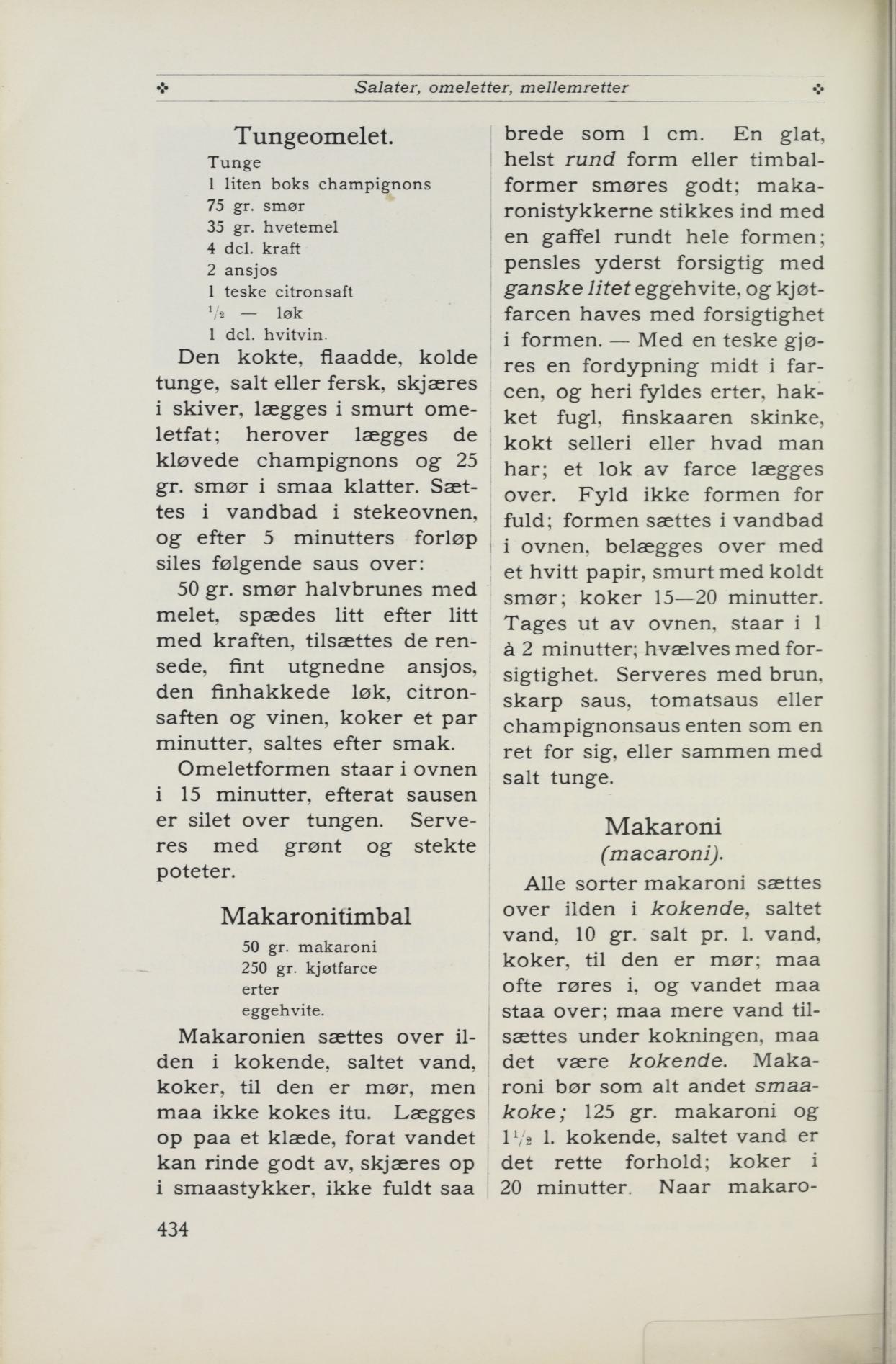
Macaroni timbale from Erken's Stor kokebok 1914: a greased mold is lined with cooked macaroni pieces, brushed with egg white, filled with meat forcemeat around a core of peas, poultry, ham, or celeriac, and baked in a water bath under greased paper for 15–20 minutes. Turned out and served with a sharp brown sauce, tomato sauce, or mushroom sauce.

Source: Henriette Schønberg Erken, Stor kokebok, 1914-utg. s. 434 (falt i det fri)

Be the first to rate

About the dish

The timbale was a fine entremets in bourgeois festive fare: a mold lined with a pattern (here macaroni pieces) and filled with meat forcemeat around a «core» of vegetables, poultry, or ham. The dish shows how macaroni in Erken's time was used both for decoration and as an ingredient in its own right.

How to make it

  1. 1

    Boil the macaroni

    Boil the macaroni in boiling, salted water until tender, but be careful that it does not boil to pieces.

  2. 2

    Drain and cut up

    Lay the macaroni on a cloth so the water drains off well, and cut it into pieces slightly narrower than 1 cm.

  3. 3

    Line the mold

    Grease a smooth, preferably round mold or small timbale molds well. Set the macaroni pieces around the whole mold with a fork and brush very carefully with a little egg white.

  4. 4

    Fill with forcemeat

    Carefully place the meat forcemeat in the mold. Make a hollow in the center of the forcemeat with a teaspoon and fill it with peas, chopped poultry, finely cut ham, cooked celeriac, or whatever you have. Lay a lid of forcemeat over it. Do not fill the mold too full.

  5. 5

    Bake in a water bath

    Set the mold in a water bath in the oven, cover with a white paper greased with cold butter, and let it cook for 15–20 minutes.

  6. 6

    Turn out and serve

    Take the mold out of the oven, let it stand 1–2 minutes, and turn it out carefully. Serve with a sharp brown sauce, tomato sauce, or mushroom sauce, as a dish of its own or together with salted tongue.

Changes from the original

Quantities for the cooking water and salt have been specified (about 1 liter of water and 10 g salt), and the egg white and peas have been estimated since the original gives none. «Kjøtfarce» has been modernized to meat forcemeat (of veal or beef). Otherwise the method is unchanged, only divided into steps.

In stores now

Clean, minimally processed groceries matched to the ingredients — approximate prices.

Product data and prices via Kassalapp. Prices are updated daily and may vary.

Time machine – what changed?

Pick two editions and see what Henriette Schønberg Erken added, removed or changed between them.

Pick two different editions to see a comparison.

Community interpretations

Be the first to share your own version.

See interpretations →

Frequently asked questions

Why should the macaroni not boil too long?
Because it must hold its shape. Boil it tender in boiling, salted water, but not to pieces—it must be possible to cut it into pieces of barely 1 cm and fix it around the mold with a fork.
What can be used as filling in the center?
Peas, chopped poultry, finely cut ham, cooked celeriac—or whatever you have. Make a hollow in the meat forcemeat with a teaspoon, fill it, and lay a lid of forcemeat over it.
How is the timbale prepared?
The mold is greased well, the macaroni pieces are fixed around it, brushed carefully with a little egg white, and the forcemeat is placed in. Do not fill the mold too full. The mold is then set in a water bath. The dish serves 4 and takes around 75 minutes in all.
Where does the recipe come from?
From Henriette Schønberg Erken's «Stor kokebok» from 1914, page 434, in the chapter on salads, omelets, and entremets.

Equipment for this dish

Advertisement

We may earn a commission if you buy through these links. It does not affect the price.

Related recipes

More dishes in the same category from the archive

Read also

Kommentarer

Ingen kommentarer ennå. Bli den første til å dele!