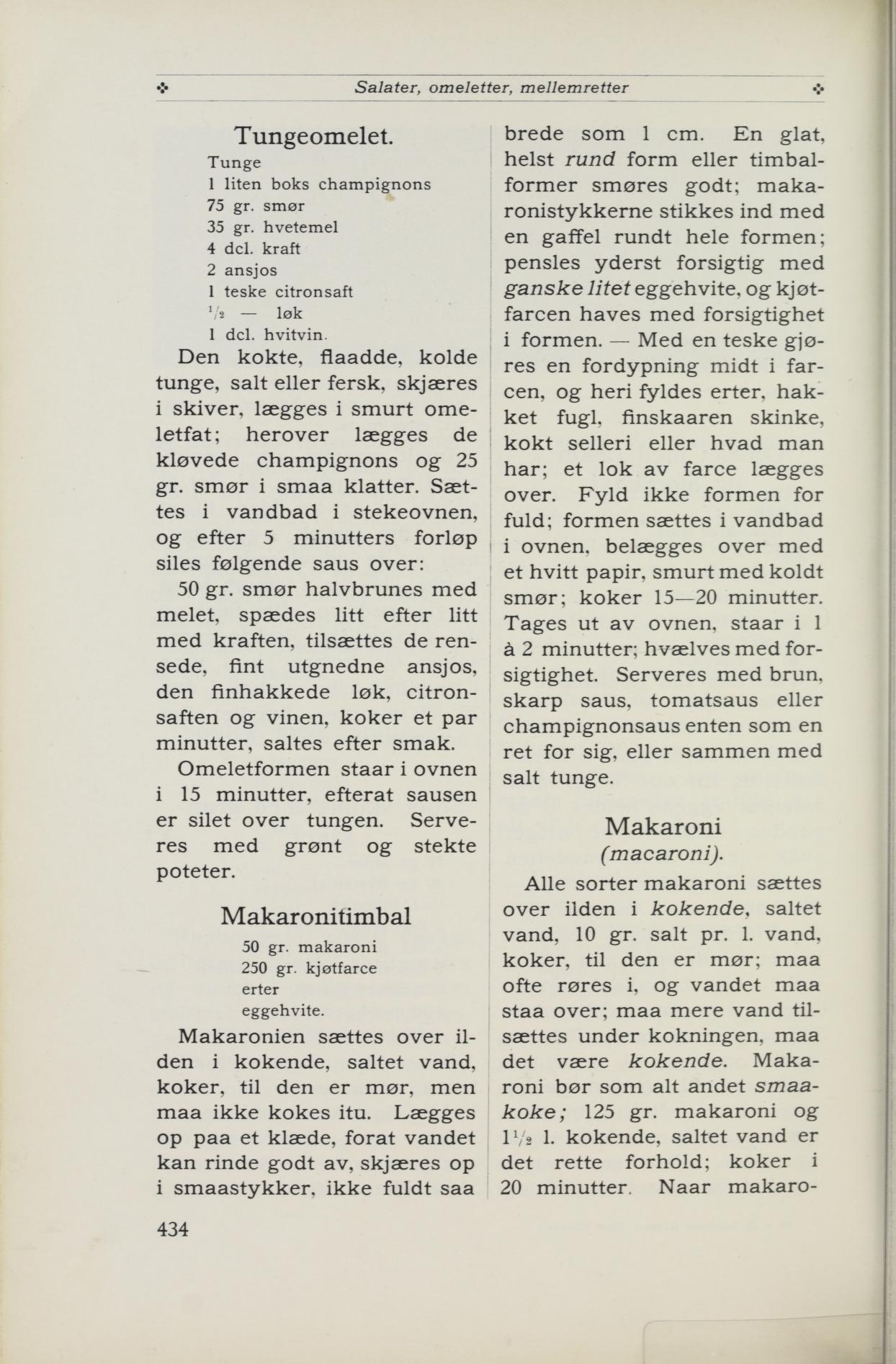
Macaroni timbale from Erken's Stor kokebok 1914: a greased mold is lined with cooked macaroni pieces, brushed with egg white, filled with meat forcemeat around a core of peas, poultry, ham, or celeriac, and baked in a water bath under greased paper for 15–20 minutes. Turned out and served with a sharp brown sauce, tomato sauce, or mushroom sauce.
Source: Henriette Schønberg Erken, Stor kokebok, 1914-utg. s. 434 (falt i det fri)
Be the first to rate
About the dish
The timbale was a fine entremets in bourgeois festive fare: a mold lined with a pattern (here macaroni pieces) and filled with meat forcemeat around a «core» of vegetables, poultry, or ham. The dish shows how macaroni in Erken's time was used both for decoration and as an ingredient in its own right.
How to make it
1
Boil the macaroni
Boil the macaroni in boiling, salted water until tender, but be careful that it does not boil to pieces.
2
Drain and cut up
Lay the macaroni on a cloth so the water drains off well, and cut it into pieces slightly narrower than 1 cm.
3
Line the mold
Grease a smooth, preferably round mold or small timbale molds well. Set the macaroni pieces around the whole mold with a fork and brush very carefully with a little egg white.
4
Fill with forcemeat
Carefully place the meat forcemeat in the mold. Make a hollow in the center of the forcemeat with a teaspoon and fill it with peas, chopped poultry, finely cut ham, cooked celeriac, or whatever you have. Lay a lid of forcemeat over it. Do not fill the mold too full.
5
Bake in a water bath
Set the mold in a water bath in the oven, cover with a white paper greased with cold butter, and let it cook for 15–20 minutes.
6
Turn out and serve
Take the mold out of the oven, let it stand 1–2 minutes, and turn it out carefully. Serve with a sharp brown sauce, tomato sauce, or mushroom sauce, as a dish of its own or together with salted tongue.
Changes from the original
Quantities for the cooking water and salt have been specified (about 1 liter of water and 10 g salt), and the egg white and peas have been estimated since the original gives none. «Kjøtfarce» has been modernized to meat forcemeat (of veal or beef). Otherwise the method is unchanged, only divided into steps.
📖1914
Original 1914 recipe
Verbatim from the first edition of the Big Cookbook.
Foto: Faksimile: Nasjonalbiblioteket
ProofreadPage 434
50 gr. makaroni
250 gr. kjøtfarce
erter
eggehvite.
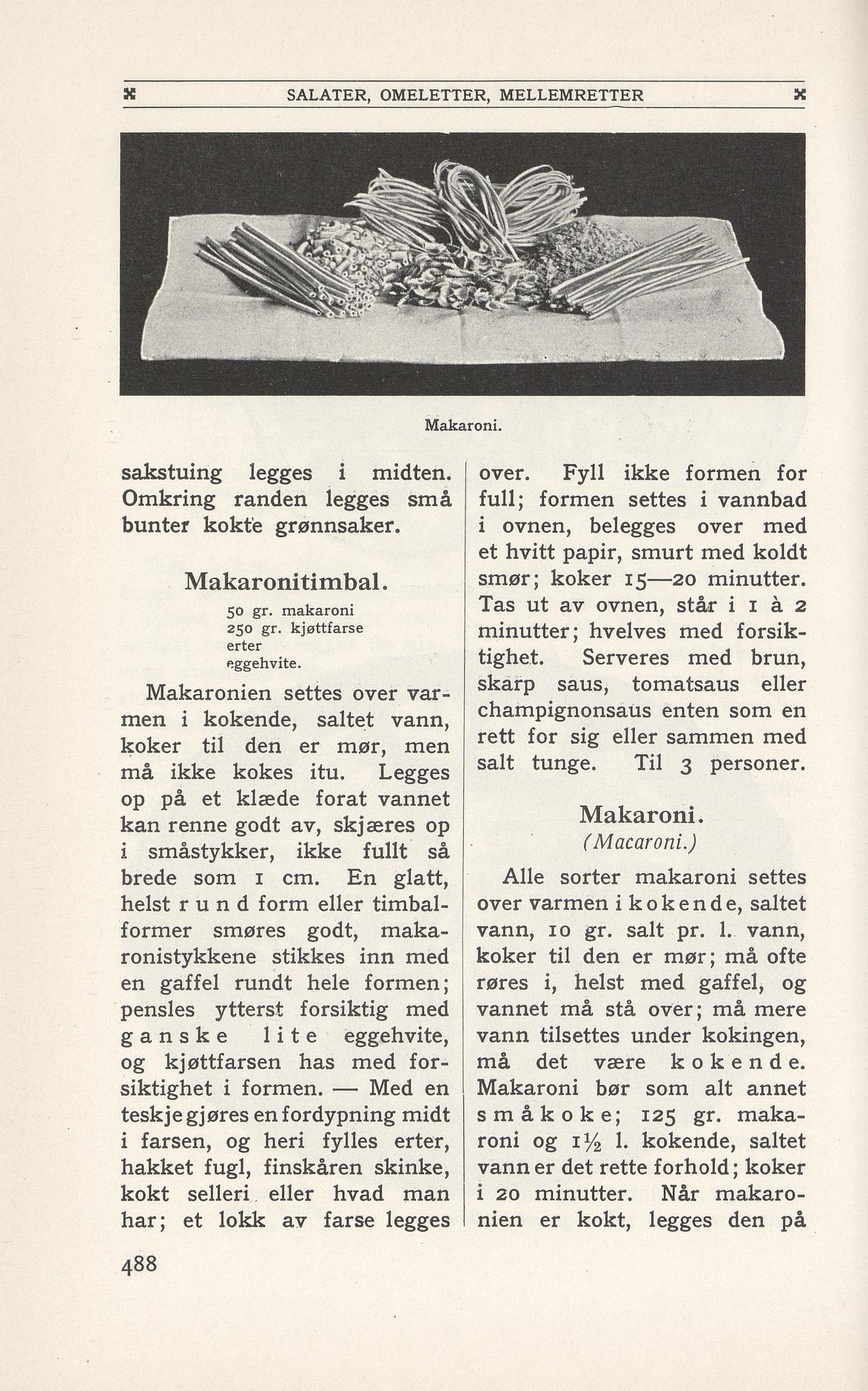
Makaronien sættes over ilden i kokende, saltet vand, koker, til den er mør, men maa ikke kokes itu. Lægges op paa et klæde, forat vandet kan rinde godt av, skjæres op i smaastykker, ikke fuldt saa brede som 1 cm. En glat, helst rund form eller timbalformer smøres godt; makaronistykkerne stikkes ind med en gaffel rundt hele formen; pensles yderst forsigtig med ganske litet eggehvite, og kjøtfarcen haves med forsigtighet i formen. — Med en teske gjøres en fordypning midt i farcen, og heri fyldes erter, hakket fugl, finskaaren skinke, kokt selleri eller hvad man har; et lok av farce lægges over. Fyld ikke formen for fuld; formen sættes i vandbad i ovnen, belægges over med et hvitt papir, smurt med koldt smør; koker 15—20 minutter. Tages ut av ovnen, staar i 1 à 2 minutter; hvælves med forsigtighet. Serveres med brun, skarp saus, tomatsaus eller champignonsaus enten som en ret for sig, eller sammen med salt tunge.
📖1949
Revised 1949 recipe
From the revised edition of the Big Cookbook.
Foto: Faksimile: Nasjonalbiblioteket
ProofreadPage 488
50 gr. makaroni
250 gr. kjøttfarse
erter
eggekvite.
Makaronien settes over varmen i kokende, saltet vann, koker til den er mør, men må ikke kokes itu. Legges op på et klæde forat vannet kan renne godt av, skjæres op i småstykker, ikke fullt så brede som 1 cm. En glatt, helst rund form eller timbal former smøres godt, makaronistykkene stikkes inn med en gaffel rundt hele formen; pensles ytterst forsiktig med ganske lite eggehvite, og kjøttfarsen has med forsiktighet i formen. — Med en teskje gjøres en fordypning midt i farsen, og heri fylles erter, hakket fugl, finskåren skinke, kokt selleri eller hvad man har; et lokk av farse legges over. Fyll ikke formen for full; formen settes i vannbad i ovnen, belegges over med et hvitt papir, smurt med koldt smør; koker 15—20 minutter. Tas ut av ovnen, står i 1 å 2 minutter; hvelves med forsiktighet. Serveres med brun, skarp saus, tomatsaus eller champignonsaus enten som en rett for sig eller sammen med salt tunge. Til 3 personer.
In stores now
Clean, minimally processed groceries matched to the ingredients — approximate prices.
1914 (korrekturlest, s. 434) → 1949 (korrekturlest, s. 488)~44% av teksten endretfjernetlagt til
50 gr. makaroni 250 gr. kjøtfarce kjøttfarse erter eggehvite. eggekvite. Makaronien sættes settes over ilden varmen i kokende, saltet vand, koker, vann, koker til den er mør, men maa må ikke kokes itu. Lægges Legges op paa på et klæde, klæde forat vandet vannet kan rinde renne godt av, skjæres op i smaastykker, småstykker, ikke fuldt saa fullt så brede som 1 cm. En glat, glatt, helst rund form eller timbalformer timbal former smøres godt; makaronistykkerne godt, makaronistykkene stikkes ind inn med en gaffel rundt hele formen; pensles yderst forsigtig ytterst forsiktig med ganske litet lite eggehvite, og kjøtfarcen haves kjøttfarsen has med forsigtighet forsiktighet i formen. — Med en teske teskje gjøres en fordypning midt i farcen, farsen, og heri fyldes fylles erter, hakket fugl, finskaaren finskåren skinke, kokt selleri eller hvad man har; et lok lokk av farce lægges farse legges over. Fyld Fyll ikke formen for fuld; full; formen sættes settes i vandbad vannbad i ovnen, belægges belegges over med et hvitt papir, smurt med koldt smør; koker 15—20 minutter. Tages Tas ut av ovnen, staar står i 1 à å 2 minutter; hvælves hvelves med forsigtighet. forsiktighet. Serveres med brun, skarp saus, tomatsaus eller champignonsaus enten som en ret rett for sig, sig eller sammen med salt tunge. Til 3 personer.
Because it must hold its shape. Boil it tender in boiling, salted water, but not to pieces—it must be possible to cut it into pieces of barely 1 cm and fix it around the mold with a fork.
What can be used as filling in the center?
Peas, chopped poultry, finely cut ham, cooked celeriac—or whatever you have. Make a hollow in the meat forcemeat with a teaspoon, fill it, and lay a lid of forcemeat over it.
How is the timbale prepared?
The mold is greased well, the macaroni pieces are fixed around it, brushed carefully with a little egg white, and the forcemeat is placed in. Do not fill the mold too full. The mold is then set in a water bath. The dish serves 4 and takes around 75 minutes in all.
Where does the recipe come from?
From Henriette Schønberg Erken's «Stor kokebok» from 1914, page 434, in the chapter on salads, omelets, and entremets.