Skip to content

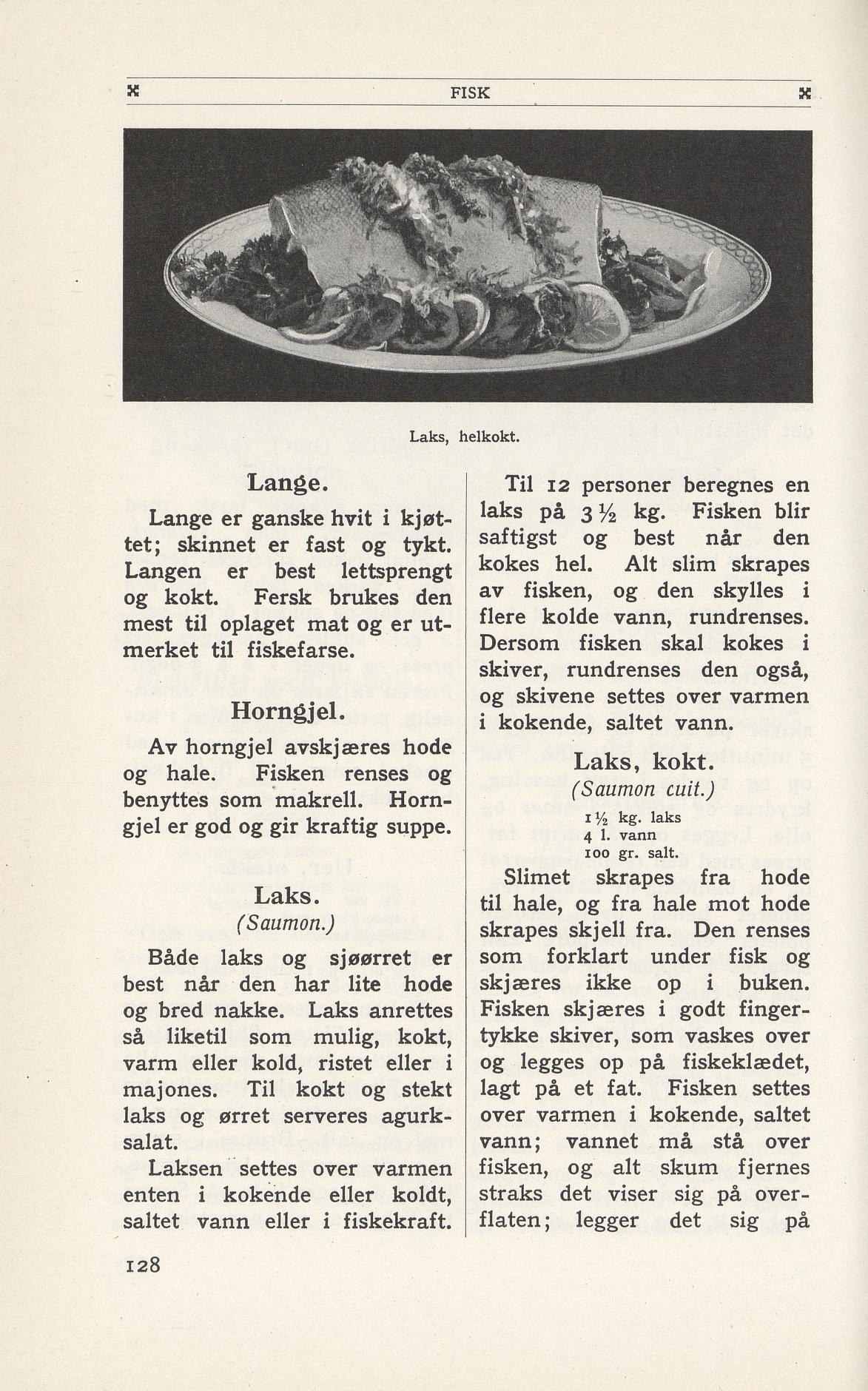
Salmon, whole poached

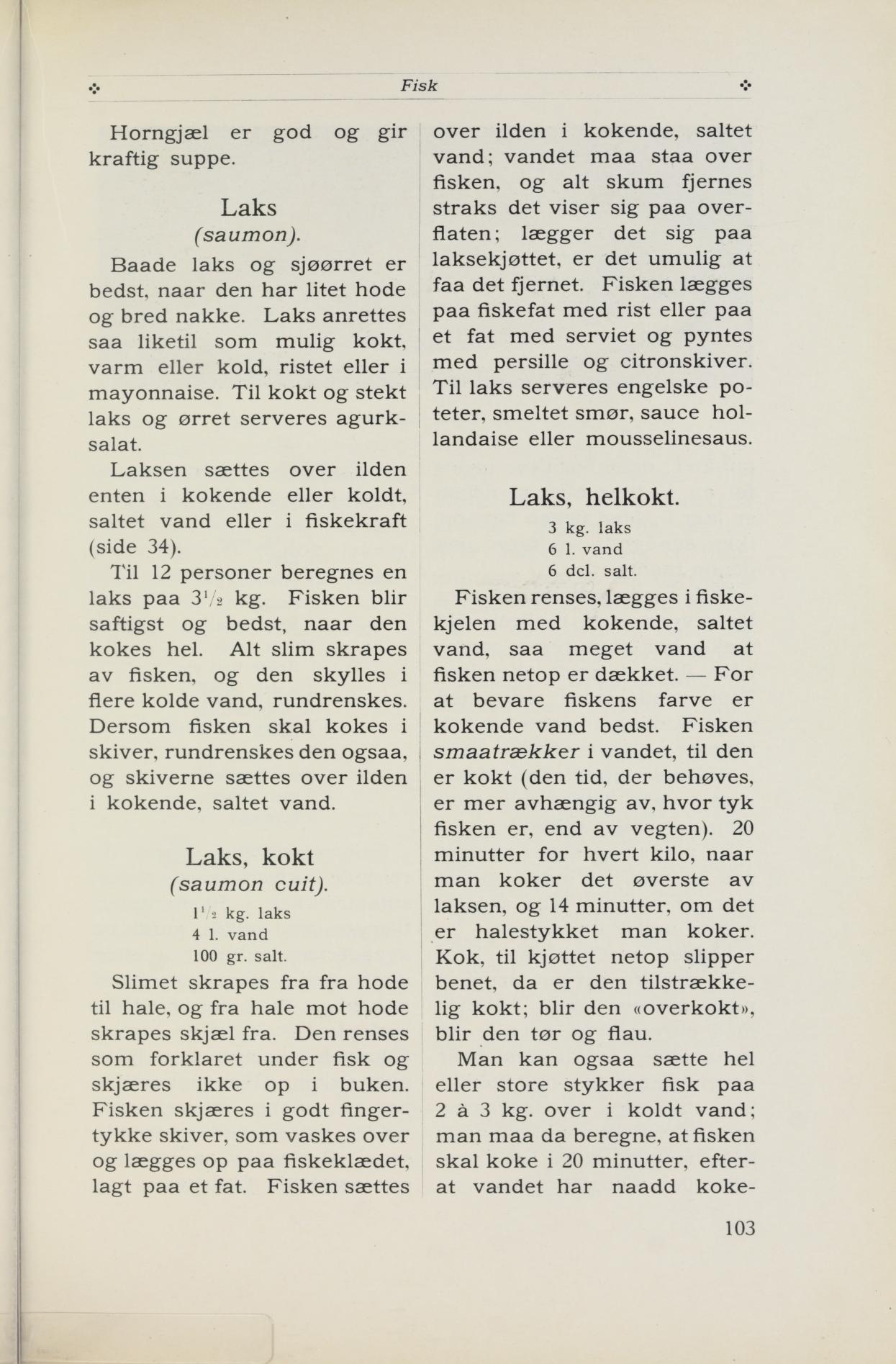
Erken's basic recipe for whole poached salmon (3 kg) in boiling salted water; about 20 min per kilo for the front part, 14 min for the tail piece, cooked until the flesh comes away from the bone. Served with potatoes, melted butter, or hollandaise. Serves 12.

Source: Henriette Schønberg Erken, Stor kokebok, 1914-utg. s. 103 (falt i det fri)

Be the first to rate

About the dish

From the fish chapter of 'Stor kokebok' (1914), where Erken states that salmon is juiciest when cooked whole. For 12 people she reckoned a salmon of about 3 kg, and she recommends English potatoes, melted butter, sauce hollandaise, or mousseline sauce with it.

How to make it

  1. 1

    Clean the fish

    Scrape all the slime off the fish from head to tail, and the scales from tail to head. Rinse in several changes of cold water and gut the fish without slitting the belly.

  2. 2

    Score the skin

    Make a couple of small cuts in the skin along the back, so the skin does not split as easily during cooking.

  3. 3

    Bring the water to a boil

    Bring the water and salt to a boil in a fish kettle. Boiling water preserves the fish's color best.

  4. 4

    Add the fish

    Put the fish into the boiling, salted water – only enough water to just cover the fish. Remove all scum as soon as it appears on the surface; if it settles on the salmon flesh, it is impossible to remove.

  5. 5

    Let it barely simmer

    Draw the kettle to the side so the water only barely simmers. Allow about 20 minutes per kilo when cooking the upper part of the salmon, and about 14 minutes per kilo for the tail piece. The cooking time depends more on how thick the fish is than on its weight.

  6. 6

    Test whether it is done

    Cook until the flesh just comes away from the bone – then it is sufficiently cooked. If overcooked, it turns dry and flat.

  7. 7

    Plating

    Place the salmon on a fish platter with a rack or on a platter with a napkin, and garnish with parsley and lemon slices. Serve with English potatoes, melted butter, sauce hollandaise, or mousseline sauce.

Changes from the original

The amount of salt has been converted to grams (the original's '6 del. salt' is very generous; here about 30 g of salt per liter of water). Otherwise the method is unchanged, but described in modern steps with the clarification that the water should barely simmer, not boil hard.

Time machine – what changed?

Pick two editions and see what Henriette Schønberg Erken added, removed or changed between them.

Modernised → 1949 (proofread, p. 128)~84% of the text changedremovedadded
3 kg kg. laks (hel, rundrenset). 6 l 1. vann (eller så mye at fisken er dekket). 180 g 3 del. salt (ca. 30 g per liter vann). Skrap alt slim av fisken fra hode mot hale, og skjellene fra hale mot hode. Skyll i flere kalde vann og rundrens fisken uten å skjære opp buken.. Lag et sitronskiver. Et par små snitt i skinnet på helkokt fisk langs ryggen, så ryggen gjør at skinnet ikke så lett revner under kokingen.. Kok opp vannet med salt i en fiskekjele. Kokende vann bevarer fiskens farge best.. Legg fisken kokingen. Fisken renses, legges i det fiskekjelen med kokende, saltede vannet – bare saltet vann, så mye meget vann at fisken nettopp er dekket. Fjern alt skum straks det viser seg på overflaten; legger det seg på laksekjøttet, nettop er det umulig dekket, og sitronskiver. For å få det bort.. Trekk kjelen til side så bevare fiskens farve er kokende vann best. Fisken småtrekker i vannet bare småtrekker. Regn ca. til den er kokt (den tid derbehoves, er mer avhengig av hvor tykk fisken er, enn av vekten). 20 minutter per for hvert kilo når du man koker det øverste av laksen, og ca. 14 minutter per kilo for halestykket. Koketiden avhenger mer av hvor tykk fisken om det er enn av vekten.. halestykket man koker. Kok til kjøttet nettopp nettop slipper benet – benet, da er den tilstrekkelig kokt. Blir kokt; blir den overkokt, «overkokt», blir den tørr og flau.. Legg laksen på fiskefat med rist flau. Man kan også sette hel eller store stykker fisk på et fat 2 å 3 kg. over i koldt vann; man må da beregne at fisken skal koke i 20 minutter, efterat vannet har nådd kokepunktet; dette bør ikke nåes før ca. % time efterat fisken er lagt i. Men fisken bevarer ikke så godt sin farve på denne måte. Laksen anrettes på varmt fat, dryppes med serviett, og pynt smeltet smør, pyntes med sitronskiver, persille og sitronskiver. Server engelske poteter, tomatskiver. — På skrå over fisken legges en stripe finhalket, kokt rogn og finskåren salat. Serveres med hollandsk saus, smeltet smør, sauce hollandaise smør med persille eller mousselinesaus mousselinesaus. Agurksalat eller tomatsalat serveres til.

Note on Modernised

Saltmengden er omregnet til gram (originalens «6 del. salt» er svært rikelig; her ca. 30 g salt per liter vann). Ellers uendret metode, men beskrevet i moderne trinn med presisering av at vannet skal småtrekke, ikke fosskoke.

Community interpretations

Be the first to share your own version.

See interpretations →

Frequently asked questions

How long should the salmon cook?
Allow 20 minutes per kilo when cooking the upper (thickest) part of the salmon, and 14 minutes per kilo for the tail piece. A whole 3 kg salmon thus takes about an hour. The cooking time depends more on how thick the fish is than on its weight.
How do I know the salmon is done?
Cook until the flesh just comes away from the bone – then it is sufficiently cooked. Overcooked salmon turns dry and flat in flavor.
Should the fish be put in cold or boiling water?
In boiling, salted water. Boiling water preserves the fish's color best. Use only enough water to just cover the fish, and let it barely simmer – not boil hard.
How much salt and water do I use?
The recipe (Stor kokebok 1914, p. 103) calls for 6 liters of water and 6 deciliters of salt for 3 kg of salmon, which serves 12.

Related recipes

More dishes in the same category from the archive

Read also

Kommentarer

Ingen kommentarer ennå. Bli den første til å dele!