Erken's giblet soup from 1914: giblets, head, feet, and heart of goose or duck simmered 4 hours in salted water with root vegetables, the stock strained and cooked with prunes and apples, thickened with sago flour and seasoned sweet-and-sour with sugar and vinegar.
Source: Henriette Schønberg Erken, Stor kokebok, 1914-utg. s. 50 (falt i det fri)
Be the first to rate
About the dish
Giblets — the neck, wing tips, heart, gizzard, head, and feet of goose or duck — were never thrown away in Erken's household. This sweet-and-sour giblet soup with prunes and apples belongs to the traditional festive soups made when poultry was slaughtered, and is thickened with sago flour.
How to make it
1
Clean the giblets
Scald and brush the cut-up giblets, head, feet, and heart well, and wash them in several changes of water.
2
Cook the stock
Put the parts in boiling, salted water (20 g salt to the water) and skim well. Let it simmer for about 4 hours.
3
Cook with root vegetables
Add the cleaned carrots, the leeks, and the bouquet garni during the last hour of cooking.
4
Strain the soup
Strain the soup and pour it back into the pot. Set aside the giblet parts and the root vegetables.
5
Cook the fruit
Cook the washed prunes and the peeled, cut-up apples in the soup until they are tender.
6
Thicken the soup
Stir the sago flour into 1 dl cold water, whisk it into the boiling soup, and give it a quick boil-up.
7
Season and serve
Season with sugar, vinegar, and pepper. Serve the soup with the prunes, apples, finely cut giblet parts, and cut-up root vegetables.
Changes from the original
"del." interpreted as deciliter. Sago flour can be replaced by potato starch or sago pearls; the amount kept. The amount of water in the ingredient list (3 l) and in the method (2.5 l) is kept as in the original, with 3 l as the starting point. Salt given in grams as in the original's method.
📖1914
Original 1914 recipe
Verbatim from the first edition of the Big Cookbook.
Foto: Faksimile: Nasjonalbiblioteket
ProofreadPage 50
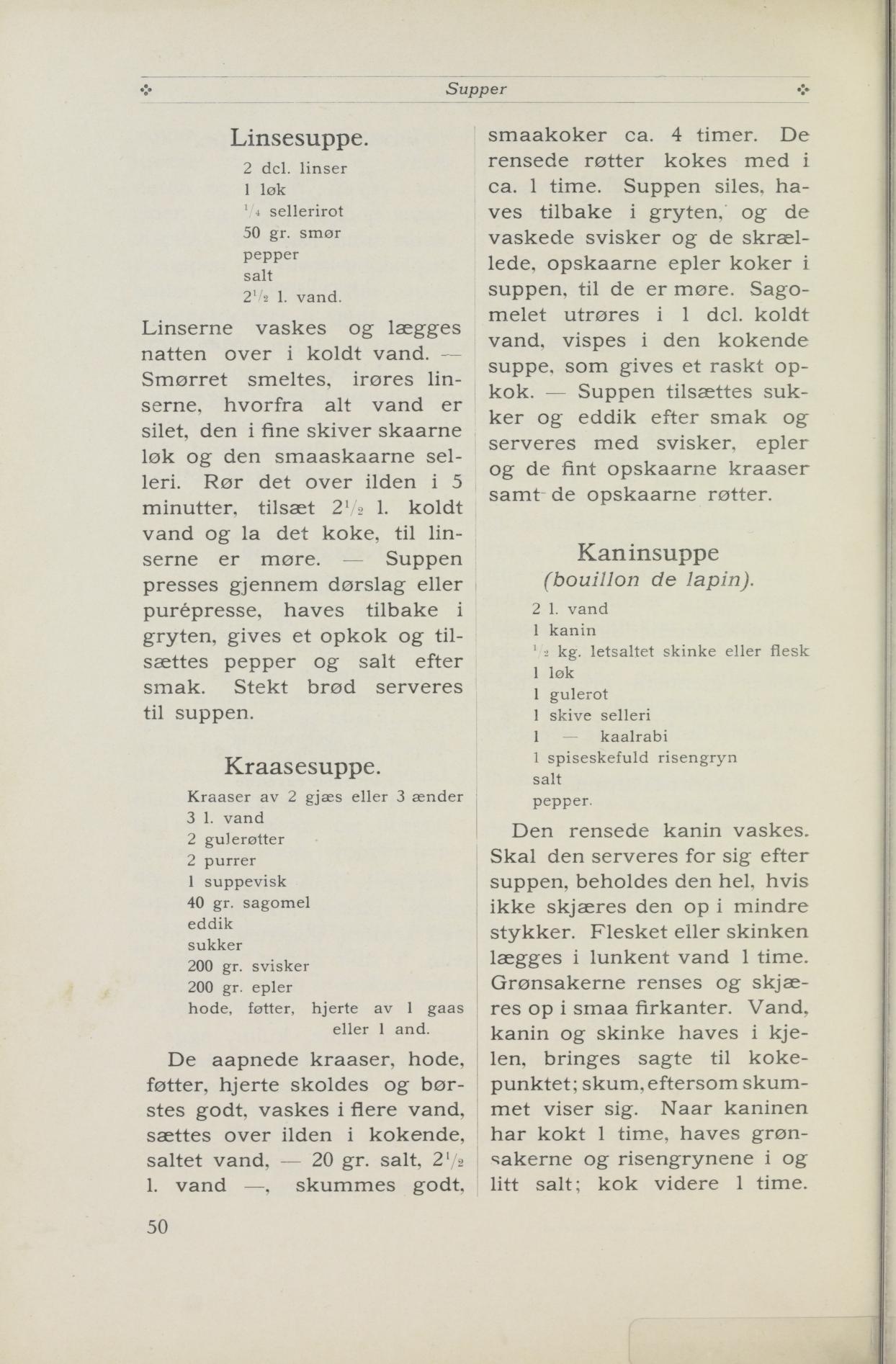
Kraaser av 2 gjæs eller 3 ænder
hode, føtter, hjerte av 1 gaas eller 1 and
3 l. vand
2 gulerøtter
2 purrer
1 suppevisk
40 gr. sagomel
200 gr. svisker
200 gr. epler
eddik
sukker
salt
pepper.
De aapnede kraaser, hode, føtter, hjerte skoldes og børstes godt, vaskes i flere vand, sættes over ilden i kokende, saltet vand, — 20 gr. salt, 2 1/2 l. vand —, skummes godt, smaakoker ca. 4 timer. De rensede røtter kokes med i ca. 1 time. Suppen siles, haves tilbake i gryten, og de vaskede svisker og de skrællede, opskaarne epler koker i suppen, til de er møre. Sagomelet utrøres i 1 del. koldt vand, vispes i den kokende suppe, som gives et raskt opkok. — Suppen tilsættes sukker og eddik efter smak og serveres med svisker, epler og de fint opskaarne kraaser samt de opskaarne røtter.
📖1949
Revised 1949 recipe
From the revised edition of the Big Cookbook.
Foto: Faksimile: Nasjonalbiblioteket
ProofreadPage 61
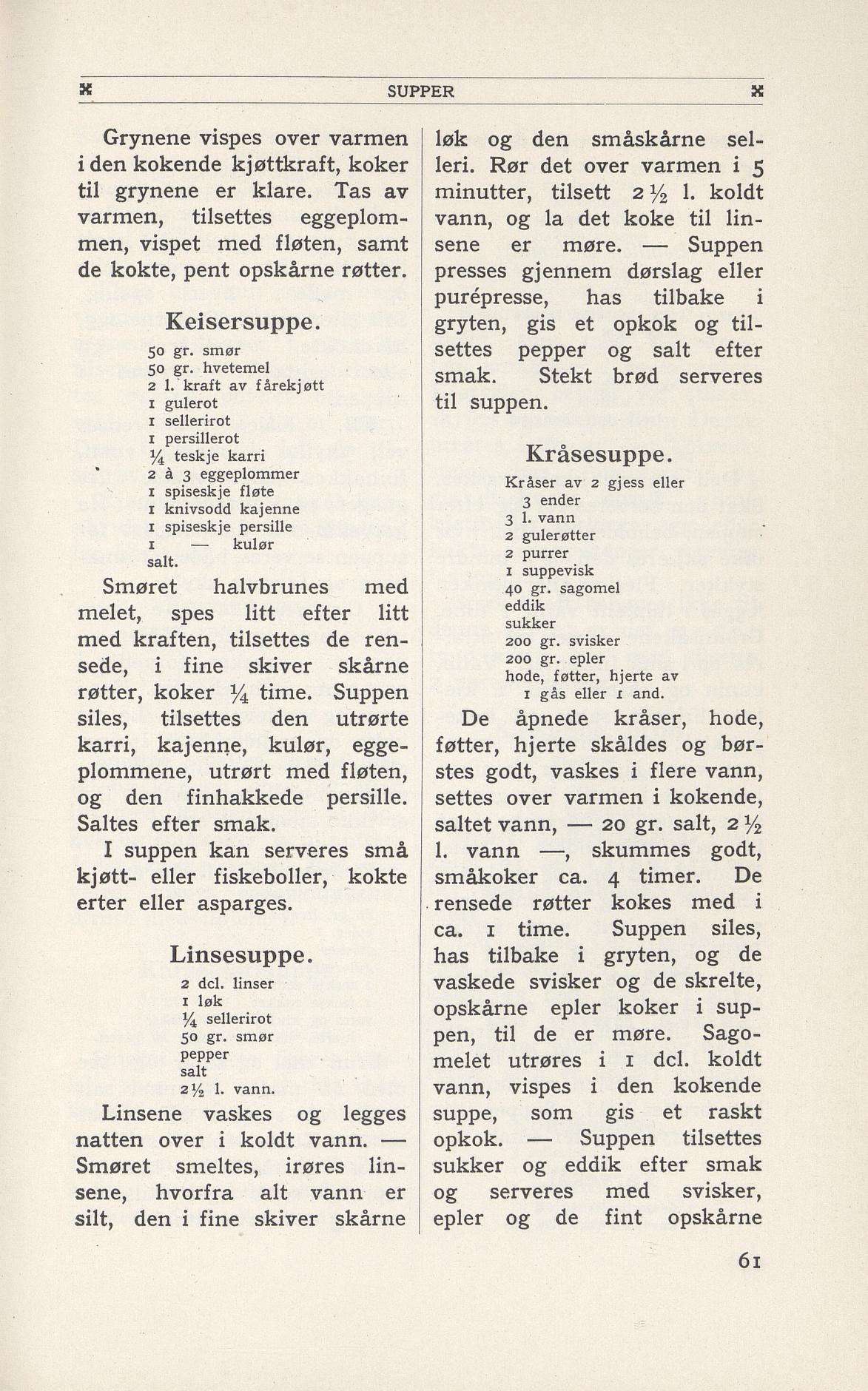
Kråser av 2 gjess eller 3 ender
3 l. vann
2 gulerøtter
2 purrer
1 suppevisk
40 gr. sagomel
eddik
sukker
200 gr. svisker
200 gr. epler
hode, føtter, hjerte av 1 gås eller 1 and.
De åpnede kråser, hode, føtter, hjerte skåldes og børstes godt, vaskes i flere vann, settes over varmen i kokende, saltet vann, — 20 gr. salt, 2 1/2 l. vann —, skummes godt, småkoker ca. 4 timer. De rensede røtter kokes med i ca. 1 time. Suppen siles, has tilbake i gryten, og de vaskede svisker og de skrelte, opskårne epler koker i suppen, til de er møre. Sagomelet utrøres i 1 del. koldt vann, vispes i den kokende suppe, som gis et raskt opkok. — Suppen tilsettes sukker og eddik efter smak og serveres med svisker, epler og de fint opskårne kråser samt de opskårne røtter og melbollér.
I suppen kan serveres små kjøtt- eller fiskeboller, kokte erter eller asparges.
In stores now
Clean, minimally processed groceries matched to the ingredients — approximate prices.
1949 (proofread, p. 61) → 1914 (proofread, p. 50)~44% of the text changedremovedadded
Kråser Kraaser av 2 gjess gjæs eller 3 ender ænder hode, føtter, hjerte av 1 gaas eller 1 and 3 l. vann vand 2 gulerøtter 2 purrer 1 suppevisk 40 gr. sagomel eddik sukker 200 gr. svisker 200 gr. epler hode, føtter, hjerte av 1 gås eller 1 and. eddik sukker salt pepper. De åpnede kråser, aapnede kraaser, hode, føtter, hjerte skåldes skoldes og børstes godt, vaskes i flere vann, settes vand, sættes over varmen ilden i kokende, saltet vann, vand, — 20 gr. salt, 2 1/2 l. vann vand —, skummes godt, småkoker smaakoker ca. 4 timer. De rensede røtter kokes med i ca. 1 time. Suppen siles, has haves tilbake i gryten, og de vaskede svisker og de skrelte, opskårne skrællede, opskaarne epler koker i suppen, til de er møre. Sagomelet utrøres i 1 del. koldt vann, vand, vispes i den kokende suppe, som gis gives et raskt opkok. — Suppen tilsettes tilsættes sukker og eddik efter smak og serveres med svisker, epler og de fint opskårne kråser opskaarne kraaser samt de opskårne røtter og melbollér. I suppen kan serveres små kjøtt- eller fiskeboller, kokte erter eller asparges. opskaarne røtter.
Figure on about 5 hours total. The giblets, head, feet, and heart simmer about 4 hours in boiling, salted water (20 g salt to 2 1/2 l water), and the roots cook along during the last hour.
Which offal parts are used?
Giblets of 2 geese or 3 ducks, plus the head, feet, and heart of 1 goose or 1 duck. Everything is scalded, brushed well, and washed in several changes of water before cooking, and the soup is skimmed well.
How is the soup thickened and seasoned?
40 g sago flour is stirred into 1 dl cold water and whisked into the boiling soup, which is given a quick boil-up. Prunes (200 g) and peeled, cut-up apples (200 g) are cooked tender in the soup, and it is seasoned with sugar, vinegar, salt, and pepper.
Where does the recipe come from?
From Henriette Schønberg Erken's "Stor kokebok" (1914), page 50. The recipe is meant for 6 servings.