Skip to content

Consommé II (chicken) – consommé de volaille

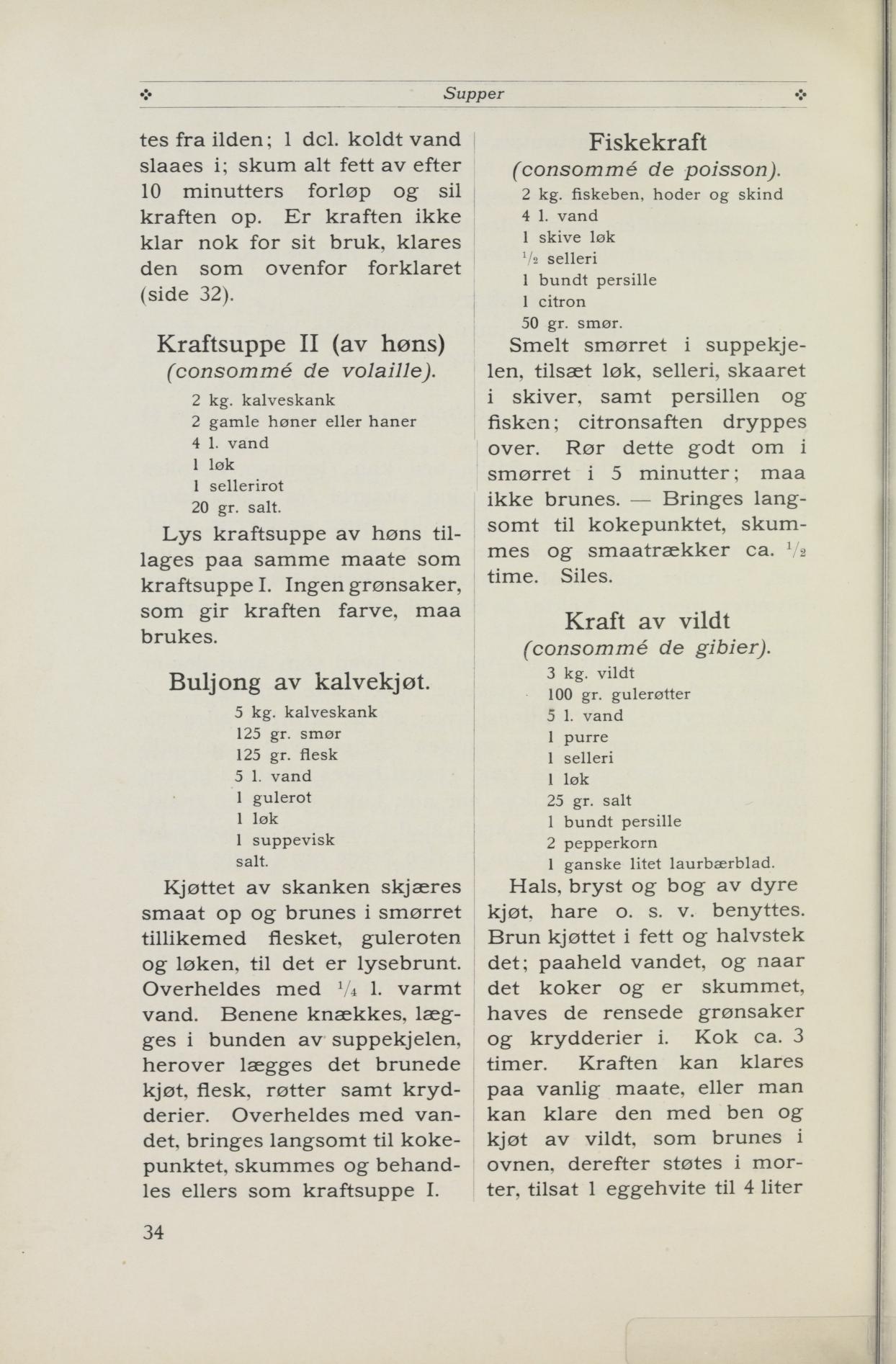
A clear, pale chicken consommé (consommé de volaille) made from veal shank and old hens, simmered slowly in 4 liters of water with onion and celeriac; no coloring vegetables. From Erken's Stor kokebok (Great Cookbook) 1914, page 34.

Source: Henriette Schønberg Erken, Stor kokebok, 1914-utg. s. 34 (falt i det fri)

Be the first to rate

About the dish

The recipe appears in the soup chapter among the classic clear soups (consommés). Erken refers to "consommé I" on the preceding page for the method itself: meat and bones are set over cold water, brought slowly to a boil, skimmed well and left to simmer for several hours, after which the stock is clarified and strained.

How to make it

  1. 1

    Set up the stock

    Place the veal shank with the cracked bones and the cleaned hens in a roomy stockpot. Pour over 4 liters of cold water and let it stand and steep for a while.

  2. 2

    Bring slowly to a boil

    Set the pot over low heat and let it slowly come to a boil. Skim off carefully as soon as the foam rises.

  3. 3

    Simmer the stock

    Add the salt, onion and celeriac. Let the stock barely simmer, covered, for 4–5 hours without boiling hard. Use no vegetables that give the stock color – the soup should be pale.

  4. 4

    Strain and skim

    Take the pot off the heat, add a little cold water if you like, skim off all the fat after ten minutes and strain the stock through a fine sieve.

  5. 5

    Clarifying

    If the stock is not clear enough, clarify it in the usual way with egg white and finely chopped meat.

Changes from the original

Quantities have been converted to modern measures (liters and grams). The method has been written out in steps as described for consommé I, since the original merely refers to it. Old hens can today be replaced with stewing fowl.

In stores now

Clean, minimally processed groceries matched to the ingredients — approximate prices.

Product data and prices via Kassalapp. Prices are updated daily and may vary.

Tidsmaskin – hva endret seg?

Velg to utgaver og se hva Henriette Schønberg Erken la til, fjernet eller endret mellom dem.

1914 (korrekturlest, s. 34)Modernisert~90% av teksten endretfjernetlagt til
2 kg. kg kalveskank (i biter, benene knekkes). 2 stk gamle høner eller haner (suppehøns). 4 l. vand l vann (kaldt). 1 løk stk løk. 1 sellerirot stk sellerirot. 20 gr. g salt. Lys kraftsuppe Legg kalveskank med knekte ben og de rensede hønene i en romslig suppekjele. Hell over 4 liter kaldt vann og la det stå og trekke en stund.. Sett kjelen over svak varme og la den langsomt komme til kokepunktet. Skum av høns tillages paa samme maate som kraftsuppe I. Ingen grønsaker, omhyggelig så snart skummet stiger.. Tilsett salt, løk og sellerirot. La kraften småtrekke under lokk i 4–5 timer uten å fosskoke. Bruk ingen grønnsaker som gir kraften farve, maa brukes. farge – suppen skal være lys.. Ta kjelen av varmen, tilsett gjerne litt kaldt vann, skum av alt fett etter ti minutter og sil kraften gjennom fin sil.. Er kraften ikke klar nok, klares den på vanlig måte med eggehvite og finhakket kjøtt.

Note til Modernisert

Mengder er ført over til moderne mål (liter og gram). Fremgangsmåten er skrevet ut i trinn slik den er beskrevet for kraftsuppe I, siden originalen bare henviser til den. Gamle høner kan i dag erstattes av suppehøns.

Community interpretations

Be the first to share your own version.

See interpretations

Frequently asked questions

What kind of meat do I need for this chicken consommé?
2 kg of veal shank and 2 old hens or roosters, simmered in 4 liters of water with onion, celeriac and 20 grams of salt.
Why shouldn't I use other vegetables?
This is meant to be a pale consommé. The recipe explicitly says that no vegetables that give the stock color may be used – which is why only onion and celeriac are used, not, for example, carrot or browned vegetables.
How long does the stock take?
Allow about 5 hours in all. The stock simmers slowly, just like consommé I, and old hens and roosters need a long cooking time to give a good stock.
Where does the recipe come from?
From Henriette Schønberg Erken's Stor kokebok (Great Cookbook) of 1914, page 34. The quantities given yield about 8 servings.

Related recipes

More dishes in the same category from the archive

Read also

Kommentarer

Ingen kommentarer ennå. Bli den første til å dele!