Skip to content

Cutlets à la Nelson

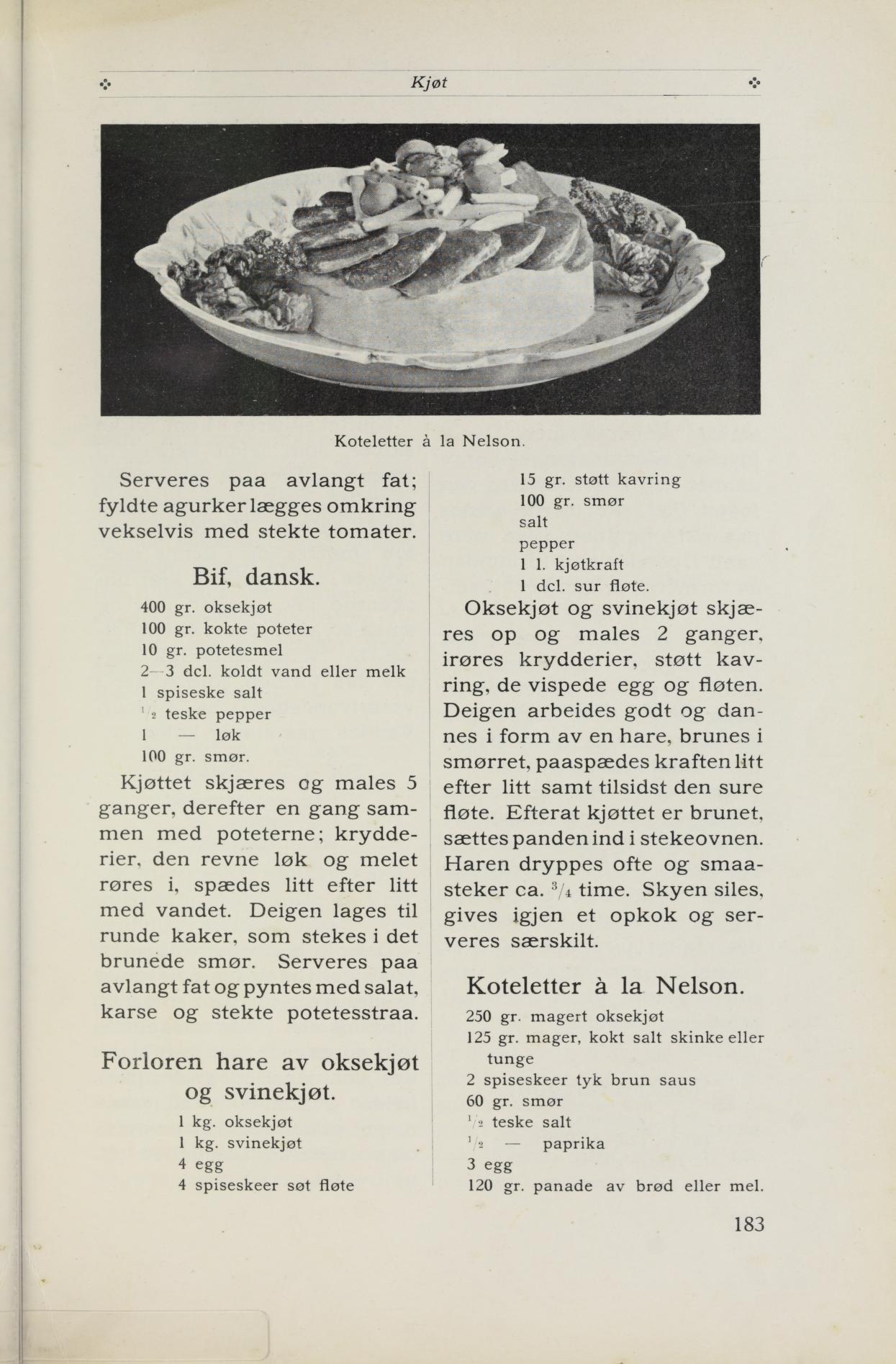
Cutlets à la Nelson from Erken 1914: a fine forcemeat of scraped beef and cooked salt-cured ham or tongue pounded in a mortar with panade, brown sauce, butter, eggs, and cream, pressed through a hair sieve, steamed in small cutlet molds in a water bath about 20 minutes, dipped in tomato sauce, and arranged in a ring on a potato or rice border with a macaroni ragout in the center.

Source: Henriette Schønberg Erken, Stor kokebok, 1914-utg. s. 183 (falt i det fri)

Be the first to rate

About the dish

A finer party dish from the meat chapter: a richly worked forcemeat of scraped beef and salt-cured ham or tongue, pressed through a hair sieve, steamed in small cutlet molds, and arranged in a ring around a macaroni ragout. The dish shows Erken's French-inspired plating art with a potato or rice border as the base.

How to make it

  1. 1

    Pound the forcemeat

    Scrape the beef finely and pound it in a mortar together with the ham or tongue. Add the panade, the brown sauce, and the butter little by little as you pound.

  2. 2

    Seasoning and eggs

    When the forcemeat is well worked, add the salt and paprika, and then the well-beaten eggs, one at a time. Stir in the cream.

  3. 3

    Sieve the forcemeat

    Press the forcemeat through a hair sieve (fine sieve) and scrape the forcemeat off the underside as you go.

  4. 4

    Fill the molds

    Fill the forcemeat into 15–18 small greased cutlet molds, or shape cutlets on a moistened board.

  5. 5

    Steam in a water bath

    Set the molds on a rack in a water bath — no more water in the pan than covers the bottom of the molds. Steam in the oven at about 160 °C (320 °F) for roughly 20 minutes. If you shaped them on a board, place the cutlets between two greased papers on a tray or rack over the water bath.

  6. 6

    Plating

    Turn the cutlets out of the molds just before plating, dip them in boiling hot, slightly thick tomato sauce, and arrange them in a ring on a potato or rice border. Fill the center with macaroni ragout, sprinkle finely chopped parsley over, and garnish the platter with lettuce or parsley.

Changes from the original

Measures modernized (gr. → g, spiseskeer → tbsp, teske → tsp). Paprika is given in pinches. "Cream" is sweet cream (heavy cream). The method has been divided into numbered steps, and the water bath/steaming in the oven is described with a modern temperature. The filling (macaroni ragout) belongs to a separate recipe.

In stores now

Clean, minimally processed groceries matched to the ingredients — approximate prices.

Product data and prices via Kassalapp. Prices are updated daily and may vary.

Tidsmaskin – hva endret seg?

Velg to utgaver og se hva Henriette Schønberg Erken la til, fjernet eller endret mellom dem.

1914 (korrekturlest, s. 183)1949 (korrekturlest, s. 214)~47% av teksten endretfjernetlagt til
250 gr. magert oksekjøt oksekjøtt 125 gr. mager, kokt salt skinke eller tunge 2 spiseskeer tyk spiseskjeer tykk brun saus 60 gr. smør 1/2 teske teskje salt 1—2 knivsodd 1/2 paprika 4 3 egg 4 spiseskeer søt fløte 120 gr. panade pånade av brød eller mel. Oksekjøttet skrapes fint og støtes i morter arbeides sammen med skinken eller tungen; under støtningen tilsættes herunder tilsettes panaden, sausen og smørret smøret litt efter litt. Naar Når deigen er godt arbeidet, tilsættes tilsettes krydderier og de godt vispede egg, 1 ad gangen; deigen presses gjennem haarsigt, hårsikt, idet man skraper deigen paa undersiden fra efterhvert. Deigen haves has i smaa små smurte koteletformer, kotelettformer, 15—18 former, eller i mangel herav dannes den i koteletform paa fugtet fjæl. Formerne sættes paa kotelettform på fuktet fjel. Formene settes på rist i vandbad; vannbad; ikke mere vand vann i panden end pannen enn til bunden bunnen av formerne formene er dækket. dekket. Dampes i ovnen omtrent 20 minutter. Har man dannet paa fjæl, lægges koteletterne paa på fjel, legges kotelettene på smurt papir, et andet annet smurt papir lægges legges over, lægges paa legges på en plate eller rist, som lægges legges over vandbadet vannbadet i ovnen. Naar Når de er færdige, ferdige, vendes de straks før anretningen av formerne, formene, anrettes i rundkreds paa potetes- eller risbord efterat være dyppet i kokende varm, rundkrets på varmt fat med litt tyk tykk tomatsaus. I midten fyldes fylles makaroniragout, og over denne drysses finhakket persille. Fatet pyntes med litt salat eller persille.

Community interpretations

Be the first to share your own version.

See interpretations

Frequently asked questions

What is the forcemeat in cutlets à la Nelson made of?
250 g lean beef and 125 g lean, cooked salt-cured ham or tongue, pounded together with 120 g panade of bread or flour, 2 tablespoons thick brown sauce, 60 g butter, salt, 1–2 pinches of paprika, 4 eggs, and 4 tablespoons sweet cream.
How should the cutlets be prepared?
The forcemeat is pressed through a hair sieve and placed in 15–18 small greased cutlet molds (or shaped as cutlets on a moistened board). The molds are set on a rack in a water bath — not too much water.
Why are the eggs added one at a time?
The eggs are beaten well and stirred in one at a time after the mixture has been well worked with panade, sauce, and butter, so the forcemeat becomes smooth and does not separate.
Where does the recipe come from?
From Henriette Schønberg Erken's "Stor kokebok" (1914), page 183. It is counted as 6 servings and takes around 90 minutes.

Related recipes

More dishes in the same category from the archive

Read also

Kommentarer

Ingen kommentarer ennå. Bli den første til å dele!