Skip to content

Rendering (Clarifying) Fat

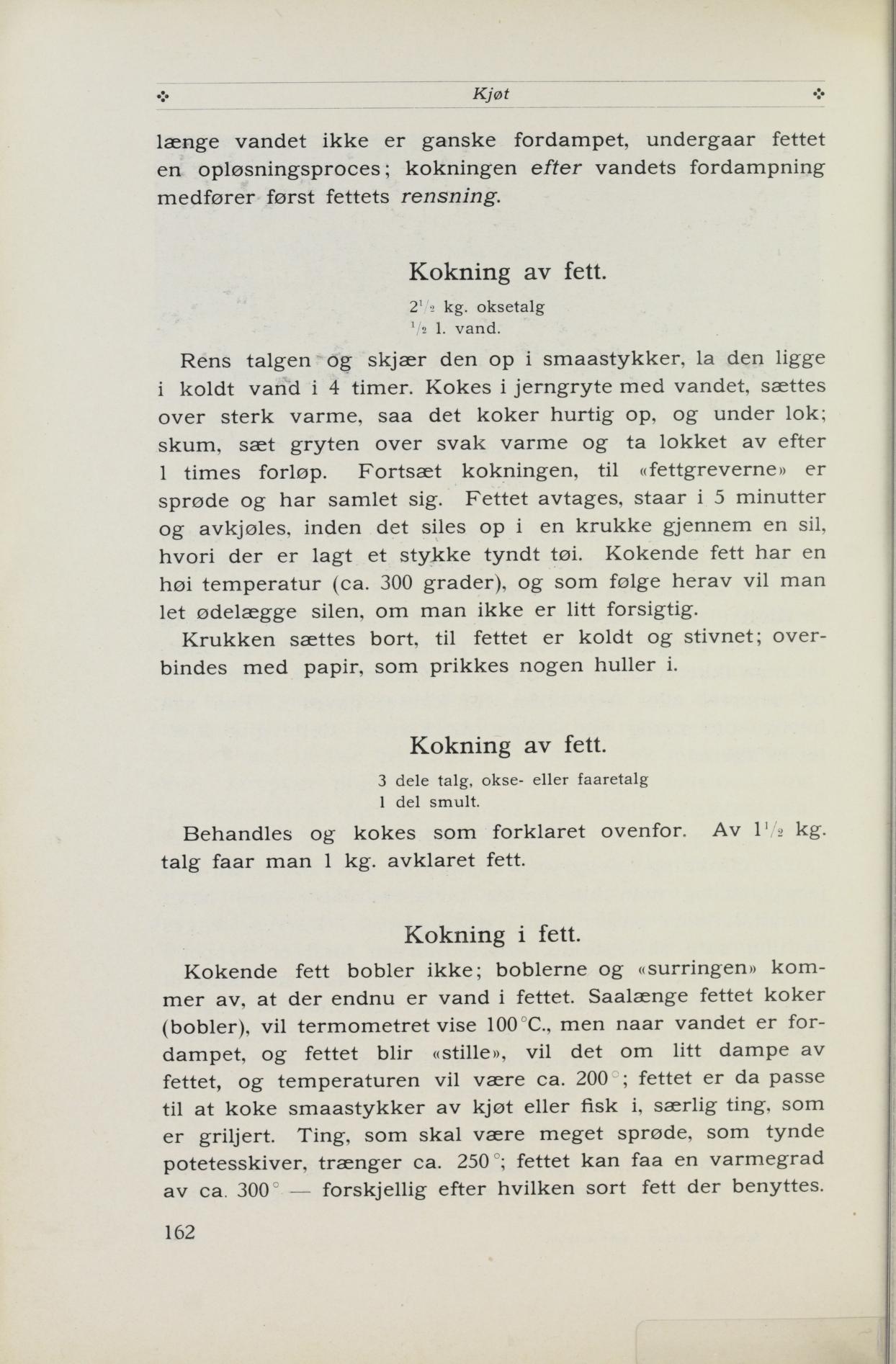
Erken's basic recipe for clarifying beef tallow into cooking fat: 2.5 kg tallow soaked for 4 hours, boiled with 1 liter of water covered, then uncovered until the cracklings are crisp, strained, and stored in a crock.

Source: Henriette Schønberg Erken, Stor kokebok, 1914-utg. s. 162 (falt i det fri)

Be the first to rate

About the dish

Erken explains how to clarify (purify) tallow into cooking fat – a completely central household technique before store-bought margarine and vegetable fat became common. The point is that the water first dissolves the fatty tissue, while the further cooking, after the water has evaporated, purifies the fat itself.

How to make it

  1. 1

    Clean and soak

    Clean the tallow, cut it into small pieces, and let it soak in cold water for 4 hours.

  2. 2

    Bring to a boil

    Put the tallow in an iron pot together with 1 liter of water. Set the pot over high heat with the lid on, so it comes quickly to a boil. Skim.

  3. 3

    Simmer

    Set the pot over low heat. Take off the lid after 1 hour of boiling and continue cooking until the cracklings are crisp and have gathered together.

  4. 4

    Strain

    Take the pot off the heat, let the fat stand for 5 minutes and cool a little before straining it into a crock through a sieve lined with a thin cloth. Be careful: boiling fat has a very high temperature (about 300 degrees) and can ruin the sieve.

  5. 5

    Storage

    Set the crock aside until the fat is cold and set. Cover it with paper and prick a few holes in the paper.

Changes from the original

The measurements are kept (kg and liter), but the method is divided into numbered steps with modern spelling. "Fettgrever" is explained as cracklings/crunchy residue. The use of a fine cloth is described as a cloth/cheesecloth.

Time machine – what changed?

Pick two editions and see what Henriette Schønberg Erken added, removed or changed between them.

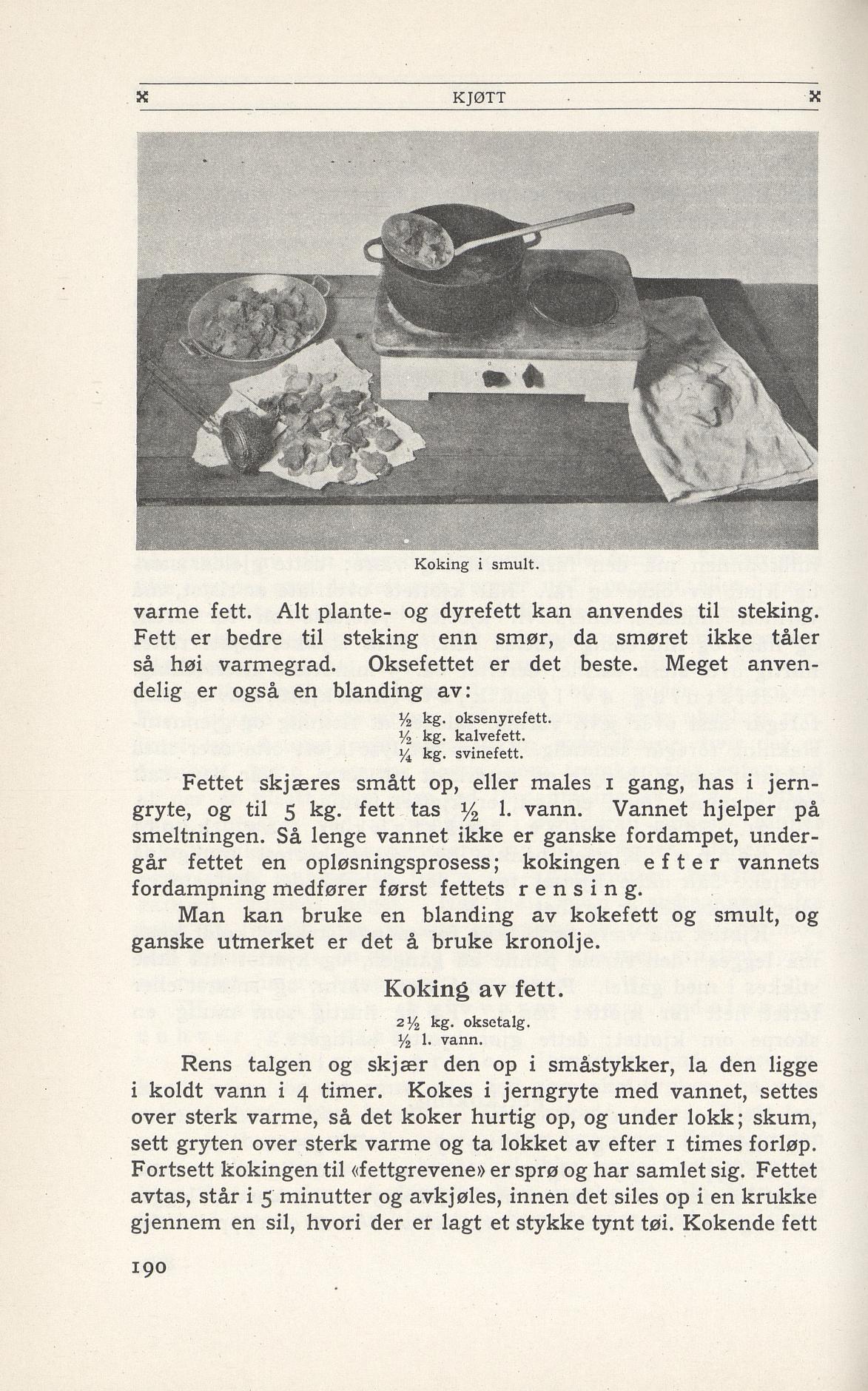
Modernised → 1949 (proofread, p. 190)~72% of the text changedremovedadded
2,5 kg oksetalg (renset). 1 l 2½ kg. oksetalg. ½ l. vann. Rens talgen, talgen og skjær den op i småstykker og småstykker, la den ligge i kaldt koldt vann i 4 timer.. Legg talgen timer. Kokes i en jerngryte sammen med 1 liter vann. Sett gryten vannet, settes over sterk varme med lokk på, varme, så det koker raskt opp. Skum av.. Sett hurtig op, og under lokk; skum, sett gryten over svak varme. Ta av sterk varme og ta lokket etter av efter 1 times koking og fortsett forløp. Fortsett kokingen til fettgrevene «fettgrevene» er sprø og har samlet seg.. Ta gryten av varmen, la fettet stå sig. Fettet avtas, står i 5 minutter og avkjøles litt før avkjøles, innen det siles op i en krukke gjennom gjennem en sil med sil, hvori der er lagt et stykke tynt klede i. Vær forsiktig: kokende tøi. Kokende fett har svært høy en høi temperatur (ca. 300 grader) grader), og kan som følge herav vil man lett ødelegge silen.. Sett krukken silen, om man ikke er litt forsiktig. Krukken settes bort til fettet er kaldt koldt og stivnet. Bind over stivnet; overbindes med papir og prikk noen hull i papiret. papir, som prikkes huller i.

Note on Modernised

Målene er beholdt (kg og liter), men fremgangsmåten er delt i nummererte trinn med moderne rettskriving. «Fettgrever» er forklart som fettgrever/knasende rester. Bruk av tyntflytende klede er beskrevet som klede/osteklede.

Community interpretations

Be the first to share your own version.

See interpretations →

Frequently asked questions

Why should the tallow soak in cold water for 4 hours?
How long does the whole process take?
The recipe figures on about 7 hours in all: 4 hours of soaking in cold water, then cooking – first a hard boil under the lid, 1 hour over low heat with the lid on, and further cooking until the cracklings are crisp and have gathered together.
How is the fat strained safely?
Let the fat stand 5 minutes and cool somewhat before straining it into a crock through a sieve lined with a thin piece of cloth. Boiling fat has a very high temperature (about 300 degrees according to the book), so the sieve can easily be ruined if you are not careful.
How is the finished fat stored?
The crock is set aside until the fat is cold and set, then covered with paper that is pricked with holes.

Related recipes

More dishes in the same category from the archive

Read also

Kommentarer

Ingen kommentarer ennå. Bli den første til å dele!