Skip to content

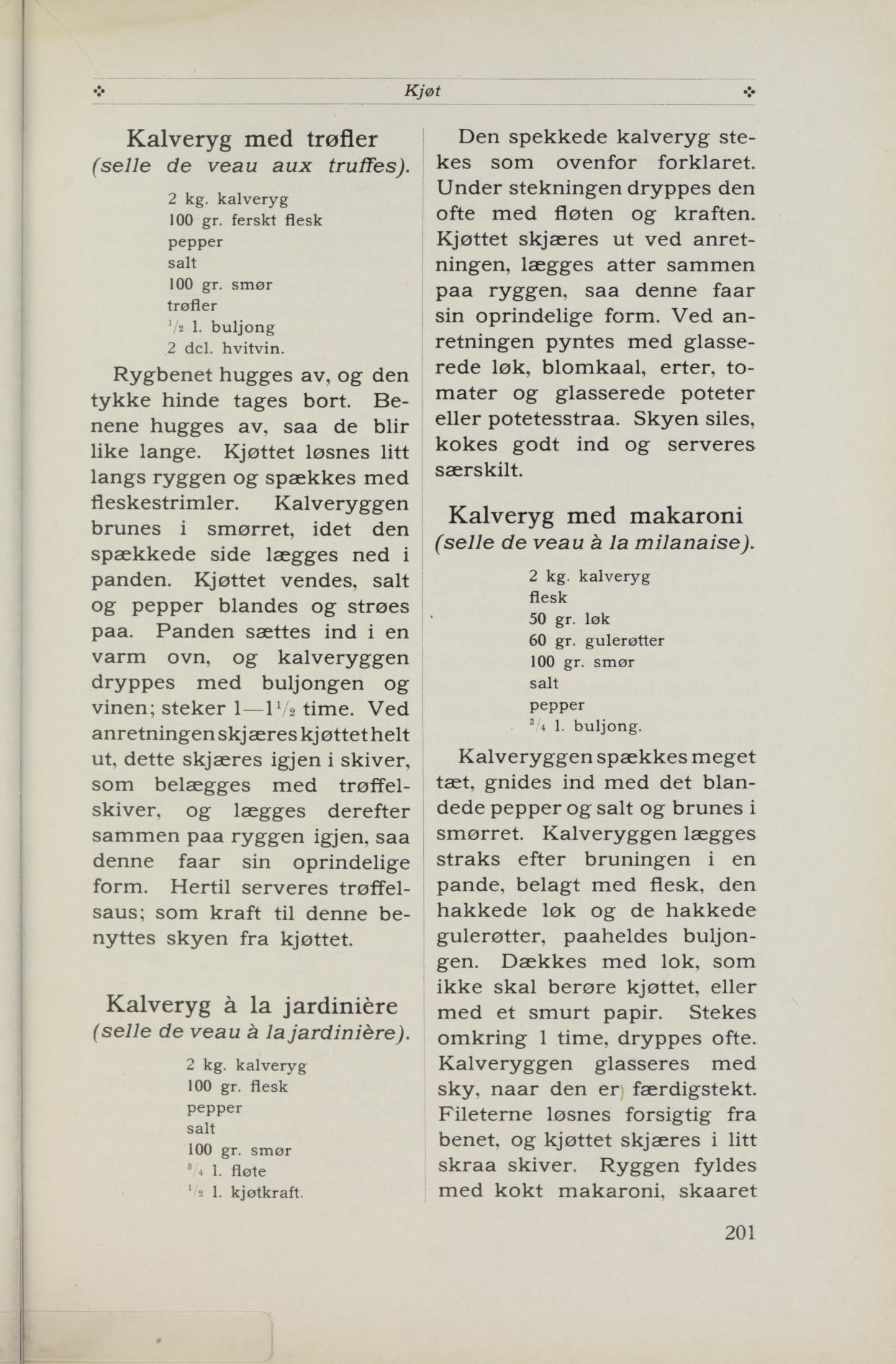
Saddle of Veal à la Jardinière (selle de veau à la jardinière)

Larded saddle of veal roasted in the oven and basted with cream and meat stock, carved and laid back on the backbone, garnished with glazed onions, cauliflower, peas, tomatoes and potatoes, with reduced jus alongside.

Source: Henriette Schønberg Erken, Stor kokebok, 1914-utg. s. 201 (falt i det fri)

Be the first to rate

About the dish

"Jardinière" means gardener's wife and refers to the abundant vegetable garnish around the roast. The recipe builds on the preceding saddle of veal with truffles.

How to make it

  1. 1

    Lard and roast

    Lard the saddle of veal and roast it as in the recipe for saddle of veal with truffles: brown in butter, season with salt and pepper and continue roasting in a hot oven.

  2. 2

    Baste

    Baste the roast often with cream and meat stock during roasting.

  3. 3

    Carve

    Carve the meat off the saddle, divide it into slices and lay the slices back together on the backbone so the roast regains its original shape.

  4. 4

    Garnish

    Garnish the platter with glazed onions, cauliflower, peas, tomatoes and glazed potatoes or potato straw.

  5. 5

    Jus

    Strain the jus, cook it down well and serve it separately.

Changes from the original

The ingredient list has been reassembled from the column typesetting, where it was printed after the method. Measures modernized (del. = dl, gr. = g). The amount of cream in the OCR was unclear and is interpreted as ½ dl; vegetable quantities are not given in the original.

In stores now

Clean, minimally processed groceries matched to the ingredients — approximate prices.

Product data and prices via Kassalapp. Prices are updated daily and may vary.

Time machine – what changed?

Pick two editions and see what Henriette Schønberg Erken added, removed or changed between them.

1914 (proofread, p. 201) → Modernised~88% of the text changedremovedadded
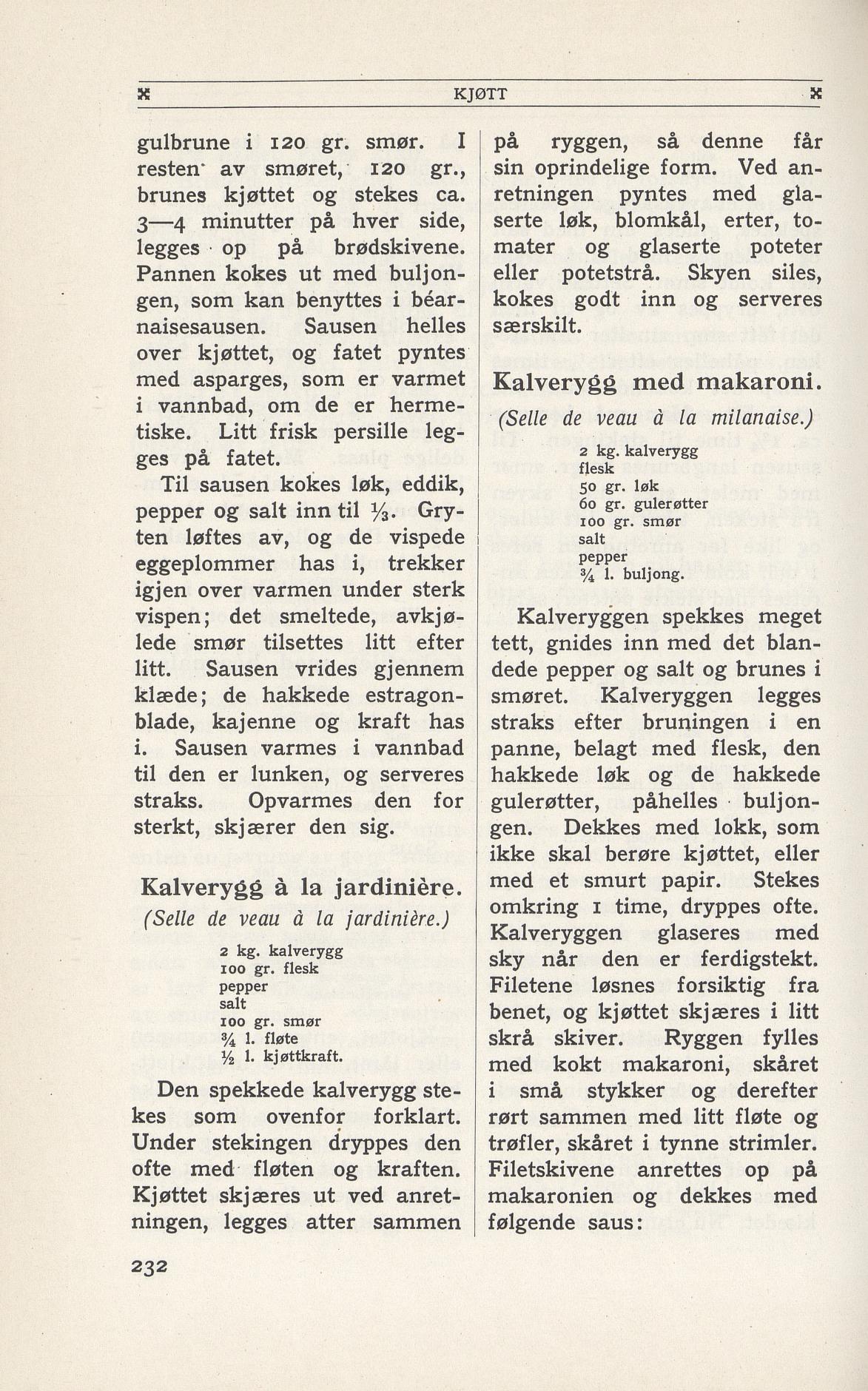
2 kg. kalveryg kg kalverygg. 100 gr. flesk pepper salt g sideflesk (til spekking). 1 ts salt. 0,5 ts pepper. 100 gr. smør 1/2 del. g smør. 0,5 dl fløte (til dryppe­sky). 1 1. kjøtkraft. Den spækkede kalveryg stekes som ovenfor forklaret. Under stekningen dryppes l kjøttkraft. glasserte løk (til garnityr). blomkål (kokt, til garnityr). grønne erter (til garnityr). tomater (til garnityr). glasserte poteter eller potetstrå (til garnityr). Spekk kalveryggen og stek den som i oppskriften på kalverygg med trøfler: brun i smør, krydre med salt og pepper og stek videre i varm ovn.. Drypp steken ofte med fløten fløte og kraften. Kjøttet skjæres kjøttkraft under stekingen.. Skjær kjøttet ut ved anretningen, lægges atter sammen paa av ryggen, saa denne faar del det i skiver og legg skivene sammen på ryggbeinet igjen så steken får sin oprindelige form. Ved anretningen pyntes opprinnelige form.. Pynt fatet med glasserede glasserte løk, blomkaal, blomkål, erter, tomater og glasserede glasserte poteter eller potetesstraa. Skyen siles, kokes potetstrå.. Sil skyen, kok den godt ind inn og serveres særskilt. server den for seg.

Note on Modernised

Ingredienslisten er satt sammen igjen fra spaltesatsen, der den sto trykt etter fremgangsmåten. Mål modernisert (del. = dl, gr. = g). Fløtemengden i OCR var uklar og er tolket som ½ dl; grønnsakmengder er ikke oppgitt i originalen.

Community interpretations

Be the first to share your own version.

See interpretations →

Frequently asked questions

How is the saddle of veal prepared?
The saddle is larded with pork (100 g), seasoned with pepper and salt, and roasted with butter. During roasting it is basted often with the cream (1/2 dl) and the meat stock (1 l). The total time is about 2.5 hours for 2 kg.
What does "à la jardinière" mean here?
It refers to the vegetable garnish: glazed onions, cauliflower, peas, tomatoes and glazed potatoes or potato straw laid around the roast at plating.
How is the dish arranged and served?
The meat is carved off, laid back on the backbone so the roast regains its original shape, and garnished with the vegetables. The jus is strained, cooked down well and served separately.
Where does the recipe come from?
From Henriette Schønberg Erken's "Stor kokebok" (1914), page 201. It serves 8.

Related recipes

More dishes in the same category from the archive

Read also

Kommentarer

Ingen kommentarer ennå. Bli den første til å dele!