Skip to content

Turkey, roasted (dindon rôti)

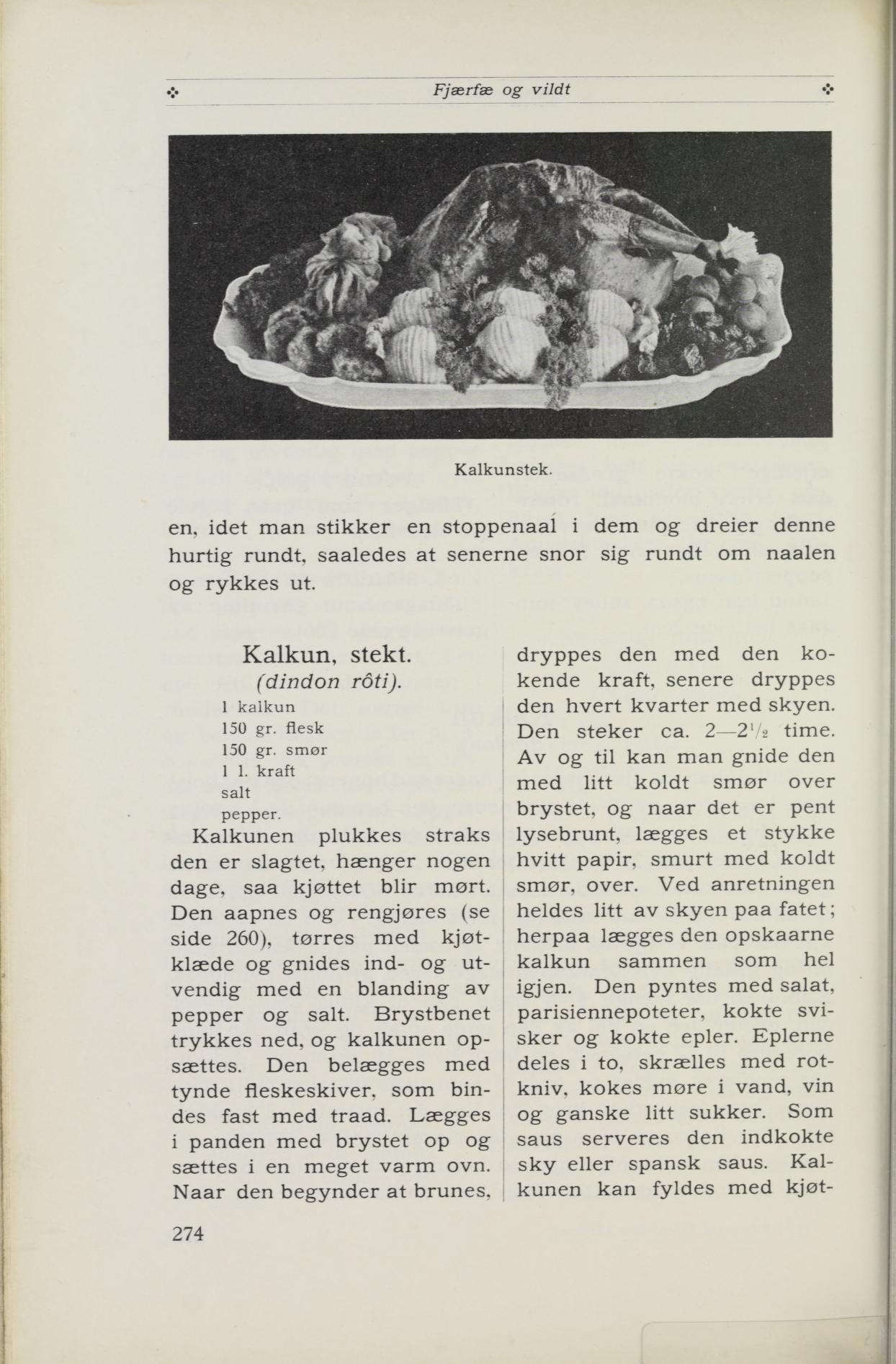
Erken's basic recipe for whole roast turkey (1914): aged, seasoned, and barded with pork fat slices, roasted 2–2½ hours in a hot oven with basting stock and juices, served with lettuce, pommes parisienne, prunes, cooked apples, and reduced pan juices or espagnole sauce. Includes a forcemeat of giblets, pork, pork fat, white bread, onion, parsley, and egg to stuff under the neck skin.

Source: Henriette Schønberg Erken, Stor kokebok, 1914-utg. s. 274 (falt i det fri)

Be the first to rate

About the dish

A classic whole roast turkey from the chapter on poultry and game. Erken assumes the bird is hung for a few days after slaughter so the meat tenderizes, and that it is barded with thin slices of pork fat before roasting. Finally she gives a recipe for a forcemeat of giblets, pork, and pork fat to stuff the neck skin.

How to make it

  1. 1

    Aging and cleaning

    Pluck the turkey immediately after slaughter and let it hang for a few days so the meat becomes tender. Open and clean it, and wipe it with a damp meat cloth.

  2. 2

    Season and truss

    Rub the turkey inside and out with a mixture of salt and pepper. Press the breastbone down and truss the bird. Lay thin slices of pork fat over the breast and tie them on with string.

  3. 3

    Roasting

    Place the turkey in a roasting pan or skillet breast up and put it in a very hot oven (about 225 °C (435 °F)). When it begins to brown, baste it with boiling stock; then baste it with the pan juices every quarter hour. Lower the heat to about 175 °C (345 °F).

  4. 4

    Watch the browning

    Roast about 2–2½ hours (internal temperature about 75 °C (165 °F) in the thickest part of the thigh). Rub the breast now and then with a little cold butter, and lay a sheet of white paper greased with cold butter over it when the breast is nicely light brown.

  5. 5

    Plating

    Pour a little of the pan juices onto the platter, carve the turkey, and reassemble the pieces as a whole bird again. Garnish with lettuce, pommes parisienne, cooked prunes, and cooked apples — the apples are halved, peeled, and cooked tender in water, wine, and a very little sugar. Serve reduced pan juices or espagnole sauce with it.

  6. 6

    Forcemeat for stuffing (optional)

    Scrape the gizzard, liver, and heart and grind them together with an equal weight of pork and half as much pork fat as the giblets weighed. Soak 100 g white bread in water and squeeze it lightly. Stir the bread together with the meat, a pinch of onion, and 1 tbsp finely chopped parsley.

  7. 7

    Stuff the turkey

    Work the forcemeat well and add 2 beaten eggs a little at a time; season with salt and pepper and stir to a fine paste. Lay the turkey breast down, loosen the skin at the neck to form a pocket, and fill the forcemeat in here before roasting. Bread forcemeat or potato forcemeat can be used instead.

Changes from the original

Measures are converted to modern units (dl, grams, tablespoons), "flesk" is specified as thin slices of salt pork belly/bacon, and the stock/bouillon is clarified. Roasting time is given with a recommended internal temperature in addition to Erken's time. The forcemeat has been separated out as its own optional step.

In stores now

Clean, minimally processed groceries matched to the ingredients — approximate prices.

Product data and prices via Kassalapp. Prices are updated daily and may vary.

Time machine – what changed?

Pick two editions and see what Henriette Schønberg Erken added, removed or changed between them.

Pick two different editions to see a comparison.

Community interpretations

Be the first to share your own version.

See interpretations →

Frequently asked questions

How long should the turkey roast?
About 2–2 1/2 hours in the oven. It is put in a very hot oven breast up, and basted with boiling stock when it begins to brown, then with the pan juices every quarter hour.
Why should the turkey hang for a few days before roasting?
It is plucked immediately after slaughter and hung for a few days so the meat becomes tender. Then it is opened and cleaned, wiped with a meat cloth, and rubbed inside and out with pepper and salt.
What is the purpose of the pork fat slices and the paper?
Thin slices of pork fat (150 g) are tied over the breast with string to keep the meat juicy. When the breast is nicely light brown, a piece of greased white paper is laid over it so it does not get too dark.
What do I need for the recipe?
1 turkey, 150 g pork fat, 150 g butter, 1 liter stock, salt, and pepper. The recipe is from Henriette Schønberg Erken's "Stor kokebok" (1914), p. 274, and serves 8.

Related recipes

More dishes in the same category from the archive

Read also

Kommentarer

Ingen kommentarer ennå. Bli den første til å dele!