Skip to content

Chicken Mousselines à la Saint-Clair

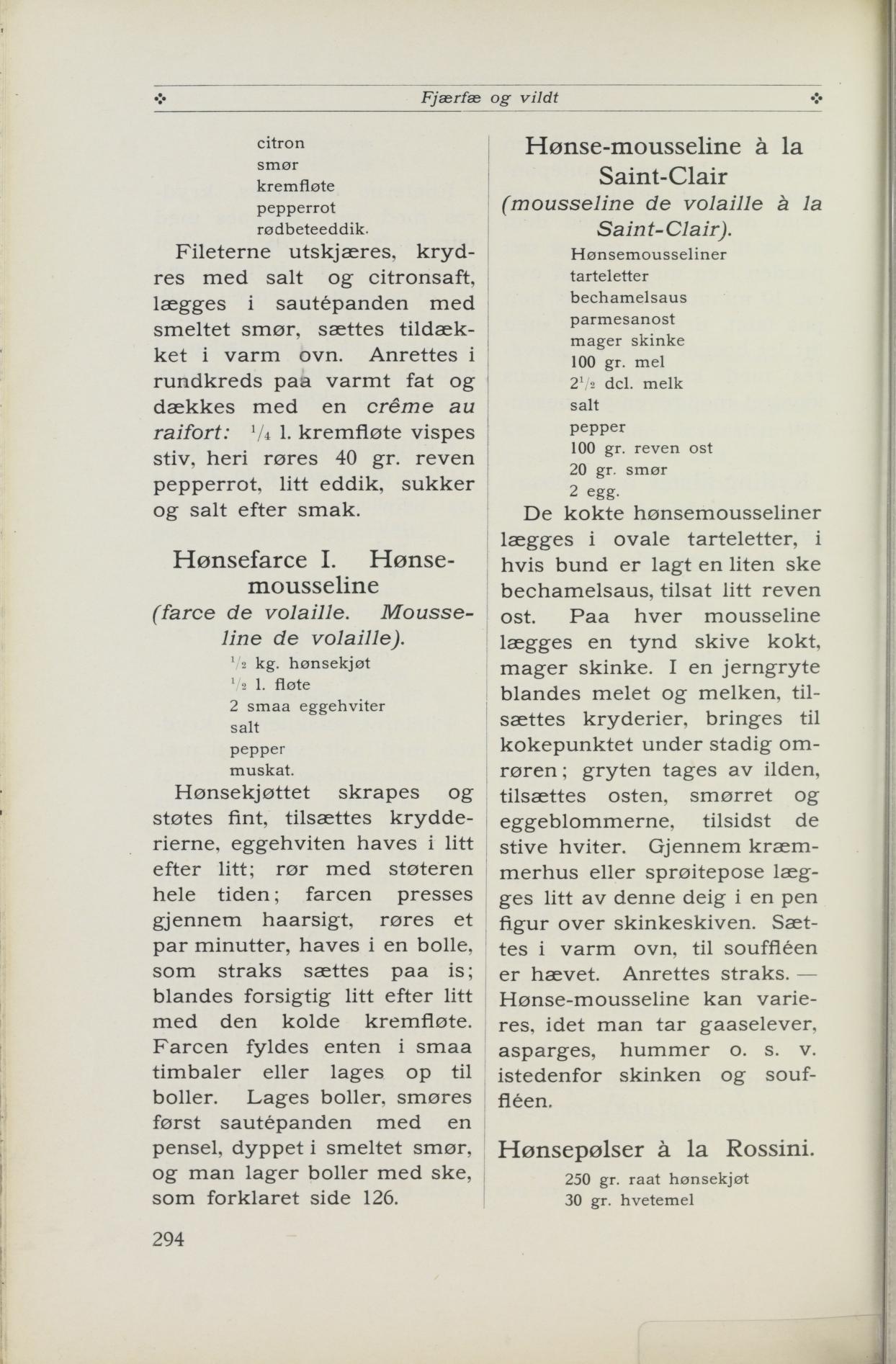
Cooked chicken mousselines are placed in tartlet shells with béchamel sauce and cheese flakes, topped with a slice of cooked ham, and a cheese-soufflé batter of 100 g flour, 2.5 dl milk, 100 g parmesan, 20 g butter and 2 eggs is piped over. Gratinéed in a hot oven and served at once.

Source: Henriette Schønberg Erken, Stor kokebok, 1914-utg. s. 294 (falt i det fri)

Be the first to rate

About the dish

A festive arrangement in which ready-cooked chicken mousselines are placed in tartlet shells and topped with a cheese-soufflé mixture that is piped on and gratinéed. Erken herself suggests variations with foie gras or asparagus.

How to make it

  1. 1

    Assemble the tartlets

    Place a small spoonful of béchamel sauce mixed with a little grated cheese in the bottom of each tartlet, and set a cooked chicken mousseline on top.

  2. 2

    Add the ham

    Lay a thin slice of cooked, lean ham over each mousseline.

  3. 3

    Cook the soufflé mixture

    Combine flour and milk in a pan, season with salt and pepper and bring to a boil, stirring constantly, until you have a thick paste.

  4. 4

    Finish the batter

    Take the pan off the heat and stir in the grated cheese, butter and egg yolks. Finally fold in the stiffly beaten egg whites.

  5. 5

    Pipe and gratiné

    Pipe an attractive shape of the mixture over the ham slices with a piping bag. Place the molds in a hot oven (about 220 °C (430 °F)) until the soufflé has risen and taken on color.

  6. 6

    Serve

    Serve at once. The ham and soufflé can be replaced with foie gras, asparagus or the like.

Changes from the original

Measurements are converted to modern units. "Grated cheese" is specified as parmesan. An oven temperature is given (about 220 °C (430 °F)). A paper cornet has been replaced with a piping bag.

In stores now

Clean, minimally processed groceries matched to the ingredients — approximate prices.

Product data and prices via Kassalapp. Prices are updated daily and may vary.

Time machine – what changed?

Pick two editions and see what Henriette Schønberg Erken added, removed or changed between them.

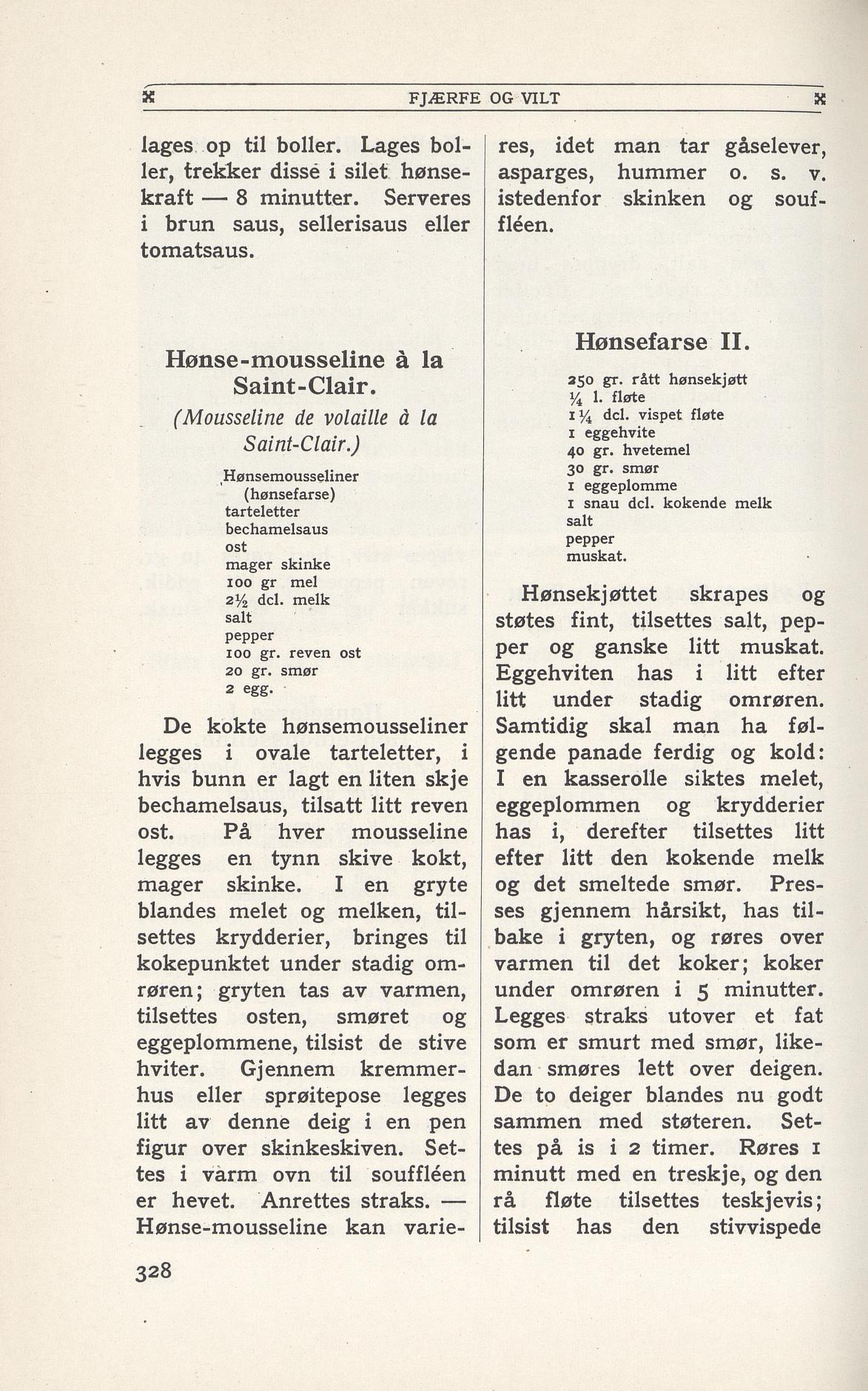
1949 (proofread, p. 328) → 1914 (proofread, p. 294)~36% of the text changedremovedadded
Hønsemousseliner (hønsefarse) hønsemousseliner tarteletter bechamelsaus ost parmesanost mager skinke 100 gr gr. mel 2½ del. melk salt pepper 100 gr. reven ost 20 gr. smør 2 egg. De kokte hønsemousseliner legges lægges i ovale tarteletter, i hvis bunn bund er lagt en liten skje ske bechamelsaus, tilsatt tilsat litt reven ost. På Paa hver mousseline legges lægges en tynn tynd skive kokt, mager skinke. I en gryte jerngryte blandes melet og melken, tilsettes krydderier, tilsættes kryderier, bringes til kokepunktet under stadig omrøren; gryten tas tages av varmen, tilsettes ilden, tilsættes osten, smøret smørret og eggeplommene, tilsist eggeblommerne, tilsidst de stive hviter. Gjennem kremmerbus kræmmerhus eller sprøitepose legges lægges litt av denne deig i en pent pen figur over skinkeskiven. Settes Sættes i varm ovn ovn, til souffléen er hevet. hævet. Anrettes straks. — Hønse-mousseline kan varieres, idet man tar gåselever, gaaselever, asparges, hummer nummer o. s. v. istedenfor skinken og souffléen.
Community interpretations

Be the first to share your own version.

See interpretations →

Frequently asked questions

What is the top soufflé batter made of?
A thick, cooked base of 100 g flour and 2½ dl milk seasoned with salt and pepper, to which — off the heat — 100 g grated cheese, 20 g butter and 2 egg yolks are added, and finally the stiffly beaten whites.
How is the dish assembled?
Oval tartlets get a small spoonful of béchamel sauce with a little grated cheese in the bottom, then a cooked chicken mousseline, a thin slice of cooked lean ham, and finally the soufflé batter is piped in an attractive shape over the ham.
How are they baked and served?
They are placed in a hot oven until the soufflé has risen, and served at once – the soufflé sinks if it stands.
Where does the recipe come from?
From Henriette Schønberg Erken's "Stor kokebok" (1914), page 294. It is considered a starter and is intended for 6 servings.

Related recipes

More dishes in the same category from the archive

Read also

Kommentarer

Ingen kommentarer ennå. Bli den første til å dele!