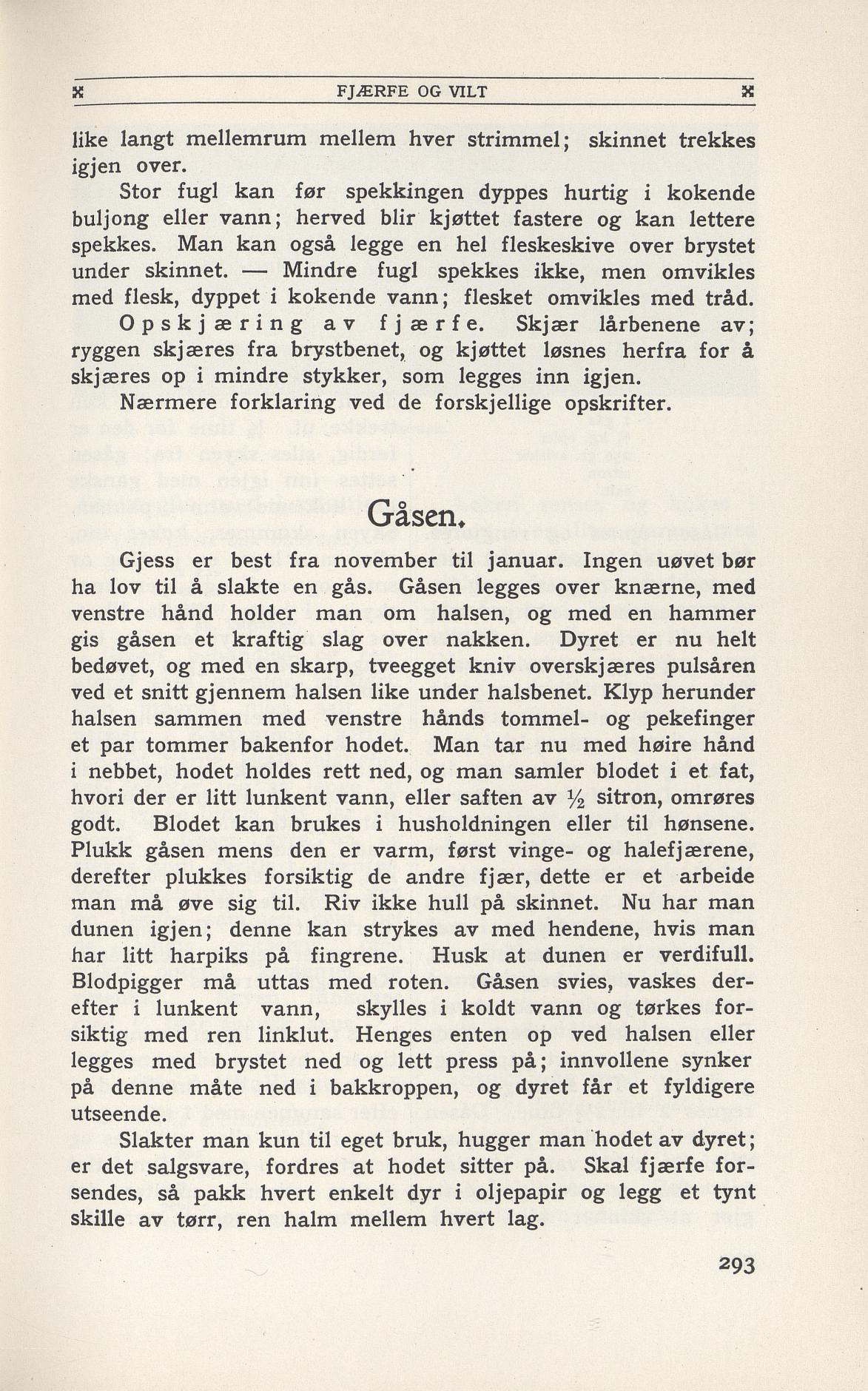
Original 1914 recipe
Verbatim from the first edition of the Big Cookbook.
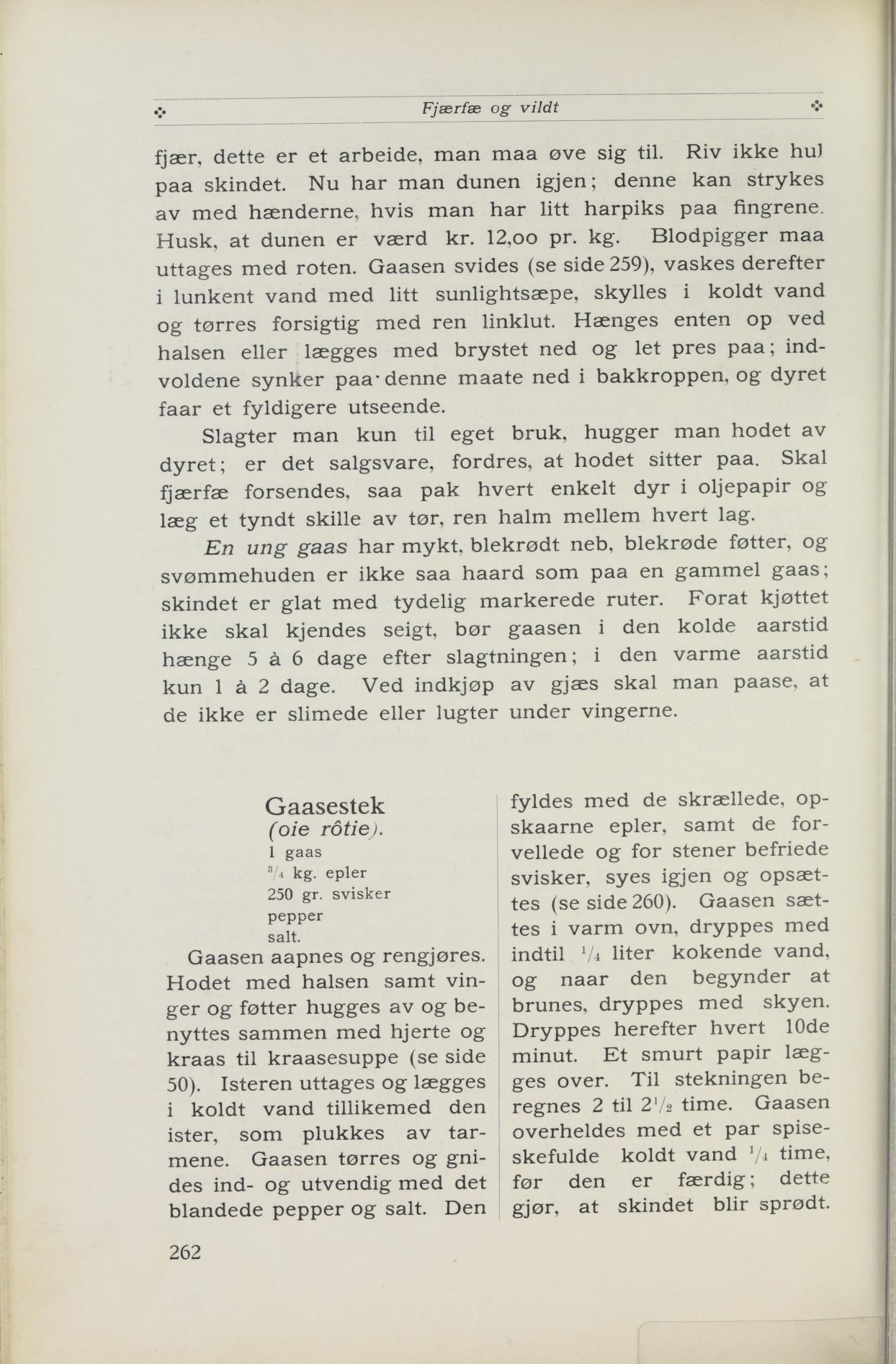
Erken's classic roast goose from 1914: the goose is cleaned, seasoned with salt and pepper, stuffed with apples and prunes, sewn shut and roasted 2–2½ hours while continuously basted with pan juices. Cold water poured over near the end gives crisp skin. The juices are reduced or thickened into gravy, and the goose is served whole with browned potatoes, Brussels sprouts and the fruit from the stuffing. The goose's internal fat (leaf lard) is rendered with apple and red onion into goose fat.
Source: Henriette Schønberg Erken, Stor kokebok, 1914-utg. s. 262 (falt i det fri)
The recipe appears in the chapter on poultry and game, right after Erken's thorough guidance on plucking, singeing and aging a goose. Roast goose with apples and prunes was the classic Norwegian festive meal for Martinmas and Christmas, and Erken emphasizes that nothing should go to waste: the head, wings, feet, heart and gizzard go into giblet soup, while the leaf lard is rendered into goose fat used in place of butter.
Cleaning the bird
Open and clean the goose. Chop off the head with neck, wings and feet; use these along with the heart and gizzard for giblet soup. Remove the leaf lard (internal fat) and place it in cold water together with the fat you pick off the intestines.
Season
Dry the goose well and rub it inside and out with the mixed salt and pepper.
Stuff
Stuff the bird with peeled, cut-up apples and blanched, pitted prunes. Sew the opening shut and truss the goose.
Roast
Place the goose in a hot oven (approx. 200 °C (390 °F)) and baste with up to 2.5 dl boiling water. Once it begins to brown, baste it with the pan juices, then every 10 minutes. Lay a piece of buttered paper over it. Allow 2–2½ hours roasting time.
Crisp skin
Pour a couple of tablespoons of cold water over the goose a quarter of an hour before it is done; this makes the skin crisp. Leave the oven door slightly ajar so the steam can escape.
Straining and gravy
Half an hour before the goose is done, strain off the juices and return the goose with a little boiling water in the pan. Skim the juices and reduce them, or make a roux of butter and flour and thin with the juices. Season to taste with a little bouillon cube or soy seasoning.
Plating
Lift out the goose and pull out the threads. Cut off the legs, carve out the breast meat and divide it into 6 pieces; put everything back together so the bird looks whole. Garnish the platter with fine lettuce leaves, browned potatoes, Brussels sprouts, potato baskets filled with vegetables, and the fruit from the stuffing. Lay strips of yellow and white root vegetables over the goose. Can also be served with red cabbage.
Goose fat from the leaf lard
Let the leaf lard soak in water for 12 hours and change the water once. Then render it together with 1 apple and a small red onion, strain, cool and use like butter. If a firmer fat is desired, render it together with 300 g suet.
The amount of apples was unclear in the OCR and has been interpreted as ¾ kg. Weights and measures are given in modern units (grams, dl), "Maggi seasoning" has been replaced with bouillon cube/soy seasoning as a flavoring for the gravy, and the roasting time has been specified along with the oven temperature. Cleaning and trussing the bird are described in modern kitchen language. Rendering the goose leaf lard has been kept as a separate step.
Original 1914 recipe
Verbatim from the first edition of the Big Cookbook.

Revised 1949 recipe
From the revised edition of the Big Cookbook.

Clean, minimally processed groceries matched to the ingredients — approximate prices.
Smør
Product data and prices via Kassalapp. Prices are updated daily and may vary.
Pick two different editions to see a comparison.
Be the first to share your own version.
More dishes in the same category from the archive
Ingen kommentarer ennå. Bli den første til å dele!