Skip to content

Poor Man's Cookies II (fattigmannsbakkels)

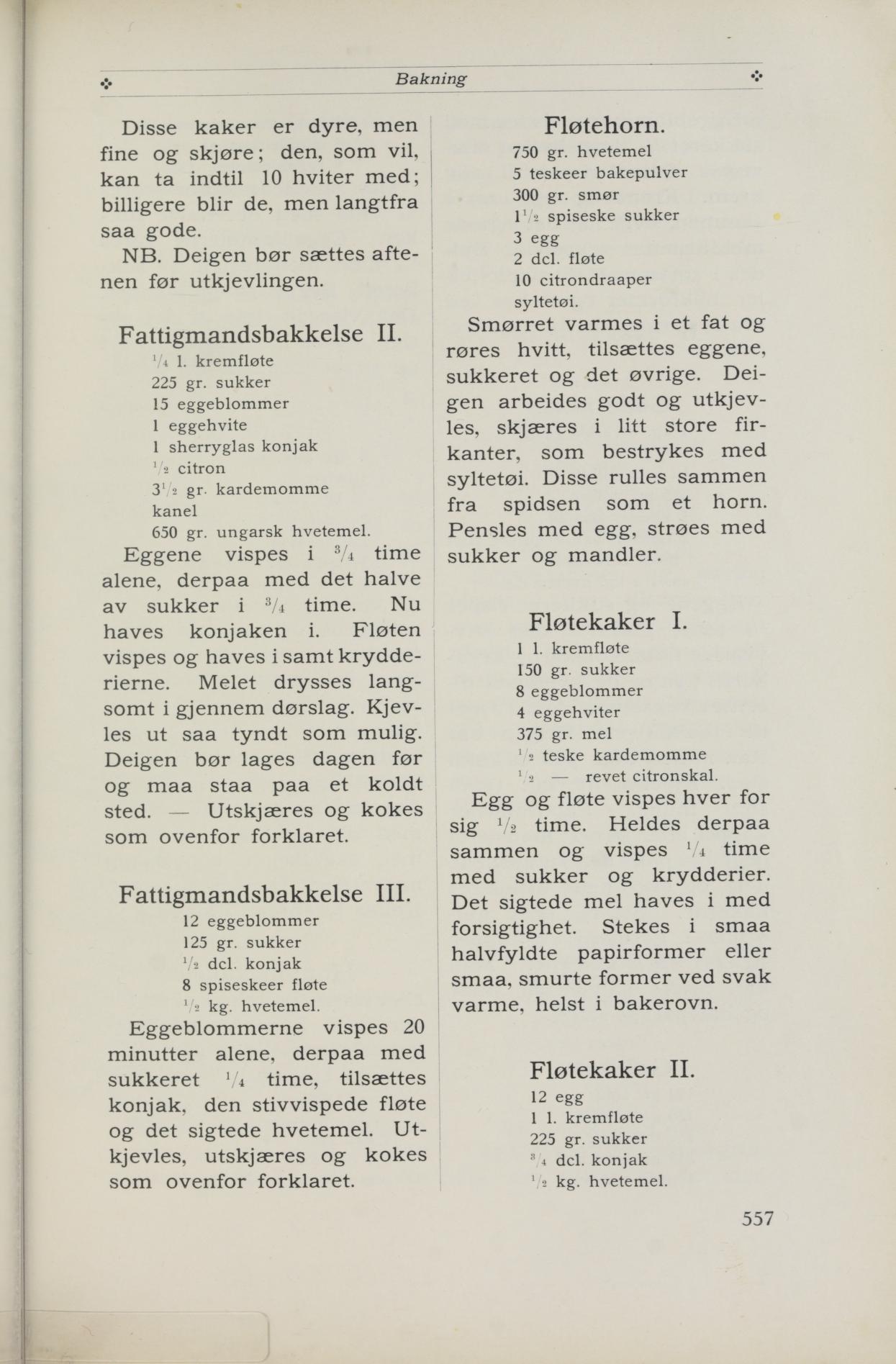
Erken's poor man's cookies no. II (fattigmannsbakkels, a traditional Norwegian deep-fried Christmas cookie) from Stor kokebok (1914): an egg-rich, long-beaten dough with cognac, cream, cardamom, and cinnamon that must rest cold overnight, is rolled very thin, and fried in fat.

Source: Henriette Schønberg Erken, Stor kokebok, 1914-utg. s. 557 (falt i det fri)

Be the first to rate

About the dish

Poor man's cookies were one of the very most important Christmas cookies in Norwegian homes, and Erken gives several variants of differing richness and cost. This variant is very egg-rich and requires long beating, in an age when everything was beaten by hand.

How to make it

  1. 1

    Beat the eggs

    Beat the egg yolks and the egg white together for 30 minutes with no other addition. Then beat further with half the sugar for 45 minutes.

  2. 2

    Add cognac and cream

    Stir in the cognac. Whip the cream and fold it in together with the rest of the sugar and the spices.

  3. 3

    Flour and rest time

    Sift the flour slowly in through a colander and mix gently into a dough. The dough should be made the day before and left cold overnight.

  4. 4

    Roll and cut out

    Roll the dough out as thin as possible. Cut out diamonds with a pastry wheel, make a slit in the middle, and pull one end through.

  5. 5

    Deep-frying

    Fry the cookies light brown in hot fat (about 175 °C (345 °F)), a few at a time. Drain on paper.

Changes from the original

Ingredient amounts are converted to modern units (grams, dl, tablespoon/teaspoon). "Sherry glass of cognac" is interpreted as about 0.5 dl. Cream is listed in the ingredient list even though the amount is missing from the printed list, since the method requires it; the amount is estimated from the other recipes. The frying temperature and the amount of fat for frying are specified. The language of the steps has been modernized.

In stores now

Clean, minimally processed groceries matched to the ingredients — approximate prices.

Product data and prices via Kassalapp. Prices are updated daily and may vary.

Tidsmaskin – hva endret seg?

Velg to utgaver og se hva Henriette Schønberg Erken la til, fjernet eller endret mellom dem.

1914 (korrekturlest, s. 557)Modernisert~89% av teksten endretfjernetlagt til
225 gr. sukker g sukker. 15 eggeblommer stk eggeplommer. 1 eggehvite stk eggehvite. 0,5 dl konjakk (originalt «1 sherryglas»). 1 sherryglas konjak 3½ gr. dl fløte (mengden mangler i originalens ingrediensliste; anslag). 3,5 g malt kardemomme og kanel kanel. 650 gr. ungarsk g hvetemel (fløte) Eggene vispes (originalt ungarsk hvetemel). 1 kg kokosfett eller smult til fritering. Visp eggeplommene og eggehviten sammen i ½ time alene, derpaa 30 minutter uten annet tilsetning. Visp deretter videre med det halve halvparten av sukkeret i ¾ time. Nu haves konjaken i. Fløten vispes 45 minutter.. Rør inn konjakken. Visp fløten til krem og haves i samt krydderierne. Melet drysses vend den inn sammen med resten av sukkeret og krydderiene.. Sikt melet langsomt i gjennem dørslag. Kjevles ut saa tyndt som mulig. inn gjennom et dørslag og bland forsiktig til en deig. Deigen bør lages dagen før og maa staa paa et koldt sted. — Utskjæres og kokes stå kaldt natten over.. Kjevle deigen ut så tynt som ovenfor forklaret. mulig. Skjær ut ruter med bakkelshjul, lag en snitt i midten og trekk den ene enden gjennom.. Kok bakkelsene lysebrune i varmt fett (ca. 175 °C), noen få om gangen. Renn av på papir.

Note til Modernisert

Ingrediensmengder er omregnet til moderne enheter (gram, dl, spiseskje/teskje). «Sherryglas konjak» er tolket som ca. 0,5 dl. Fløte er oppført i ingredienslisten selv om mengden mangler i den trykte listen, siden fremgangsmåten krever den; mengden er anslått ut fra de øvrige oppskriftene. Steketemperatur og fettmengde til fritering er presisert. Språket i trinnene er modernisert.

Community interpretations

Be the first to share your own version.

See interpretations

Frequently asked questions

Why must the dough be made the day before?
The dough should be made the day before and left cold until the next day. Then it becomes firmer and easier to roll completely thin, and that is why the recipe has a long total time (about 12 hours with rest time).
How long should the eggs be beaten?
The eggs (15 egg yolks and 1 egg white) are beaten ½ hour on their own, then ¾ hour together with half the sugar. Then cognac, whipped cream, spices, and finally the flour are added, the flour sifted in slowly through a colander.
Which spices and which flour are used?
3½ grams of cardamom and cinnamon, and 650 grams of Hungarian wheat flour. In addition 225 grams of sugar and a sherry glass of cognac.
How are the cookies fried?
The dough is rolled as thin as possible, cut out, and fried (deep-fried) as explained in the preceding poor man's cookie recipe in Stor kokebok (1914, p. 557).

Related recipes

More dishes in the same category from the archive

Read also

Kommentarer

Ingen kommentarer ennå. Bli den første til å dele!