Skip to content

Flatbread

Erken's flatbread: a dough of warm, mashed potatoes kneaded with rye/barley flour or oat flour, kneaded the evening before, rolled out very thin with a grooved rolling pin and baked on a griddle. A half-baked version becomes lefse spread with freshly churned butter and cut into triangles.

Source: Henriette Schønberg Erken, Stor kokebok, 1914-utg. s. 571 (falt i det fri)

Be the first to rate

About the dish

Erken's basic recipe for flatbread, without fixed amounts – the way the baking tradition was handed down. The baking-paddle, the spade and the griddle belonged to the traditional baking equipment, and the dough was always kneaded the evening before.

How to make it

  1. 1

    Boil the potatoes

    Boil the potatoes, peel them and mash or grind them while they are warm.

  2. 2

    Knead the dough

    Knead the flour into the warm potatoes to a smooth dough. Add a little syrup and milk if desired. This should be done the evening before rolling out.

  3. 3

    Roll the rounds

    Roll the dough out very thin with a grooved rolling pin. Sprinkle a little flour – preferably barley flour – over and under, and roll the rounds completely round.

  4. 4

    Bake

    Place the rounds, baking-side down, on a griddle, frying pan or clean-scrubbed stove plate, and lift and turn them with the paddle and a thin stick. Bake them dry and crisp.

  5. 5

    Half-baked flatbread (lefse)

    If you want half-baked flatbread, the rounds must not be turned on the griddle and must not be baked through. Place them in a clean cloth after baking.

  6. 6

    Butter and cut the lefse

    Spread half the round – the side that lay down – with good, freshly churned and lightly salted butter, fold the round together and cut it into triangles of the desired size. Wrap them in the cloth again.

Changes from the original

The original gives no amounts; here, guideline amounts for an ordinary batch have been set out. The griddle/stove plate has been supplemented with a modern frying pan or crêpe maker, and "grynmel" has been explained as barley flour/finely milled coarse flour.

In stores now

Clean, minimally processed groceries matched to the ingredients — approximate prices.

Product data and prices via Kassalapp. Prices are updated daily and may vary.

Tidsmaskin – hva endret seg?

Velg to utgaver og se hva Henriette Schønberg Erken la til, fjernet eller endret mellom dem.

1914 (korrekturlest, s. 571)1949 (korrekturlest, s. 671)~68% av teksten endretfjernetlagt til
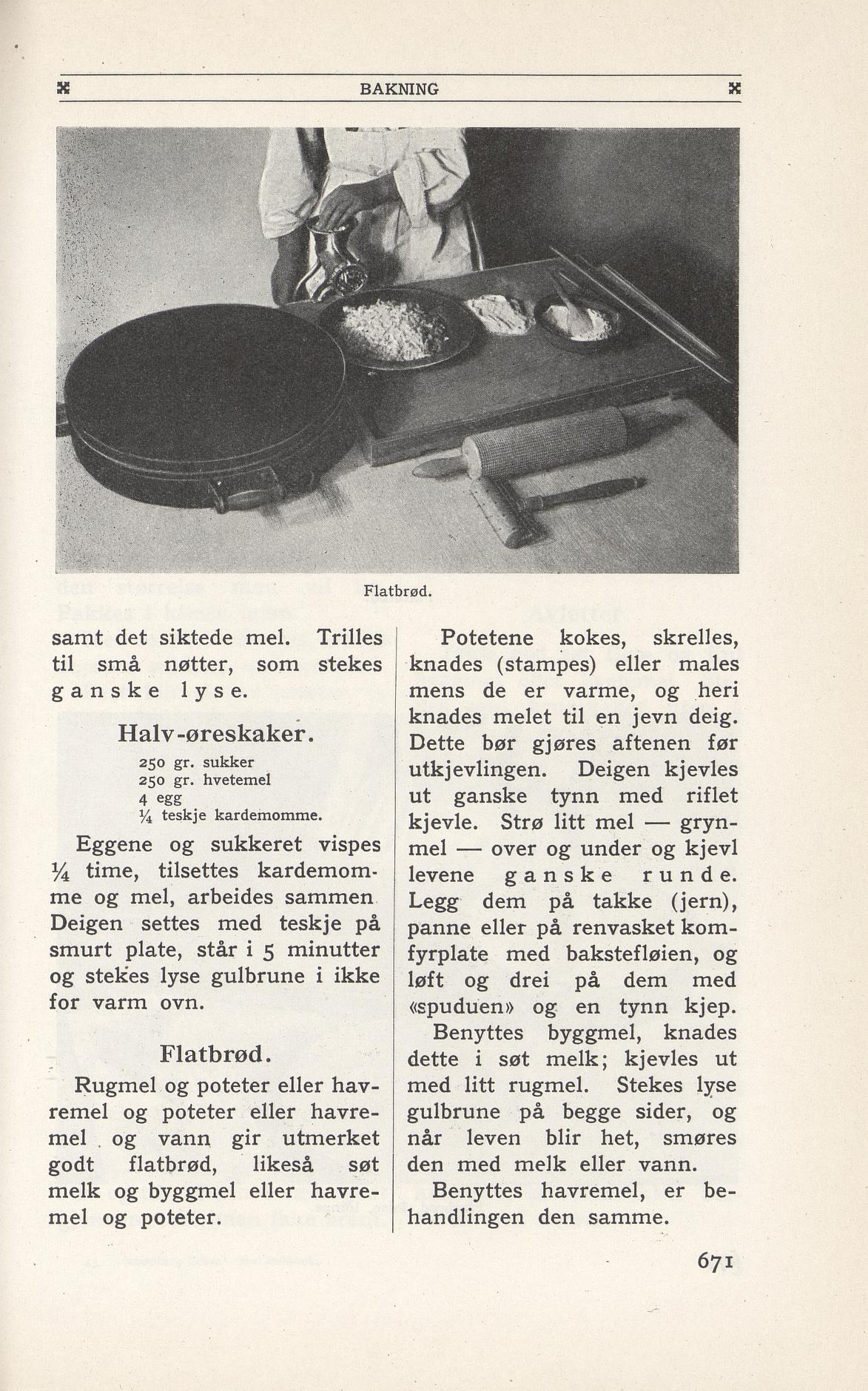
Rugmel og poteter eller havremel og poteter eller havremel og vand gir udmerket godt flatbrød. Poteterne Potetene kokes, skrælles, skrelles, knades (stampes) eller males, males mens de er varme, og heri knades melet til en jevn deig. Dette bør gjøres aftenen før utkjevlingen. Deigen kjevles ut ganske tyndt tynn med riflet kjevle. Strø litt mel — grynmel — over og under og kjevl leverne levene ganske runde. Læg Legg dem paa takke (jern), pande panne eller paa renvasket komfyrplate kom fyrplate med bakstefløien bakstefløien, og løft og drei paa dem med «spaduen» «spuduen» og en tynd tynn kjep. Vil man ha halvstekt flatbrød (lefse), lægges leverne ind i et rent klæde efter at være stekt — de maa ikke vendes paa bakstehellen og ikke gjennemstekes. Naar stekningen er færdig, smøres det halve av leven, den side som har ligget ned, med godt, nykjernet smør (ubetydelig saltet), lægges sammen, og leven skjæres i trekanter i den størrelse, man vil ha. Pakkes i klæde igjen. Bedst blir de av poteter, ½ grynmel, ½ rugmel, litt sirup og melk.
Community interpretations

Be the first to share your own version.

See interpretations

Frequently asked questions

Which flour mixtures can be used?
According to the recipe, rye flour and potatoes, oat flour and potatoes, or oat flour and water all make excellent flatbread.
Why should the dough be made the evening before?
The potatoes are mashed or ground warm and the flour is kneaded in to a smooth dough. Erken recommends doing this the evening before rolling out, so the dough gets to rest — hence the long total time of around 12 hours.
What is the difference between flatbread and lefse here?
Half-baked flatbread (lefse) is not turned on the griddle and is not baked through; the rounds are placed in a clean cloth after baking. Ordinary flatbread is baked through and turned with a paddle and a thin stick.
What equipment is needed?
A grooved rolling pin to roll the rounds very thin and round, a little barley flour to sprinkle over and under, and an iron griddle, pan or clean-scrubbed stove plate with a baking-paddle, spade and a thin stick to lift and turn the rounds.

Related recipes

More dishes in the same category from the archive

Read also

Kommentarer

Ingen kommentarer ennå. Bli den første til å dele!