Skip to content

Brown Stock Soup

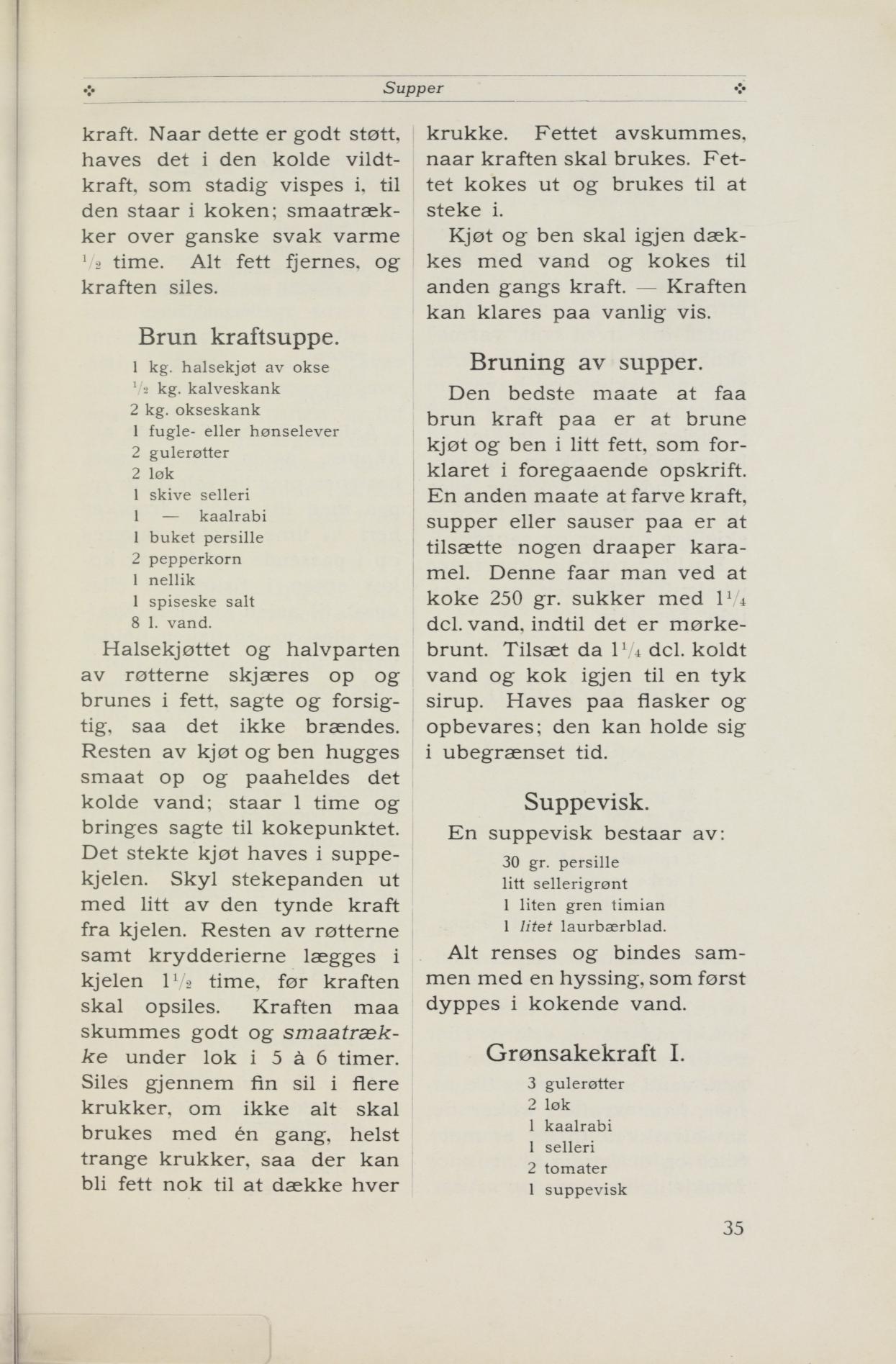
Erken's basic recipe for brown stock soup: beef neck and half the root vegetables are browned, the rest of the meat and bones are drawn in 8 l cold water, and it all simmers 5-6 hours with spices and root vegetables added in the last 1.5 hours. Strained into jars and kept under a layer of fat.

Source: Henriette Schønberg Erken, Stor kokebok, 1914-utg. s. 35 (falt i det fri)

Be the first to rate

About the dish

The base stock in Erken's soup chapter. Brown stock soup was the basis for most of the finer soups and sauces in the household, cooked in large quantities and stored in jars under a layer of fat - the preservation of the day, before the refrigerator.

How to make it

  1. 1

    Brown the meat and root vegetables

    Cut up the neck meat and half the root vegetables. Brown them gently in a little fat in a pan over medium heat, so that nothing scorches.

  2. 2

    Set over cold water

    Chop the rest of the meat and bones into smaller pieces, place them in a large pot and pour over 8 liters of cold water. Let it stand 1 hour, then slowly bring it to the boiling point.

  3. 3

    Gather everything in the pot

    Add the browned meat to the soup pot. Rinse the frying pan with a little thin stock from the pot and pour it all back, so that the pan drippings come along.

  4. 4

    Skim and simmer

    Skim the stock well. Let it simmer gently covered for 5-6 hours without boiling hard.

  5. 5

    Spices and root vegetables at the end

    Add the rest of the root vegetables, the parsley, peppercorns, clove, liver and salt to the pot one and a half hours before the stock is to be strained.

  6. 6

    Strain and store

    Strain the stock through a fine strainer into several narrow jars or glasses, so that the fat settles as a covering layer on each. Skim off the fat only when the stock is to be used; the fat can be cooked down and used for frying.

  7. 7

    Second stock

    Cover the meat and bones with fresh water and cook a second stock. The stock can be clarified in the usual way.

Changes from the original

Measurements are modernized (tablespoon, liter), "roots" written as carrots/root vegetables. The browning fat is given as butter or neutral fat instead of lard/boiled-down stock fat. The steps are broken up and written in modern Norwegian.

In stores now

Clean, minimally processed groceries matched to the ingredients — approximate prices.

Product data and prices via Kassalapp. Prices are updated daily and may vary.

Time machine – what changed?

Pick two editions and see what Henriette Schønberg Erken added, removed or changed between them.

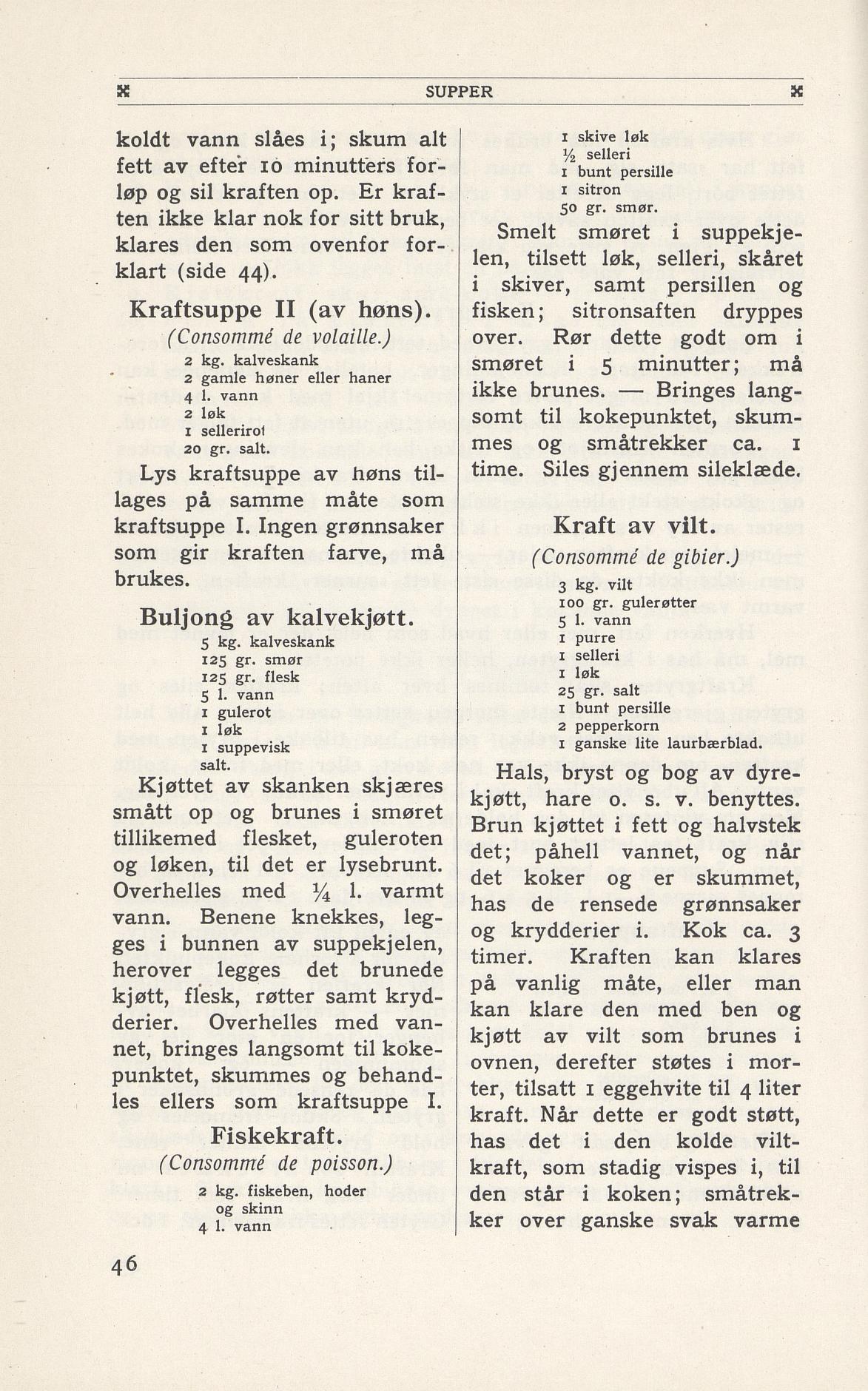
Modernised → 1949 (proofread, p. 46)~84% of the text changedremovedadded
1 kg halskjøtt kg. halsekjøtt av okse. 1,5 kg kalveskank. okse 1/2 kg. kalveskank 2 kg kg. okseskank (med bein). 1 stk fugle- eller hønselever. hønselever 2 stk gulrøtter. gulerøtter 2 stk løk. løk 1 skive sellerirot. selleri 1 skive kålrabi. — kålrabi 1 bukett persille. bunt persille 2 stk pepperkorn. pepperkorn 1 stk nellik (hel). 1 ss salt. 8 l vann (kaldt). 2 ss smør eller nøytralt fett (til bruning). Skjær opp halskjøttet spiseskje salt 6 l. vann. Halsekjøttet og halvparten av rotsakene. Brun dem forsiktig i litt fett røttene skjæres op og brunes i en panne over middels varme, slik at ingenting svir seg.. Hakk resten fett, sakte og forsik­tig, så det ikke brennes. Resten av kjøttet kjøtt og beina i mindre stykker, legg dem i en stor kjele ben hug­ges smått op og hell over 8 liter kaldt vann. La påhelles det stå kolde vann; står 1 time, time og bring det så langsomt bringes sakte til kokepunktet.. Legg det brunede kjøttet kokepunktet. Det stekte kjøtt has i suppekjelen. suppe­kjelen. Skyll stekepannen ut med litt tynn av den tynne kraft fra kjelen og hell alt tilbake, slik at stekeskyen kommer med.. Skum kraften godt. La den småtrekke under lokk i 5–6 timer uten å fosskoke.. Legg resten kjelen. Resten av rotsakene, persillen, pepperkorn, nellik, leveren og saltet røttene samt krydderiene legges i kjelen halvannen 1 1/4 time før kraften skal siles.. Sil kraften gjennom opsiles. Kraften må skummes godt og småtrekke under lokk i 5 å 6 timer. Siles gjennem en fin sil over på i flere smale krukker eller glass, slik at fettet legger seg som et dekkende lag på hver. Skum av fettet først krukker, om ikke alt skal brukes med én gang, helst trange krukker, så der kan bli fett nok til å dekke hver krukke. Fettet avskummes når kraften skal brukes; fettet kan brukes. Fet­tet kokes ut og brukes til steking.. Dekk kjøtt og bein med nytt vann og kok en andre gangs kraft. Kraften kan klares på vanlig måte. å steke i.

Note on Modernised

Mål er modernisert (spiseskje, liter), «rotter» skrevet som gulrøtter/rotsaker. Brunfettet er angitt som smør eller nøytralt fett i stedet for smult/oppkokt kraftfett. Trinnene er delt opp og skrevet i moderne norsk.

Community interpretations

Be the first to share your own version.

See interpretations →

Frequently asked questions

How long must the stock cook?
The stock should simmer gently covered for 5-6 hours after it has been well skimmed. Counting 1 hour soaking in cold water and browning, you reach around 8 hours in total.
Why should the meat and roots be browned first?
The browning gives the soup its brown color and its strong flavor. Only 1 kg of beef neck and half the roots are browned in fat - slowly and gently, so it does not scorch. The frying pan is rinsed out with a little thin stock from the pot, so that all the pan juices come along.
When should the spices and the rest of the roots go in?
The rest of the roots (carrot, onion, celery, rutabaga, parsley) and the spices - 2 peppercorns, 1 clove and salt - are added to the pot 1.5 hours before the stock is to be strained off. That keeps the flavor fresh and not cooked out.
Which cuts of meat are used for this stock?
1 kg beef neck, 1.5 kg veal shank, 2 kg beef shank and one fowl or chicken liver. The shanks with bone give the stock its gelatin and body, and are chopped small before being placed in 8 liters of cold water.

Equipment for this dish

Advertisement

We may earn a commission if you buy through these links. It does not affect the price.

Related recipes

More dishes in the same category from the archive

Read also

Kommentarer

Ingen kommentarer ennå. Bli den første til å dele!