Skip to content

Sweetbread Soup (potage aux ris de veau)

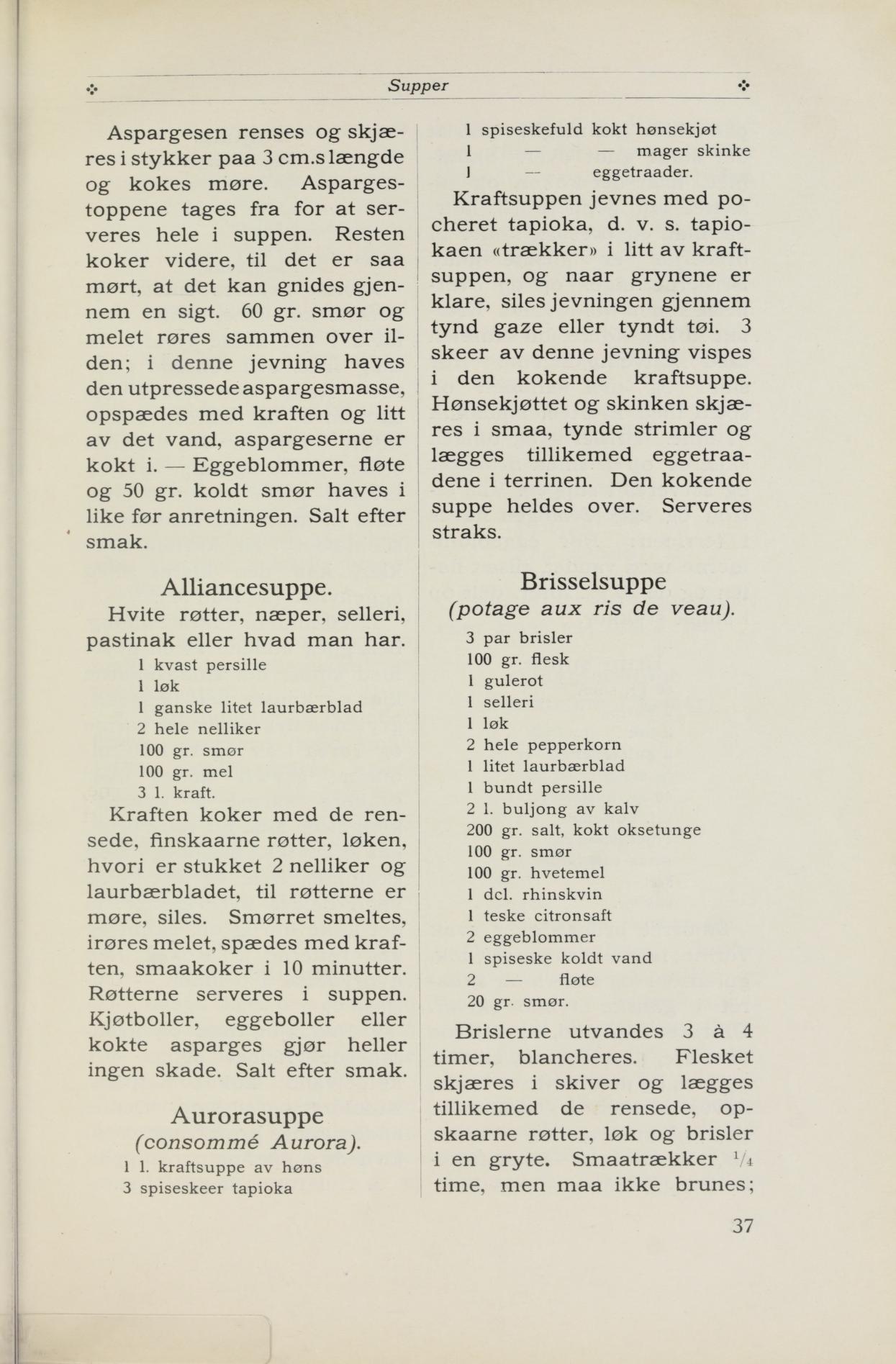
Sweetbread soup (potage aux ris de veau) from Erken 1914: veal sweetbreads are soaked and simmered with pork, root vegetables, and spices, the stock reduced with veal broth and thickened with butter and flour; served with cubes of sweetbread and salted beef tongue, finished in the tureen with egg yolks, cream, butter, white wine, and lemon juice.

Source: Henriette Schønberg Erken, Stor kokebok, 1914-utg. s. 37 (falt i det fri)

Be the first to rate

About the dish

A distinguished party soup from the soup chapter of «Stor kokebok» (1914). Sweetbreads (veal sweetbreads) were a highly valued ingredient in the bourgeois kitchen, and the soup is finished at the end with egg yolks, cream, wine, and lemon right in the tureen.

How to make it

  1. 1

    Prepare the sweetbreads

    Put the sweetbreads in cold water for 3–4 hours, changing the water a few times. Then blanch them.

  2. 2

    Simmer with pork and roots

    Cut the pork into slices and put them in a pot together with the cleaned, sliced roots, the onion, and the sweetbreads. Let it simmer gently for ½ hour, but it must not brown.

  3. 3

    Cook the stock

    Add enough water to cover well. Skim when it comes to a boil, and add salt, peppercorns, bay leaf, and parsley. Simmer until the sweetbreads are cooked through.

  4. 4

    Lift out the sweetbreads

    Lift out the sweetbreads and pour cold water over them. Let the stock continue to reduce together with the veal broth.

  5. 5

    Thicken the soup

    Stir together 100 g butter and the flour, thin with the hot stock, and let the soup simmer for ¼ hour.

  6. 6

    Cut up the meat

    Cut the sweetbreads and the beef tongue into small squares.

  7. 7

    Thickening and plating

    Stir the egg yolks with the cold water, add the cream and the 20 g butter cut into small pieces. Place this in the tureen together with the wine and lemon juice, along with the sweetbread and tongue pieces. Pour the hot soup over while stirring and serve at once.

Changes from the original

Quantities are given in modern measures (dl, g, tablespoons). «Rhine wine» is specified as a dry white wine of the Rhine-wine type. «Flesk» is interpreted as fresh, fatty pork belly. The method is divided into numbered steps.

In stores now

Clean, minimally processed groceries matched to the ingredients — approximate prices.

Product data and prices via Kassalapp. Prices are updated daily and may vary.

Tidsmaskin – hva endret seg?

Velg to utgaver og se hva Henriette Schønberg Erken la til, fjernet eller endret mellom dem.

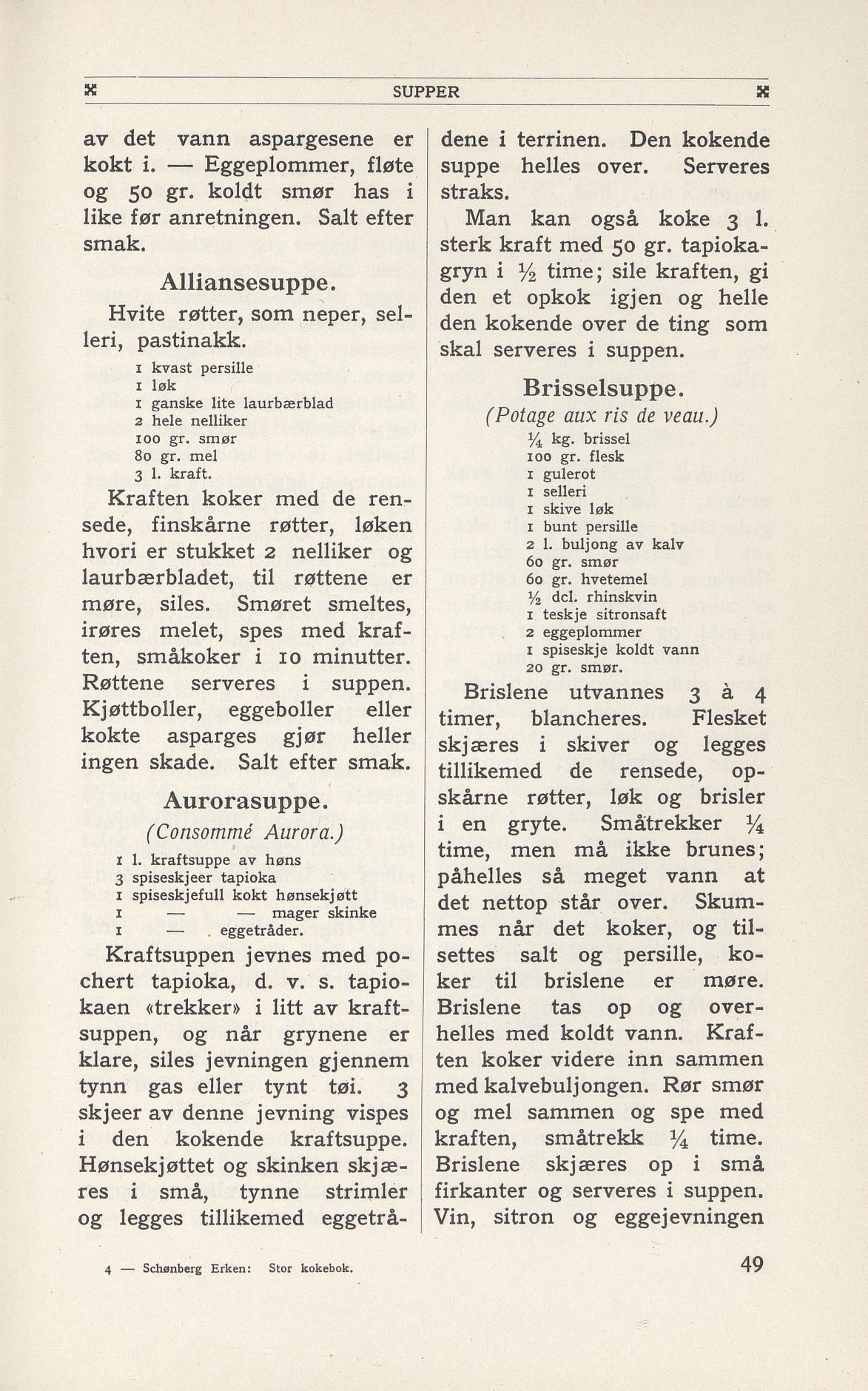
1914 (korrekturlest, s. 37)1949 (korrekturlest, s. 49)~54% av teksten endretfjernetlagt til
3 par brisler (Potage aux ris de veau.) ¾ kg. brissel 100 gr. flesk 1 gulerot 1 selleri 1 skive løk 2 hele pepperkorn 1 litet laurbærblad 1 bundt bunt persille 2 l. 1. buljong av kalv 200 gr. salt, kokt oksetunge 100 60 gr. smør 100 60 gr. hvetemel 1 ½ del. rhinskvin 1 teske citronsaft teskje sitronsaft 2 eggeblommer eggeplommer 1 spiseske spiseskje koldt vand 2 — fløte vann 20 gr. smør. Brislerne utvandes Brislene utvannes 3 à å 4 timer, blancheres. Flesket skjæres i skiver og lægges legges tillikemed de rensede, opskaarne opskårne røtter, løk og brisler i en gryte. Smaatrækker ½ Småtrekker ¾ time, men maa ikke brunes; paaheldes saa påhelles så meget vand, vann at det staar godt nettop står over. Skummes, naar Skummes når det koker, og tilsættes salt, pepperkorn, laurbærblad tilsettes salt og persille, koker til brislerne brislene er gjennemkokt. Brislerne tages møre. Brislene tas op og overheldes overhelles med koldt vand. vann. Kraften koker videre ind inn sammen med kalvebuljongen. Rør smør og mel sammen og spæd spe med kraften, smaakok ¼ småtrekk ¾ time. Brislerne og tungen Brislene skjæres op i smaa små firkanter og serveres i suppen. Vin, citron sitron og eggejevningen haves egge jevningen has i terrinen: Rør eggeblommerne eggeplommene med vandet, tilsæt fløten vannet og de 20 gr. smør, delt op i smaa små stykker.

Community interpretations

Be the first to share your own version.

See interpretations

Frequently asked questions

Why must the sweetbreads be soaked and blanched?
The sweetbreads are put in cold water for 3–4 hours to draw out blood, and then blanched. This gives a pale color and clean flavor, and makes membranes easier to remove. After simmering, cold water is poured over them so they stay firm and white.
How long does the soup take?
Allow about 5.5 hours in all for 8 servings. Most of it is soaking the sweetbreads (3–4 hours). The preparation itself consists of ½ hour of slow simmering with pork, root vegetables, and onion (without browning), then simmering until the sweetbreads are cooked through, and finally reducing the stock.
What are the soup thickened and finished with?
The soup is thickened with a roux of 100 g butter and 100 g wheat flour in 2 liters of veal broth, and seasoned with 1 deciliter of Rhine wine and 1 teaspoon of lemon juice. Finally it is finished with 2 egg yolks, 1 tablespoon of cold water, 2 tablespoons of cream, and 20 g butter – added without letting the soup boil afterward.
What is put in the soup at serving?
The finished, cut-up sweetbreads, together with 200 g salted, cooked beef tongue. The recipe is from Henriette Schønberg Erken's «Stor kokebok» (1914), p. 37.

Related recipes

More dishes in the same category from the archive

Read also

Kommentarer

Ingen kommentarer ennå. Bli den første til å dele!