Skip to content

Ansjos (Norwegian Spiced Sprats)

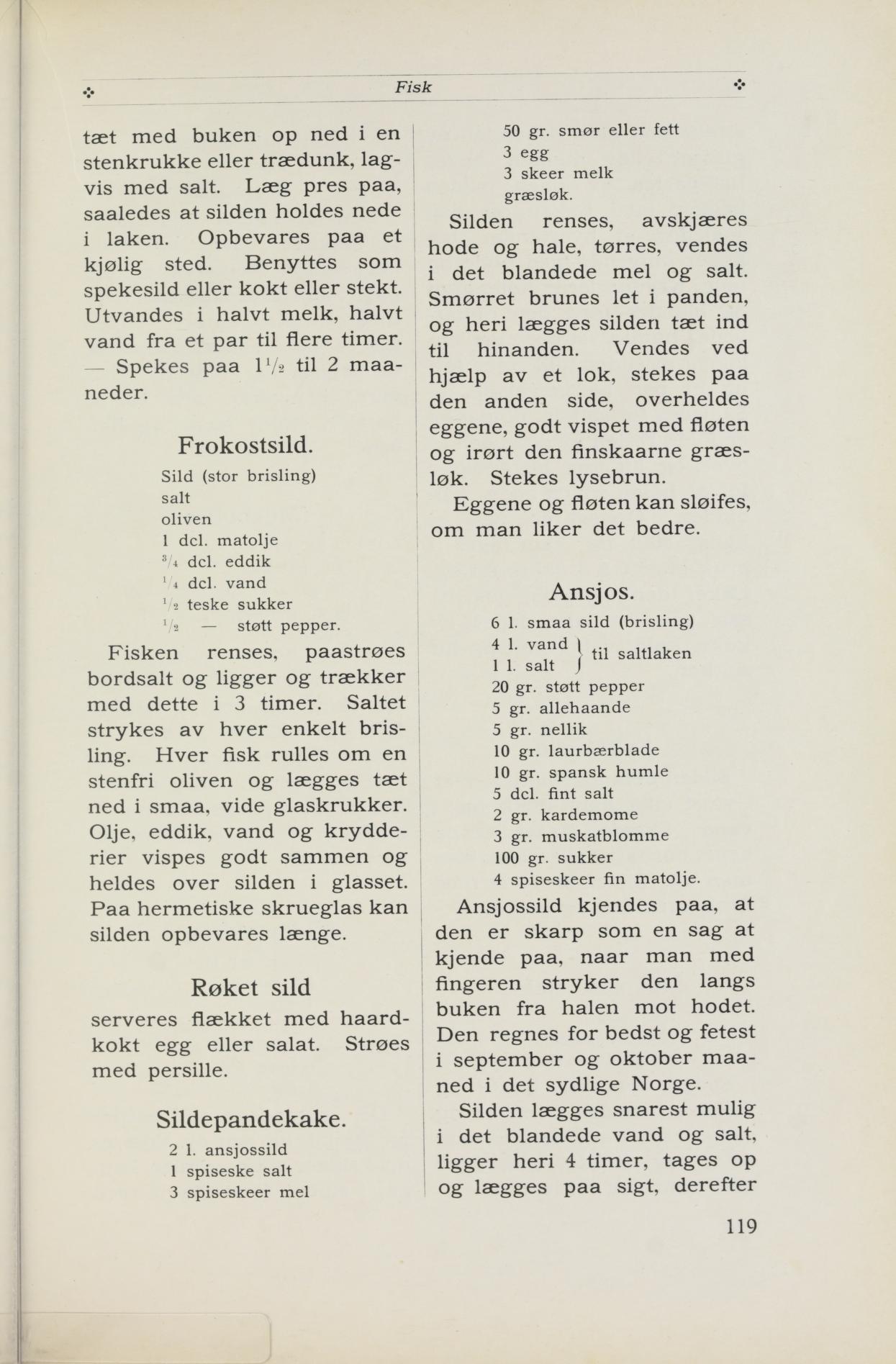
Erken's homemade ansjos (1914), Norway's spiced sprats: 6 l of small herring/sprats sit for 4 hours in a brine of 3 l water and 1 l salt, are drained, and layered at once in a jar with oil in the bottom, belly up and every other layer reversed. Between the layers are strewn ground spices (pepper, allspice, clove, cardamom, mace, sugar) mixed with chopped hops, plus fine salt and bay leaf. The rest of the oil is poured over, weighted down, tied off, and matured cool for 6–8 weeks.

Source: Henriette Schønberg Erken, Stor kokebok, 1914-utg. s. 119 (falt i det fri)

Be the first to rate

About the dish

Erken's instructions for putting up ansjos (Norwegian spiced sprats) from small herring at home. Anchovy herring was an autumn product; the book also explains how to tell the right quality – the fish should feel "sharp as a saw" along the belly.

How to make it

  1. 1

    Choosing the herring

    Use anchovy herring: it feels sharp as a saw when you run a finger along the belly from tail toward head. Best and fattest in September and October.

  2. 2

    Salt in brine

    Put the herring into the mixed water and salt as soon as possible. Let it sit in the brine for 4 hours, lift it out, and set it in a strainer.

  3. 3

    Layer into the jar

    Layer the herring at once into a jar or crock. Put half of the oil in the bottom. Lay the herring belly up, but so that every other layer is reversed head to tail.

  4. 4

    Spices between the layers

    Grind the spices well and mix them with the chopped hops. Strew the mixture between the herring layers along with salt and a couple of bay leaves.

  5. 5

    Fill and weight

    Continue this way until the jar is full. Pour the rest of the oil over and set a light weight on top to keep the herring down. Tie it off.

  6. 6

    Maturing

    Store cool. The herring can be used after 6–8 weeks. If it does not release enough brine, pour on a little brine of boiled, cooled water, salt, and a little sugar.

Changes from the original

Volume measures converted to liters/deciliters ("del." = dl). "Spanish hops" kept as in the original (dried hops for the spice mixture). Modern spelling in the steps; the quantities are otherwise unchanged.

Time machine – what changed?

Pick two editions and see what Henriette Schønberg Erken added, removed or changed between them.

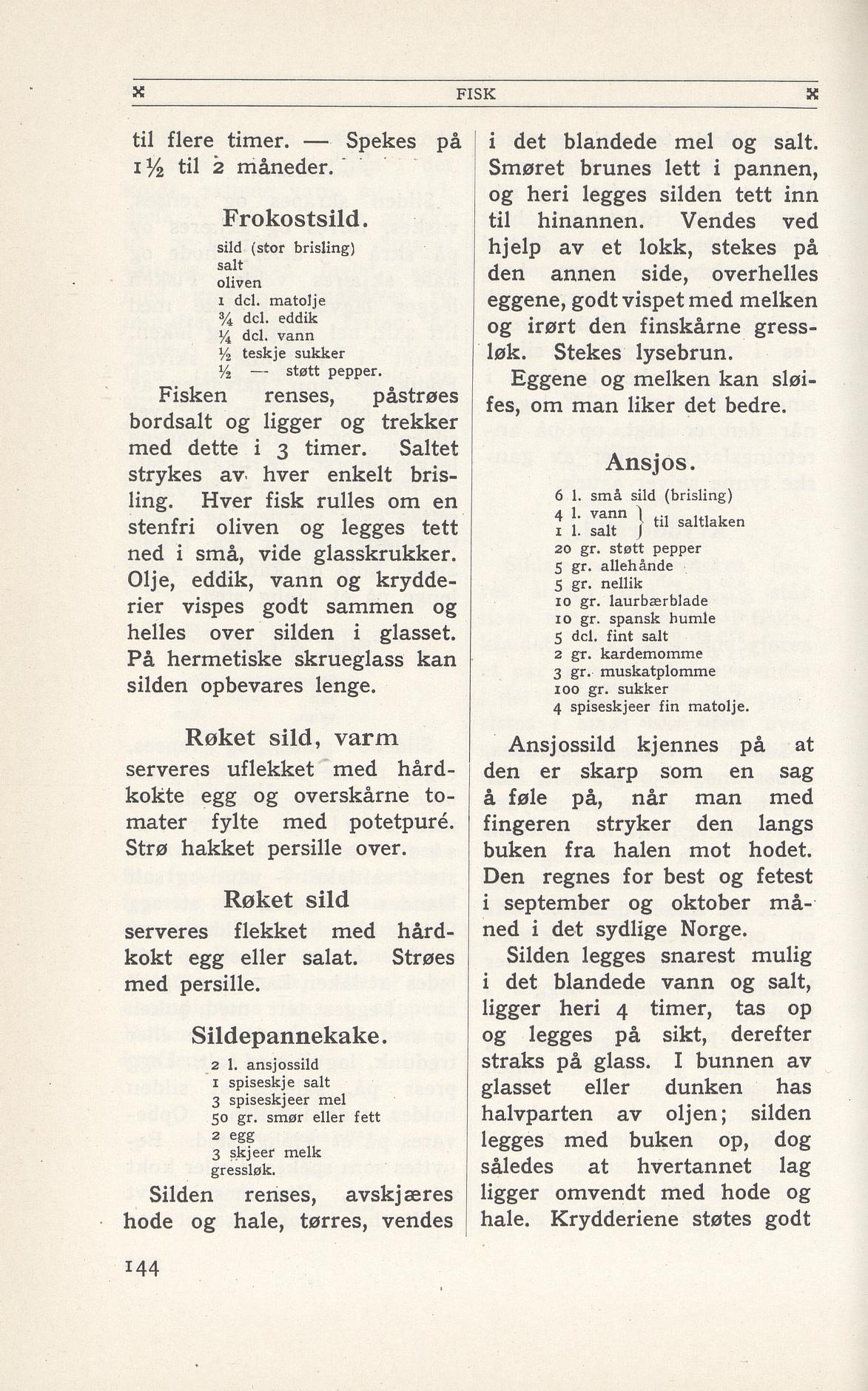
Modernised → 1949 (proofread, p. 144)~69% of the text changedremovedadded
Ingredienser: 6 l småsild l. små sild (brisling) (helst fra september–oktober). 3 l 4 l. vann (til saltlaken). 1 l salt (til saltlaken). 5 dl fint l. salt (til lagene). 20 g gr. støtt pepper. pepper 5 g allehånde. gr. allehånde 5 g nellik. gr. nellik 10 g laurbærblad. gr. laurbærblade 10 g tørket gr. spansk humle («spansk humle», oppkarvet). 5 del. fint salt 2 g kardemomme. gr. kardemomme 3 g muskatblomme. gr. muskatplomme 100 g sukker. gr. sukker 4 spiseskjeer fin matolje. Bruk ansjossild: den Ansjossild kjennes på at den er skarp som en sag å føle på, når du stryker man med fingeren stryker den langs buken fra halen mot hodet. Best Den regnes for best og fetest i september og oktober.. Legg silden oktober må ned i det sydlige Norge. Silden legges snarest mulig i det blandede vannet vann og saltet. La den ligge i laken i salt, ligger heri 4 timer, ta den opp tas op og legg den legges på sil.. Legg silden sikt, derefter straks i glass på glass. I bunnen av glasset eller dunk. Ha dunken has halvparten av oljen i bunnen. Legg oljen; silden legges med buken opp, men slik op, dog således at hvert annet hvertannet lag ligger omvendt med hode og hale.. Støt krydderiene hale. Krydderiene støtes godt og bland dem blandes med den oppkarvede humlen. Strø blandingen mellom sildelagene sammen med opkarvede humle, strøes mellem lagene av silden tillikemed salt og et par laurbærblad.. Fortsett slik laurbærblade. Således fortsettes til glasset er fullt. Hell fullt, resten av oljen over helles over, og legg litt press legges på for å holde silden nede. Bind til.. Oppbevar kjølig. Silden Tilbindes. Opbevares på et kjølig sted og kan tas i bruk etter 6–8 uker. efter 6 å 8 ukers forløp. Laker den seg sig ikke nok, hell ha så på litt lake lake, laget av kokt, avkjølt koldt vann, salt og litt sukker.

Note on Modernised

Volummål er omregnet til liter/desiliter («del.» = dl). «Spansk humle» beholdt som i originalen (tørket humle til krydderblandingen). Moderne rettskriving i trinnene; mengdene er ellers uendret.

Community interpretations

Be the first to share your own version.

See interpretations →

Frequently asked questions

How do you recognize true anchovy herring?
Anchovy herring can be told by the fact that it feels sharp as a saw when you run a finger along the belly from tail toward head. It is considered best and fattest in September and October in southern Norway.
How long should the herring sit in the brine?
The herring is placed as soon as possible into the mixed water and salt (3 liters water to 1 liter salt) and sits there for 4 hours. It is then lifted out into a strainer and layered into the jar at once.
How long does the whole process take?
The work itself is quickly done, but the maturing takes a long time – the stated total time is roughly 42 days (60,480 minutes) from the recipe in Stor kokebok 1914, p. 119.
Which spices are used in the ansjos?
Ground pepper (20 g), allspice (5 g), cloves (5 g), bay leaf (10 g), Spanish hops (10 g), cardamom (2 g), mace (3 g), 100 g sugar, 5 dl fine salt, and 4 tablespoons of fine cooking oil – half the oil goes in the bottom of the jar or crock.

Related recipes

More dishes in the same category from the archive

Read also

Kommentarer

Ingen kommentarer ennå. Bli den første til å dele!