Skip to content

Tongue omelet

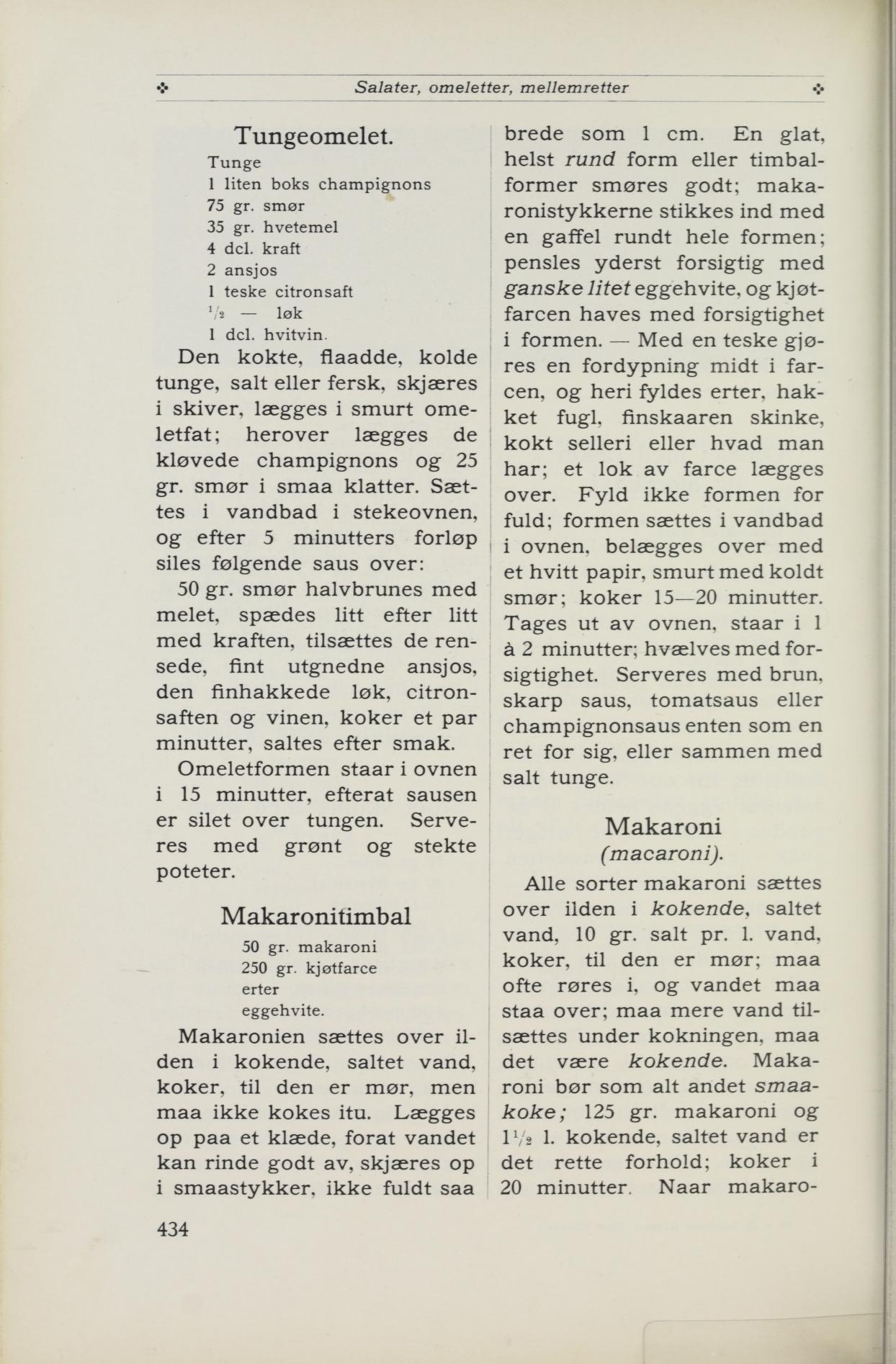
Erken's tongue omelet from 1914: slices of cooked tongue baked in a water bath in a buttered ovenproof dish with button mushroom and butter, and a browned flour sauce with stock, anchovy, onion, lemon juice and white wine strained over before 15 minutes' baking. Served with vegetables and fried potatoes.

Source: Henriette Schønberg Erken, Stor kokebok, 1914-utg. s. 434 (falt i det fri)

Be the first to rate

About the dish

The recipe belongs to the chapter on salads, omelets and entremets, and is a typical 'omelet' in Erken's sense: a buttered ovenproof dish where cooked meat is baked in a water bath with sauce. Cooked, salted tongue was a common festive and leftover food in Norwegian bourgeois homes around 1914.

How to make it

  1. 1

    Arrange the tongue

    Cut the cooked, skinned and cold tongue into slices and place them in a well-buttered, ovenproof omelet dish.

  2. 2

    Mushroom and butter

    Place the halved button mushrooms over the tongue and dot 25 g butter in small pats on top.

  3. 3

    Preheat in a water bath

    Set the dish in a water bath in the oven and leave it for 5 minutes.

  4. 4

    Make the sauce

    Lightly brown 50 g butter together with the flour, then thin little by little with the stock. Add the cleaned, finely mashed anchovies, the finely chopped onion, the lemon juice and the wine. Let the sauce boil a couple of minutes and season with salt.

  5. 5

    Finish baking

    Strain the sauce over the tongue and leave the dish in the oven in the water bath for 15 minutes.

  6. 6

    Serving

    Serve with vegetables and fried potatoes.

Changes from the original

Measurements are converted to modern units (deciliters, grams, teaspoon), and 'hvetemel' is given as wheat flour in tablespoons/grams. The quantity of tongue is estimated at about 500 g since the original only writes 'Tongue.' 'Ansjos' today corresponds to anchovy fillets (spice-cured). The method is divided into steps, otherwise unchanged.

In stores now

Clean, minimally processed groceries matched to the ingredients — approximate prices.

Product data and prices via Kassalapp. Prices are updated daily and may vary.

Tidsmaskin – hva endret seg?

Velg to utgaver og se hva Henriette Schønberg Erken la til, fjernet eller endret mellom dem.

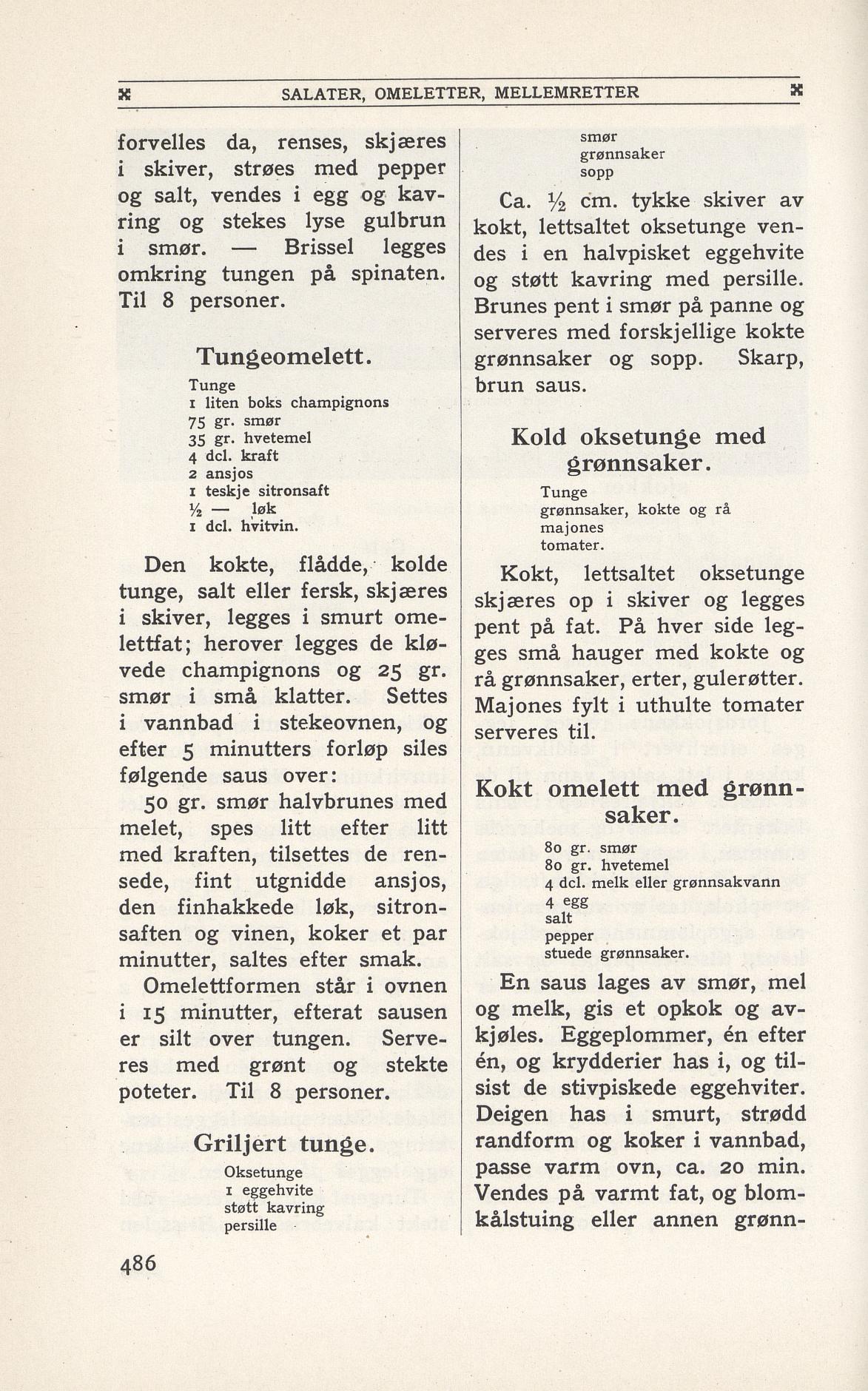
1914 (korrekturlest, s. 434)1949 (korrekturlest, s. 486)~51% av teksten endretfjernetlagt til
Tunge 1 liten boks champignons 75 gr. smør 35 gr. hvetemel 4 del. kraft 2 ansjos 1 teske citronsaft ¼ løk 1 del. hvitvin. Den kokte, flaadde, flådde, kolde tunge, salt eller fersk, skjæres i skiver, lægges legges i smurt omeletfat; omelettfat; herover lægges legges de kløvede champignons og 25 gr. smør i smaa små klatter. Sættes Settes i vandbad vannbad i stekeovnen, og efter 5 minutters forløp siles følgende saus over: 50 gr. smør halvbrunes med melet, spædes spes litt efter litt med kraften, tilsættes tilsettes de rensede, fint utgnedne utgnidde ansjos, den finhakkede løk, citronsaften sitronsaften og vinen, koker et par minutter, saltes efter smak. Omeletformen staar Omelettformen står i ovnen i 15 minutter, efterat sausen er silet silt over tungen. Serveres med grønt og stekte poteter. Til 8 personer. Ingredienser: Tunge i liten boks champignons, 75 gr. smør, 35 gr. hvetemel, 4 del. kraft, 2 ansjos, 1 teskje sitronsaft, 1/2 løk, 1 del. hvitvin.
Community interpretations

Be the first to share your own version.

See interpretations

Frequently asked questions

Which tongue is used?
Fully cooked and skinned, cold tongue – salted or fresh. It is cut into slices and placed in a buttered omelet dish.
How is the sauce made?
50 g butter is half-browned with 35 g wheat flour, thinned gradually with 4 dl stock, and mixed with mashed anchovy, finely chopped onion, 1 tsp lemon juice and 1 dl white wine. Boiled a couple of minutes and salted to taste, then strained over the tongue.
How long should the dish stay in the oven?
The dish is set in a water bath in the oven; after 5 minutes the sauce is strained over, and the dish stays a further 15 minutes.
What is it served with?
Greens and fried potatoes. The recipe is from Henriette Schønberg Erken's 'Stor kokebok' (1914), p. 434, and serves 4.

Related recipes

More dishes in the same category from the archive

Read also

Kommentarer

Ingen kommentarer ennå. Bli den første til å dele!