Erken's gooseberry wine from 1914: 20 kg green gooseberries, 15 kg sugar, 100 g tartaric acid, raisins as yeast, made up to 50 liters of liquid, fermented in a 45-liter cask, clarified with gelatin in January and bottled in spring.
Source: Henriette Schønberg Erken, Stor kokebok, 1914-utg. s. 622 (falt i det fri)
Be the first to rate
About the dish
From the chapter on winemaking and liqueurs in "Stor kokebok" (1914). Homemade fruit wine in a 45-liter cask was common in well-off Norwegian households, and Erken gives precise instructions for fermentation, racking, and clarifying with gelatin.
How to make it
1
Crush the berries
Clean the berries and put them together with the raisins in a large vat. Crush them and pour over 18 liters of boiled, lukewarm water. Stir often and vigorously until the water is cold.
2
Press the juice
Press the crushed berries through a coarse sieve, adding 4—5 liters of boiled, cold water along the way.
3
Mix in sugar and acid
Dissolve the sugar and tartaric acid in the juice and water, and top up with enough water to have 50 liters of liquid in all.
4
Initial fermentation
Cover the vat with a cloth and let it stand quietly a couple of days in a room at 15—16 °C (60 °F).
5
Fill the cask
Pour into a 45-liter cask. The 4—5 liters left over are used for topping up during fermentation.
6
Seal the cask
As soon as the hissing from the fermenting wine stops, close the cask with a tight bung. A small hole bored close to the bung hole is closed with a cork that is removed for a moment every second or third day to let out air. After 10—12 days the cork is set fast.
7
Aging
Lay the cask in a cold cellar and let the wine rest until the first half of January.
8
Racking and clarifying
Rack the wine, rinse the cask well in boiled, cold water, and return the wine as soon as possible. Dissolve the gelatin in 1 liter of the wine, pour it into the cask, and top up well.
9
Bottling
Bottle the wine over the course of spring, when the gooseberry bushes are in bloom again.
Changes from the original
Réaumur degrees are converted to Celsius (12—13 °R ≈ 15—16 °C (60 °F)). Measures are kept in kilos and liters, "loaf sugar" is given as sugar (refined), and the steps are rewritten in modern Norwegian. Fermentation can today be done with wine yeast instead of raisins.
📖1914
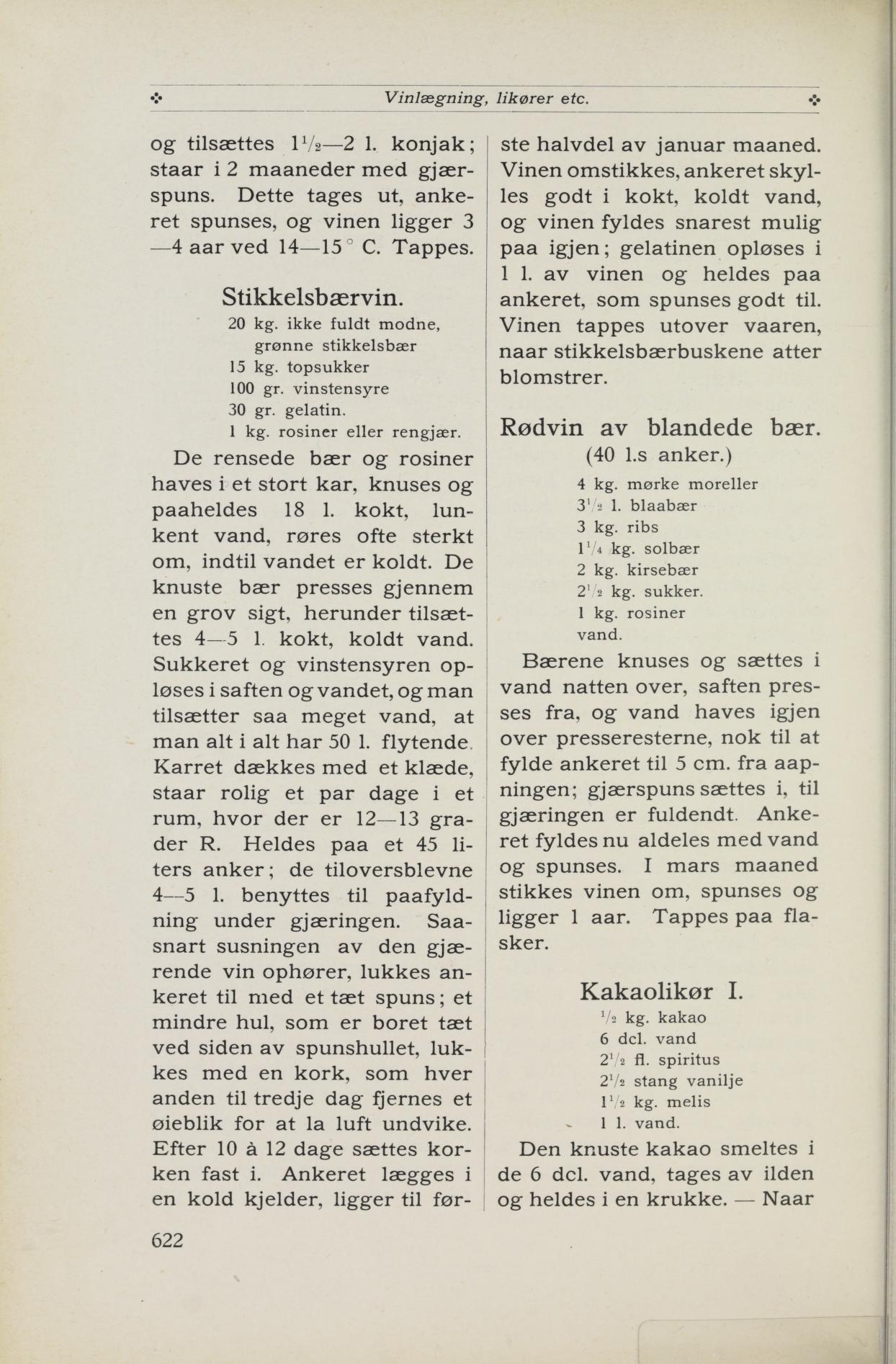
Original 1914 recipe
Verbatim from the first edition of the Big Cookbook.
Foto: Faksimile: Nasjonalbiblioteket
ProofreadPage 622
20 kg. ikke fuldt modne, grønne stikkelsbær
15 kg. topsukker
100 gr. vinstensyre
30 gr. gelatin
1 kg. rosiner eller rengjær.
De rensede bær og rosiner haves i et stort kar, knuses og paaheldes 18 l. kokt, lunkent vand, røres ofte sterkt om, indtil vandet er koldt. De knuste bær presses gjennem en grov sigt, herunder tilsættes 4—5 l. kokt, koldt vand. Sukkeret og vinstensyren opløses i saften og vandet, og man tilsætter saa meget vand, at man alt i alt har 50 l. flytende. Karret dækkes med et klæde, staar rolig et par dage i et rum, hvor der er 12—13 grader R. Heldes paa et 45 liters anker; de tiloversblevne 4—5 l. benyttes til paafyldning under gjæringen. Saasnart susningen av den gjærende vin ophører, lukkes ankeret til med et tæt spuns; et mindre hul, som er boret tæt ved siden av spunshullet, lukkes med en kork, som hver anden til tredje dag fjernes et øieblik for at la luft undvike. Efter 10 å 12 dage sættes korken fast i. Ankeret lægges i en kold kjelder, ligger til første halvdel av januar maaned. Vinen omstikkes, ankeret skylles godt i kokt, koldt vand, og vinen fyldes snarest mulig paa igjen; gelatinen opløses i 1 l. av vinen og heldes paa ankeret, som spunses godt til. Vinen tappes utover vaaren, naar stikkelsbærbuskene atter blomstrer.
📖1949
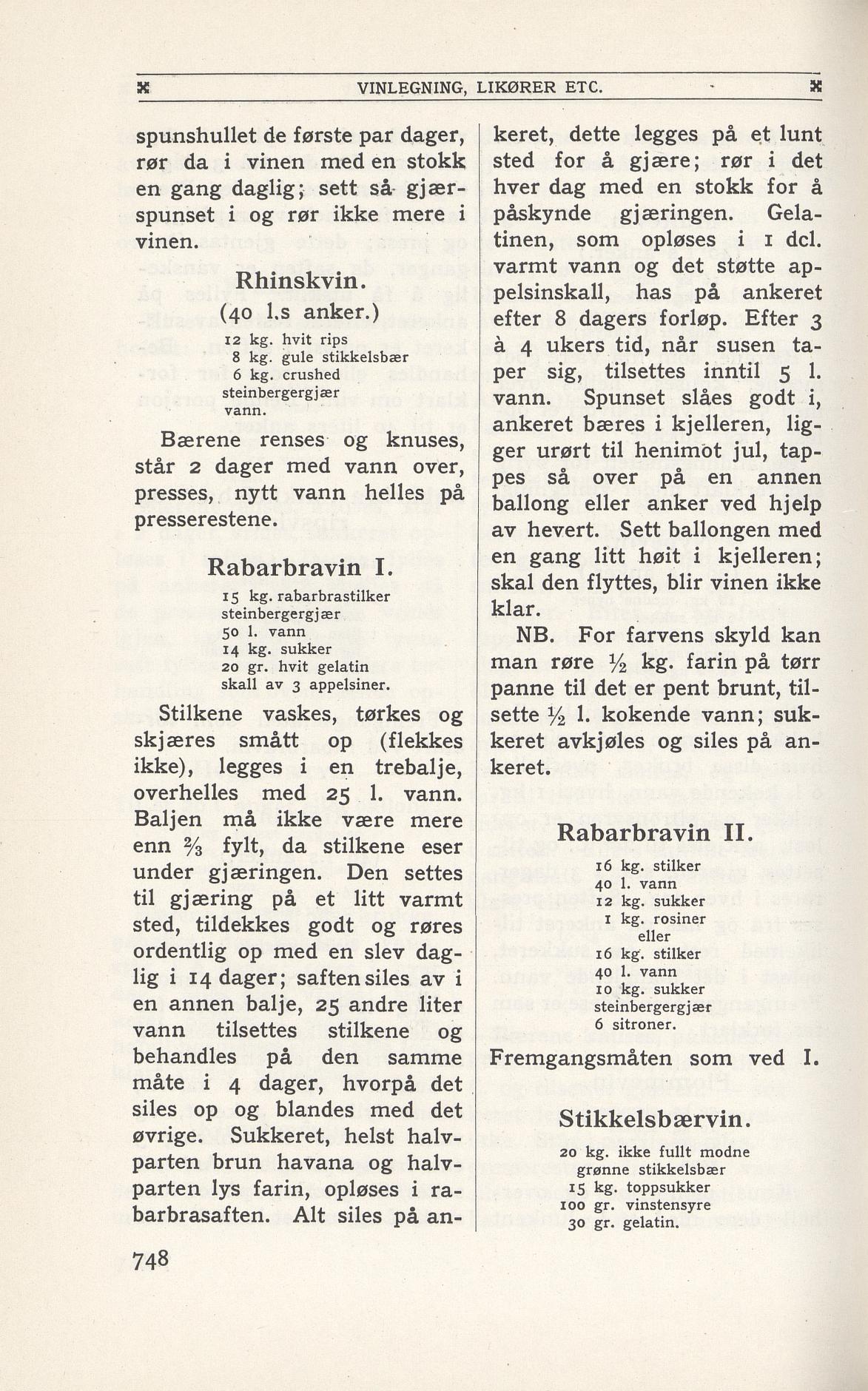
Revised 1949 recipe
From the revised edition of the Big Cookbook.
Foto: Faksimile: Nasjonalbiblioteket
ProofreadPage 748
Stikkelsb ærvin.
20 kg. ikke fullt modne
grønne stikkelsbær
15 kg. toppsukker
100 gr. vinstensyre
30 gr. gelatin.
Rengjær:
steinberger eller sherry.
De rensede bær has i et stort
kar, knuses og påhelles 18 1.
kokt, lunkent vann, røres ofte
sterkt om, inntil vannet erkoldt.
De knuste bær presses gjennem
en grov sikt, herunder tilset
tes 4 —5 1. kokt, koldt vann.
Sukkeret og vinstensyren op
løses i saften og vannet, og
man tilsetter så meget vann
at man alt i alt har 50 1. fly
tende. Karet dekkes med et
klæde, står rolig et par dager
i et rum, hvor der er 12 —13 0
R. Helles på et 45 liters
anker; de tiloversblevne 4 —5
1. benyttes til påfylling un
der gjæringen. Så snart sus
ingen av den gjærende vin
ophører, lukkes ankeret til
med et tett spuns; et mindre
hull, som er boret tett ved siden
av spunshullet, lukkes med
en kork, som hver annen til
tredje dag fjernes et øieblikk
for å la luft undvike. Efter
10 å 12 dager settes korken
fast i. Ankeret legges i en
kold kjeller, ligger til første
halvdel av januar måned.
Vinen omstikkes, ankeret skyl
les godt i kokt, koldt vann,
og vinen fylles snarest mulig
på igjen; gelatinen opløses i
1 1. av vinen og helles på
ankeret, som spunses godt til.
Vinen tappes utover våren,
når stikkelsbærbuskene atter
blomstrer.
Tidsmaskin – hva endret seg?
Velg to utgaver og se hva Henriette Schønberg Erken la til, fjernet eller endret mellom dem.
1914 (korrekturlest, s. 622) → 1949 (korrekturlest, s. 748)~46% av teksten endretfjernetlagt til
Stikkelsb ærvin. 20 kg. ikke fuldt modne, fullt modne grønne stikkelsbær 15 kg. topsukker toppsukker 100 gr. vinstensyre 30 gr. gelatin 1 kg. rosiner gelatin. Rengjær: steinberger eller rengjær. sherry. De rensede bær og rosiner haves has i et stort kar, knuses og paaheldes påhelles 18 l. 1. kokt, lunkent vand, vann, røres ofte sterkt om, indtil vandet er koldt. inntil vannet erkoldt. De knuste bær presses gjennem en grov sigt, sikt, herunder tilsættes 4—5 l. tilset tes 4 —5 1. kokt, koldt vand. vann. Sukkeret og vinstensyren opløses op løses i saften og vandet, vannet, og man tilsætter saa tilsetter så meget vand, vann at man alt i alt har 50 l. flytende. Karret dækkes 1. fly tende. Karet dekkes med et klæde, staar står rolig et par dage dager i et rum, hvor der er 12—13 grader 12 —13 0 R. Heldes paa Helles på et 45 liters anker; de tiloversblevne 4—5 l. 4 —5 1. benyttes til paafyldning under påfylling un der gjæringen. Saasnart susningen Så snart sus ingen av den gjærende vin ophører, lukkes ankeret til med et tæt tett spuns; et mindre hul, hull, som er boret tæt tett ved siden av spunshullet, lukkes med en kork, som hver anden annen til tredje dag fjernes et øieblik øieblikk for at å la luft undvike. Efter 10 å 12 dage sættes dager settes korken fast i. Ankeret lægges legges i en kold kjelder, kjeller, ligger til første halvdel av januar maaned. måned. Vinen omstikkes, ankeret skylles skyl les godt i kokt, koldt vand, vann, og vinen fyldes fylles snarest mulig paa på igjen; gelatinen opløses i 1 l. 1. av vinen og heldes paa helles på ankeret, som spunses godt til. Vinen tappes utover vaaren, naar våren, når stikkelsbærbuskene atter blomstrer.
The recipe calls for not fully ripe, green gooseberries. Green berries give higher acidity and a fresher, more wine-like character in the finished wine.
How much liquid should I end up with?
50 liters in total. The juice and water with dissolved sugar and tartaric acid are topped up with water to 50 liters. About 45 liters are poured into the cask, and the remaining 4–5 liters are used for topping up during fermentation.
What is used as yeast?
1 kg raisins or wine yeast. The raisins are cleaned and crushed together with the berries before the boiled, lukewarm water (18 liters) is poured over.
How long does it take, and what temperature is needed?
The wine is a long process — allow around nine months in total. The vat is covered with a cloth and stands quietly a couple of days in a room at 12–13 degrees Réaumur (about 15–16 °C) before it is poured into the cask.