Skip to content

Spun Sugar II

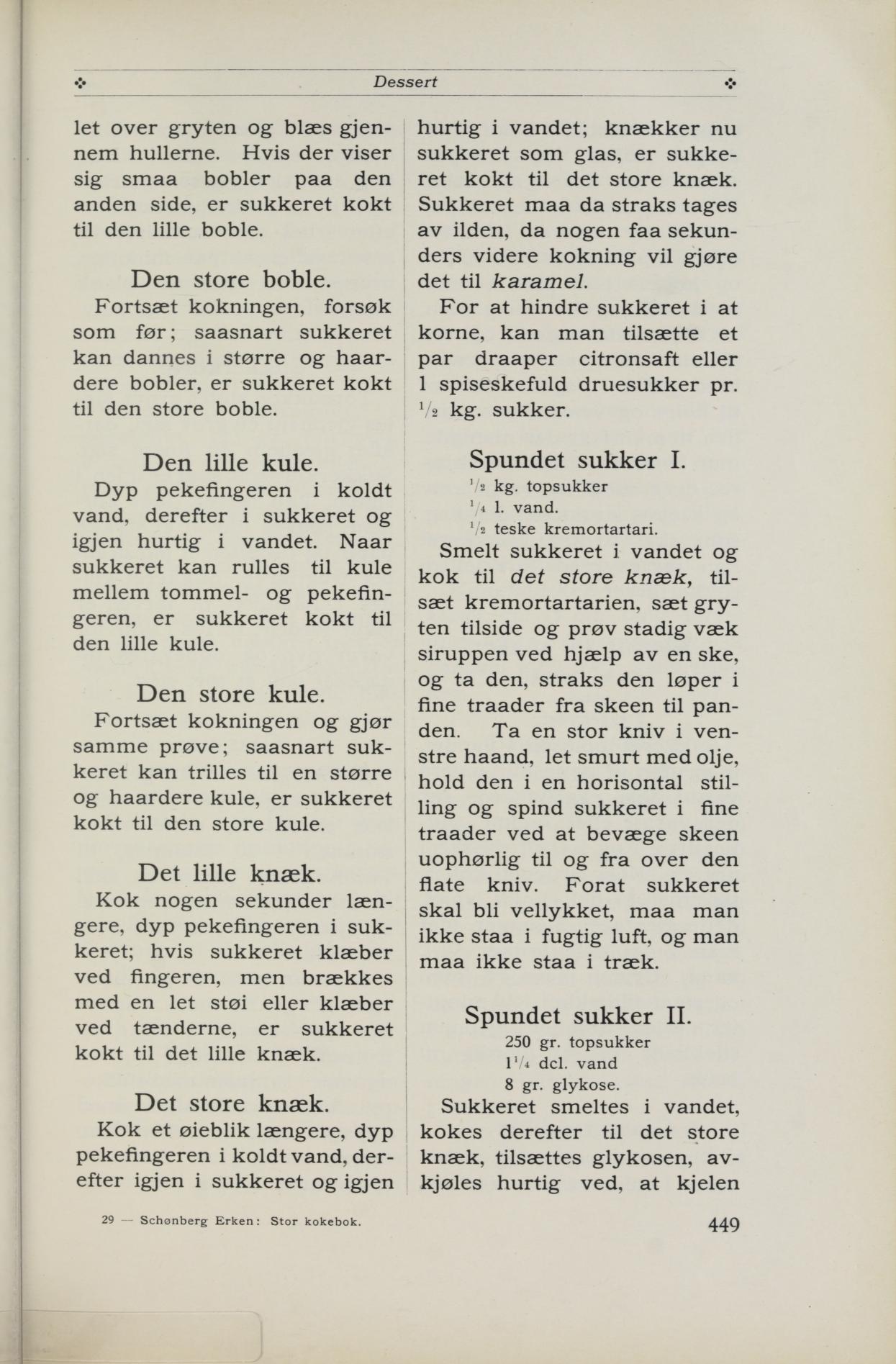
Spun Sugar II: 250 g sugar boiled with 1 1/4 dl water to the hard crack stage, mixed with 8 g glucose, cooled quickly, and flung into threads over an oiled rod on an oiled surface. The threads are cut with a hot knife and placed at once around the dessert; can be colored.

Source: Henriette Schønberg Erken, Stor kokebok, 1914-utg. s. 449 (falt i det fri)

Be the first to rate

About the dish

The smaller and more practical version of spun sugar, in which the threads are flung over an oiled rod instead of a knife. The straw ring held the pan tilted so the syrup gathered and stayed warm while you worked.

How to make it

  1. 1

    Boil the sugar

    Melt the sugar in the water and boil to the hard crack stage.

  2. 2

    Add glucose and cool

    Stir in the glucose and cool quickly by dipping the pan for a moment in cold water. Then set the pan slightly tilted in a straw ring (or a pot ring).

  3. 3

    Prepare the base

    Lightly oil a marble slab or a couple of baking sheets. Also oil a rod and place it across the slab, raised well up from the surface.

  4. 4

    Fling the threads

    Fling the sugar to the right and left over the rod with a whisk or a wide fork, until you have the amount you need.

  5. 5

    Use at once

    Cut the threads with a hot knife and place them at once around whatever is to be decorated. The sugar can be colored with various sugar colorings.

Changes from the original

Glucose = glucose/glucose syrup. The straw ring can be replaced with a pot ring or a folded cloth. The marble slab can be replaced with parchment paper on the counter.

Tidsmaskin – hva endret seg?

Velg to utgaver og se hva Henriette Schønberg Erken la til, fjernet eller endret mellom dem.

1914 (korrekturlest, s. 449)1949 (korrekturlest, s. 512)~74% av teksten endretfjernetlagt til
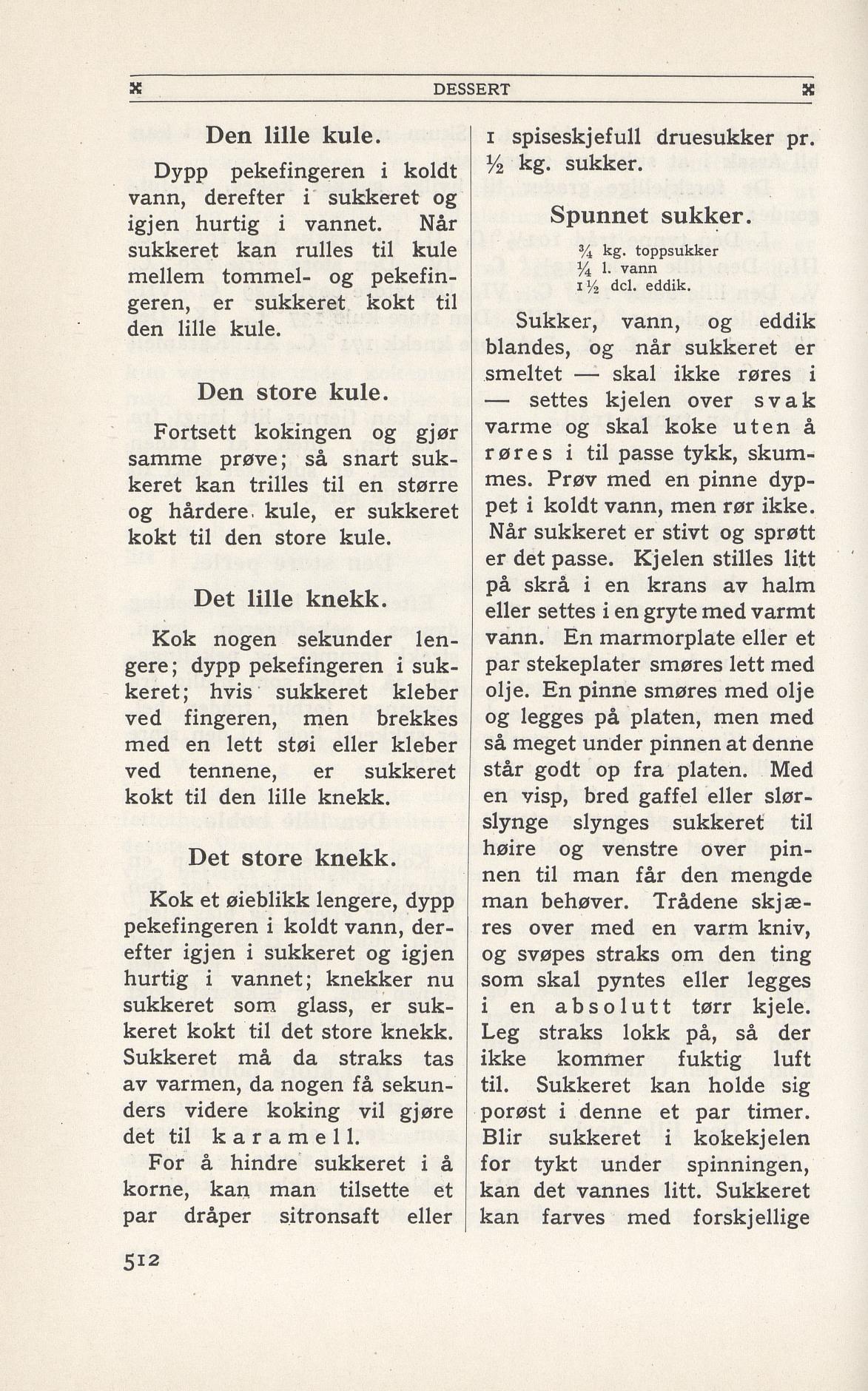
250 gr. topsukker 1 1/4 del. vand 8 gr. glykose. Sukkeret smeltes ½ kg. toppsukker ¾ l. vann 1½ dd. eddik. Sukker, vann, og eddik blandes, og når sukkeret er smeltet — skal ikke røres i vandet, kokes derefter til det store knæk, tilsættes glykosen, avkjøles hurtig ved, at — settes kjelen dyppes et øieblik over svak varme og skal koke ut en å røres i til passe tykk, skummes. Prøv med en pinne dyppet i koldt vand; derpaa vann, men rør ikke. Når sukkeret er stivt og sprøtt er det passe. Kjelen stilles den litt paa skraa på skrå i en krans av halm. halm eller settes i en gryte med varmt vann. En marmorplate eller et par stekeplater smøres let lett med olje. En pinde pinne smøres med olje og lægges paa legges på platen, men med saa meget under pinden, pinnen at denne staar står godt op fra platen. Med en visp eller visp, bred gaffel eller slørslynge slynges sukkeret til høire og venstre over pinden, pinnen til man faar får den mængde, mengde man behøver. Traadene Trådene skjæres over med en varm kniv kniv, og svøpes straks om den ting, ting som skal pyntes. pyntes eller legges i en absolutt tørr kjele. Leg straks lokk på, så der ikke kommer fuktig luft til. Sukkeret kan holde sig porøst i denne et par timer. Blir sukkeret i kokekjelen for tykt under spinningen, kan det vannes litt. Sukkeret kan farves med forskjellige sukkerfarver. De fine tråder samles og legges omkring eller over isen eller hvad der skal sløres.
Community interpretations

Be the first to share your own version.

See interpretations

Frequently asked questions

What does "the hard crack" mean?
It is the hardest stage of sugar boiling (hard crack), meaning the syrup is boiled until it becomes hard and brittle when a drop is cooled in cold water. Only then is the glucose added.
Why is the pan dipped in cold water?
To stop the boiling quickly so the sugar does not darken or burn. The pan is then set slightly tilted in a straw ring, so the mass gathers and holds the right temperature while you spin the threads.
How do you make the threads themselves?
Place an oiled rod raised above a lightly oiled marble slab or a couple of baking sheets. Fling the sugar from a whisk or wide fork to the right and left over the rod until you have enough threads. Cut them with a hot knife and place them at once around whatever is to be decorated.
Can the sugar be colored?
Yes, the recipe from Henriette Schonberg Erken's "Stor kokebok" (1914) states that spun sugar can be colored with different sugar colorings.

Related recipes

More dishes in the same category from the archive

Read also

Kommentarer

Ingen kommentarer ennå. Bli den første til å dele!