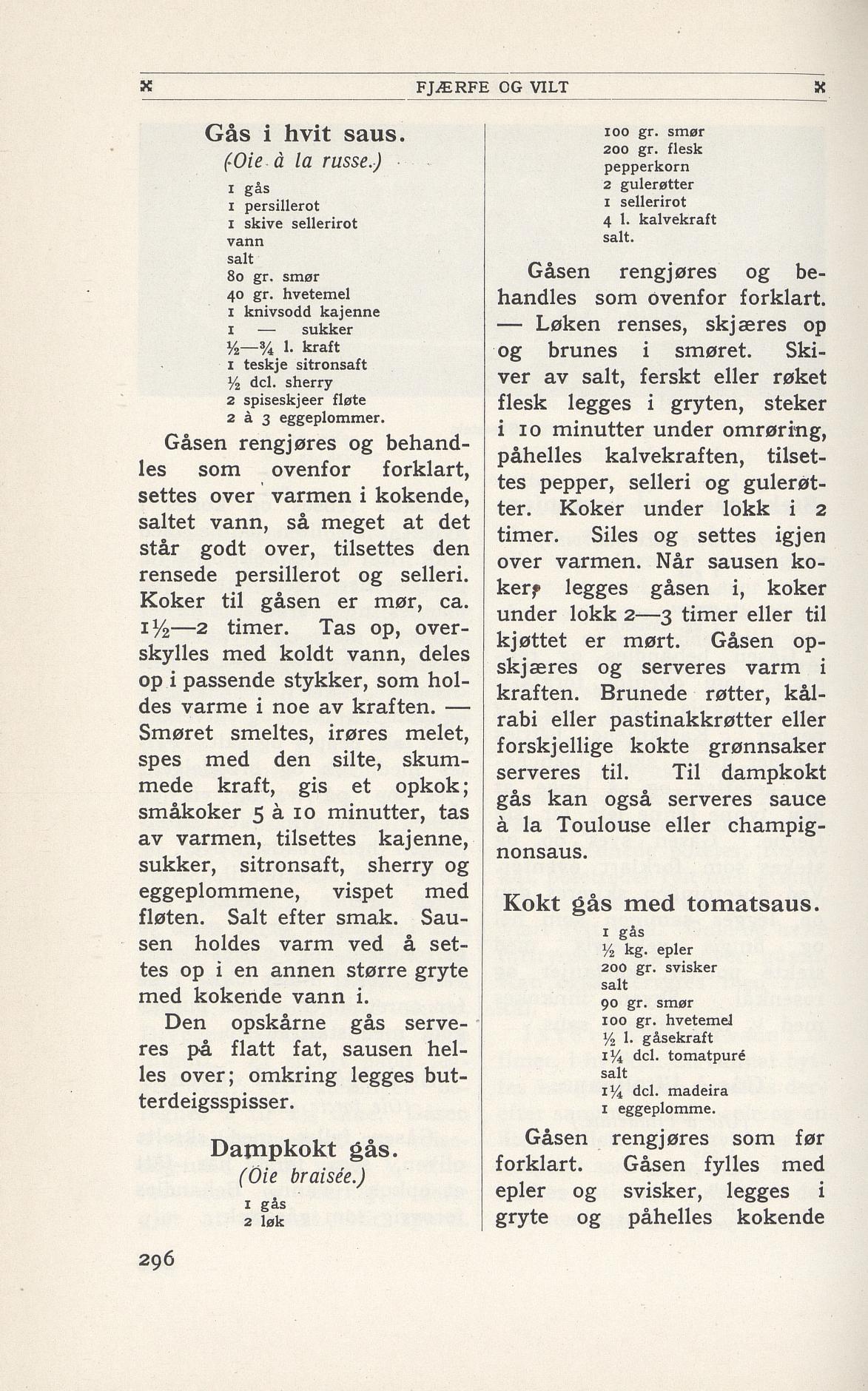
Original 1914 recipe
Verbatim from the first edition of the Big Cookbook.
A whole goose lightly cured in a strong brine with saltpeter for two days, then simmered tender in salted water and served sliced with frozen horseradish sauce and green peas. "Sprengt" is an old Norwegian term for lightly salt-cured in brine.
Source: Henriette Schønberg Erken, Stor kokebok, 1914-utg. s. 265 (falt i det fri)
"Sprengt" means, in older Norwegian cookery, lightly salt-cured in brine. Erken gives two versions of brined goose in "Stor kokebok" (1914); this is the first, with a strong brine to which saltpeter is added to preserve the red color of the meat. It is served classically with frozen horseradish sauce and "Russian peas."
Make the brine
Clean the goose. Boil just enough water to barely cover the goose, and dissolve in salt until the brine is strong enough that an egg floats, along with the saltpeter. Let the brine cool completely.
Curing
Place the goose in the cold brine so it is covered, and let it sit in a cool place for 2 days.
Cook the goose
Take the goose out of the brine and place it in boiling, salted water. Let it simmer until the meat is tender, about 2-2 1/2 hours. Skim well.
Serving
Slice the goose neatly and serve with frozen horseradish sauce and green peas.
Quantities are given in modern units, and the strength of the brine is explained (about 200 g salt per liter of water - the original's "brine strong enough that an egg floats"). Saltpeter is kept as in the original but marked as optional; it can be omitted, in which case the meat turns grayer. The method has been divided into numbered steps.
Original 1914 recipe
Verbatim from the first edition of the Big Cookbook.

Revised 1949 recipe
From the revised edition of the Big Cookbook.

Be the first to share your own version.
More dishes in the same category from the archive
Ingen kommentarer ennå. Bli den første til å dele!