Skip to content

Cured sausages

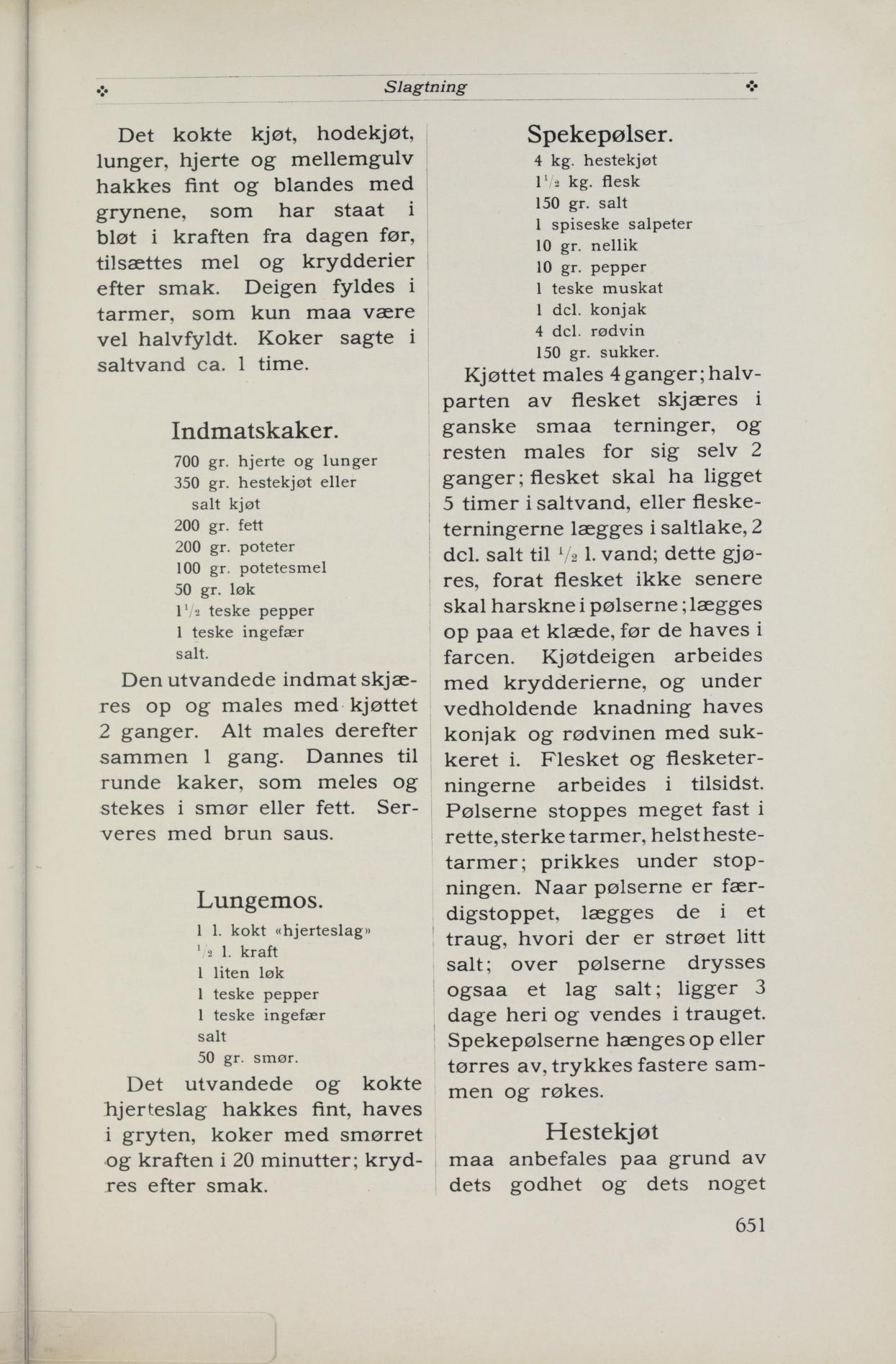
Erken's cured sausage of 4 kg horse meat and 1.5 kg pork with salt, saltpeter, clove, pepper, nutmeg, cognac, red wine, and sugar; the filling is packed tightly into casings, salted 3 days in a trough, dried, and smoked.

Source: Henriette Schønberg Erken, Stor kokebok, 1914-utg. s. 651 (falt i det fri)

Be the first to rate

About the dish

From the slaughtering chapter of "Stor kokebok" (1914). Erken recommends horse meat for cured sausage, and the recipe belongs to the part of the book about making full use of the animal after slaughter. Saltpeter was used both as a color stabilizer and a preservative.

How to make it

  1. 1

    Grind the meat

    Grind the horse meat four times.

  2. 2

    Prepare the pork

    Cut half of the pork into fairly small cubes. Grind the rest of the pork twice on its own. The pork should have sat 5 hours in salt water, or place the pork cubes in a brine of 2 dl salt to 1/2 liter water. This is done so the pork does not turn rancid in the sausages later.

  3. 3

    Drain

    Place the pork cubes on a cloth and let them drain before mixing them into the filling.

  4. 4

    Knead the filling

    Work the ground meat thoroughly with the spices. While kneading continuously, add the cognac and red wine along with the sugar. Finally work in the ground pork and the pork cubes.

  5. 5

    Fill the sausages

    Pack the filling very tightly into straight, strong casings, preferably horse casings. Prick the sausages along the way so air escapes.

  6. 6

    Salting

    Place the filled sausages in a trough sprinkled with a little salt, and scatter a layer of salt over the sausages. Let them sit 3 days and turn them in the trough.

  7. 7

    Drying and smoking

    Hang the sausages up or wipe them dry, press them together more firmly, and smoke them. Then mature them in a cool, airy place.

Changes from the original

Measurements have been modernized (del. → dl, gr. → g, tsp/tbsp spellings updated). The steps have been rewritten in modern Norwegian. Saltpeter is given as in the original, but note that nitrite/nitrate curing salt is today used per current dosing instructions; the amount should not be increased.

Time machine – what changed?

Pick two editions and see what Henriette Schønberg Erken added, removed or changed between them.

1914 (proofread, p. 651) → Modernised~79% of the text changedremovedadded
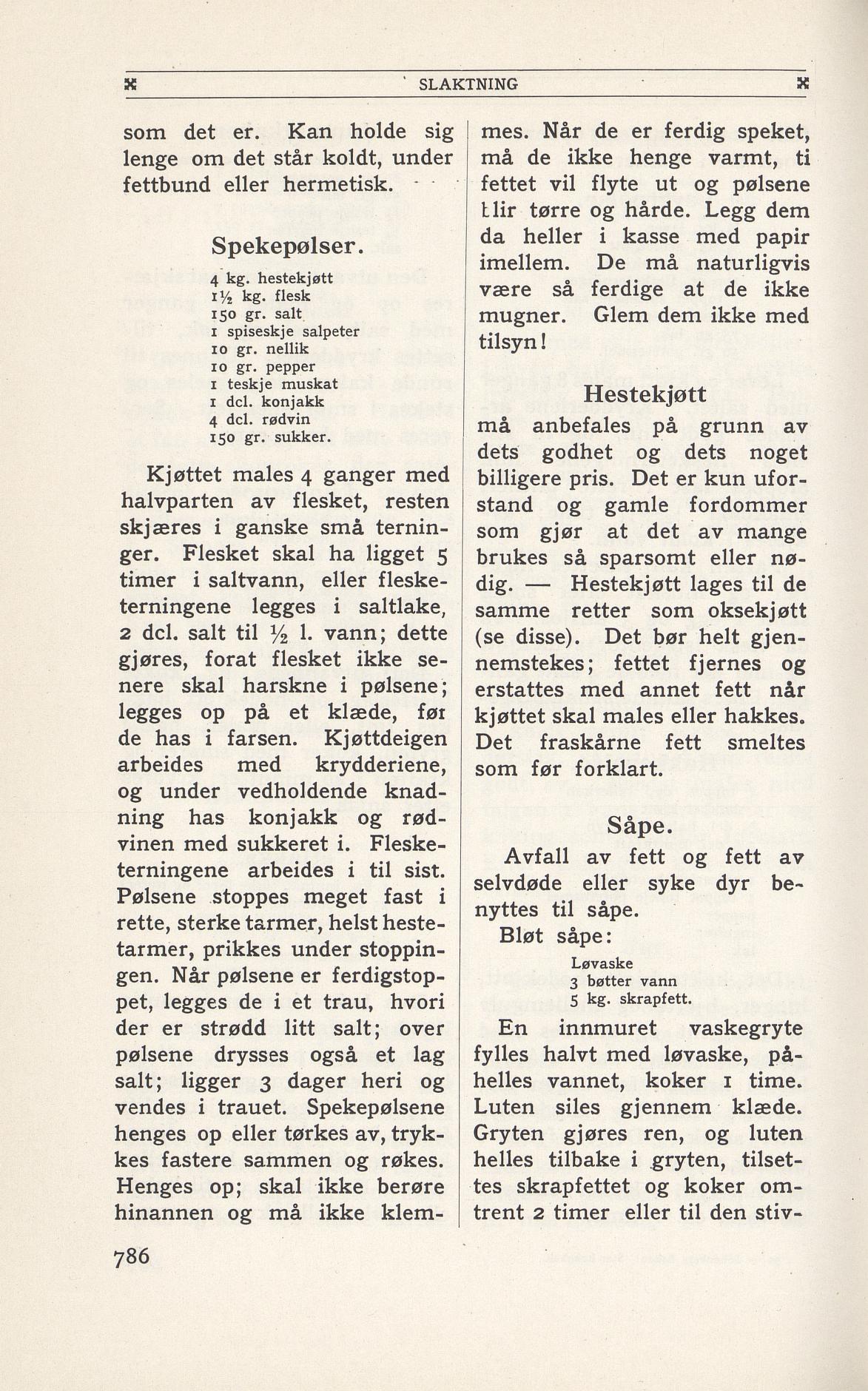
4 kg. hestekjøt 1 1/2 kg. kg hestekjøtt (kan erstattes med magert storfekjøtt). 1,5 kg flesk (ferskt svinespekk/sideflesk). 150 gr. salt g salt. 1 spiseske spiseskje salpeter (i dag: nitrittsalt etter produsentens anvisning). 10 gr. nellik g nellik, malt. 10 gr. pepper g pepper, malt. 1 teske muskat teskje muskat. 1 del. konjak dl konjakk. 4 del. rødvin dl rødvin. 150 gr. g sukker. Kjøttet males 4 ganger; 2 dl salt (til saltlake av 1/2 l vann for flesketerningene). tarmer, sterke og rette (helst hestetarmer). Kvern hestekjøttet fire ganger.. Skjær halvparten av flesket skjæres i ganske smaa terninger, og små terninger. Kvern resten males for sig selv 2 ganger; av flesket to ganger for seg selv. Flesket skal ha ligget 5 timer i saltvand, saltvann, eller fleketerningerne lægges legg flesketerningene i saltlake, en saltlake av 2 del. dl salt til 1/2 l. vand; dette gjøres, forat liter vann. Dette gjøres for at flesket ikke senere skal harskne i pølserne; lægges op paa pølsene senere.. Legg flesketerningene på et klæde, klede og la dem renne av før de haves blandes i farcen. Kjøtdeigen arbeides farsen.. Arbeid kjøttdeigen godt med krydderierne, og under vedholdende knadning haves konjak krydderne. Under vedvarende elting tilsettes konjakken og rødvinen med sukkeret i. Flesket sukkeret. Arbeid til sist inn det kvernede flesket og fleketerningerne arbeides i tilsidst. Pølserne stoppes flesketerningene.. Stopp farsen meget fast i rette, sterke tarmer, helst hestetarmer; prikkes under stopningen. Naar pølserne er færdigstoppet, lægges hestetarmer. Prikk pølsene underveis så luft slipper ut.. Legg de ferdigstoppede pølsene i et traug, hvori trau der det er strøet strødd litt salt; over pølserne drysses ogsaa salt, og dryss et lag salt; ligger salt over pølsene. La dem ligge 3 dage heri døgn og vendes vend dem i trauget. Spekepølserne hænges op trauget.. Heng pølsene opp eller tørres tørk dem av, trykkes press dem fastere sammen og røkes. røyk dem. Modnes deretter kjølig og luftig.

Note on Modernised

Mål er modernisert (del. → dl, gr. → g, teske/spiseske → teskje/spiseskje). Trinnene er skrevet om til moderne norsk. Salpeter er oppgitt som i originalen, men merk at nitritt/nitratsalt i dag brukes etter dagens doseringsanvisning; mengden bør ikke økes.

Community interpretations

Be the first to share your own version.

See interpretations →

Frequently asked questions

What meat is used in these cured sausages?
The recipe uses 4 kg horse meat and 1 1/2 kg pork (pork fat/lard). The meat is ground 4 times, half the pork is cut into small cubes, and the rest is ground 2 times.
Why is the pork placed in brine first?
The pork should sit about 5 hours in salt water (2 dl salt to 1/2 l water) so it does not later turn rancid in the sausages. The cubes are placed on a cloth to drain before being worked into the filling.
What gives the filling its flavor and color?
Clove, pepper, nutmeg, and salt, plus saltpeter for color and shelf life. While kneading continuously, 1 dl cognac and 4 dl red wine with 150 g sugar are added.
How old is the recipe?
It is from Henriette Schønberg Erken's "Stor kokebok" from 1914, page 651. The stated total time is roughly 7 days, since the sausages are packed very tightly and then cured.

Equipment for this dish

Advertisement

We may earn a commission if you buy through these links. It does not affect the price.

Related recipes

More dishes in the same category from the archive

Read also

Kommentarer

Ingen kommentarer ennå. Bli den første til å dele!